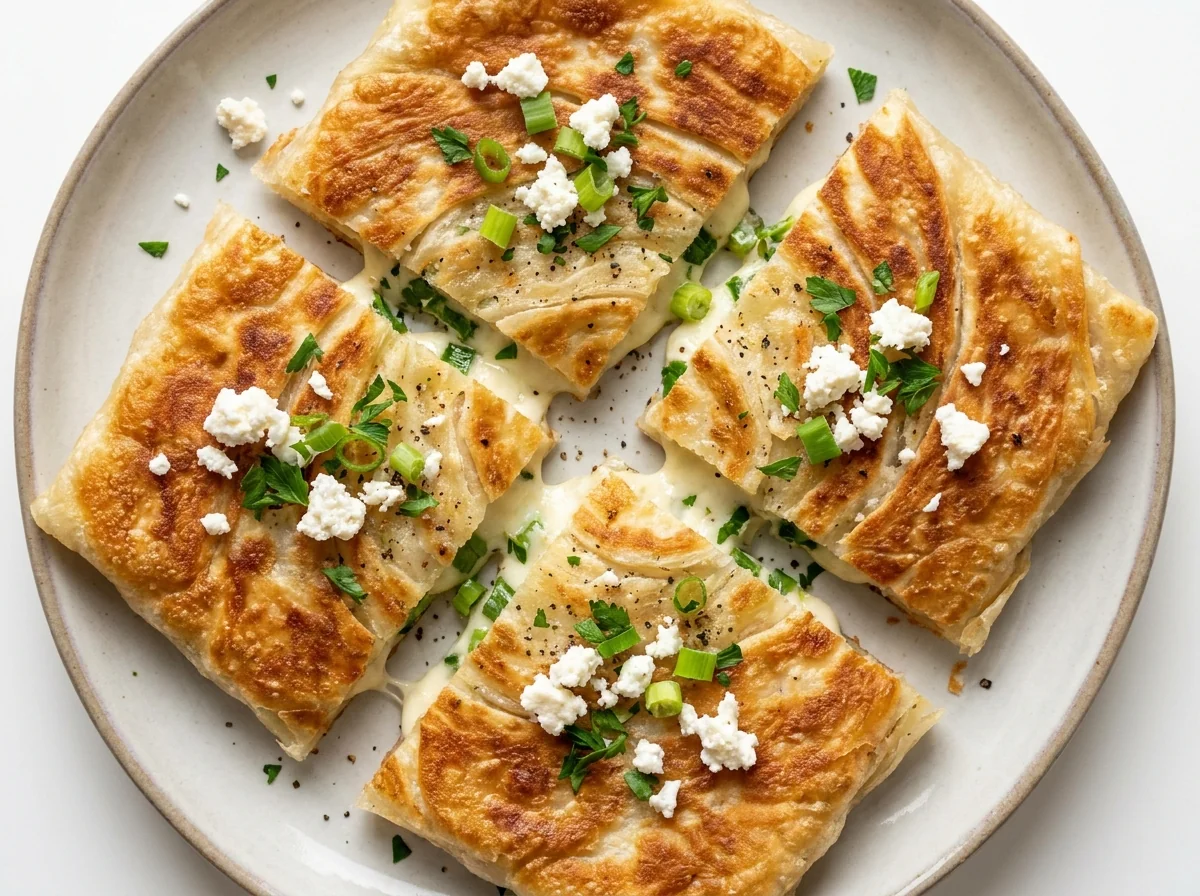
Mutabbaq is one of the landmarks of Hijazi cuisine; it arrived with the trade and pilgrimage routes from South Asia and settled in Mecca and Jeddah until it became part of their identity.
Its name comes from 'tatbeeq,' the folding of the dough over the filling, and it has two faces: savory with cheese or meat, and sweet with banana, and this is the savory member of the family for Suhoor.
Preparation Steps
Knead the supple mutabbaq dough
Mix the flour and salt, then add the water gradually and knead for eight minutes until it becomes a smooth, elastic dough that does not stick. Divide it into four balls, brush them with oil, and leave them to rest covered for half an hour. The long rest is the secret of the thin rolling.
Prepare the cheese filling
In a bowl, mix the crumbled cheese with the beaten eggs, green onion, parsley and black pepper. Extra salt is usually not needed. The salty cheese is enough.
Roll the dough until translucent
On an oiled surface, press the dough ball and stretch it with your fingertips from the center outward until it becomes an almost transparent sheet through which you can see the surface. A small tear does not ruin it, as the folding will hide it.
Fill and fold
Place a quarter of the filling in a square in the center of the sheet, then fold the four edges over it: right then left then top then bottom, 'tatbeeq' (folding), giving a tight square envelope.
Brown on the griddle with a little ghee
On a griddle or thick skillet over medium heat, add a little ghee and brown the mutabbaq for three to four minutes per side, pressing it gently with the back of a spoon, until it becomes golden, speckled and crisp and the egg inside is fully cooked.
Cut and serve hot
Cut each mutabbaq into quarters and serve it immediately. The crispness of the outside with the melting cheese inside waits for no one.
Blood Sugar Impact
The glycemic index (GI) measures how quickly a food raises blood sugar, while the glycemic load (GL) measures how much a full serving raises it. Together they give the complete picture.
Glycemic Index
GI
71High
Low0–55Medium56–69High70+
A low value (≤55) means a gradual rise in blood sugar — the most suitable range for diabetes and insulin resistance.
Glycemic Load
GL
40High
Low0–10Medium11–19High20+
Glycemic load reflects the impact of the full serving. To lower it: take half a serving, or pair the recipe with a source of protein and fiber.
Nutritional Information
Per ServingMakes 4 servings · one serving is about 225 g of raw ingredients
Calories584 kcal29%of Daily Value*
Protein18 g36%of Daily Value*
Carbohydrates60 g22%of Daily Value*
Fat29 g37%of Daily Value*
Fiber3 g11%of Daily Value*
Sodium900 mg39%of Daily Value*
Potassium185 mg4%of Daily Value*
Phosphorus305 mg24%of Daily Value*
* Percent Daily Values are based on a 2,000-calorie diet per FDA food-label reference values — your daily needs may be higher or lower. Values are derived from the recipe's ingredients via the USDA database.
Troubleshooting
The most common problems when preparing Savory Hijazi Cheese Mutabbaq, and how to fix them:
The dough tears when rolling
It did not rest enough or the kneading was insufficient. Half an hour of rest is non-negotiable.
The filling leaked onto the griddle
The fold is not tight or the filling reached the edge. Keep the filling square in the center with a three-finger border around it.
The mutabbaq soaked up oil and turned heavy
The griddle was lukewarm so it absorbed instead of browning. Heat it well before the first mutabbaq.
The inside is doughy and the outside burned
The heat is high. Medium and patient. Four minutes per side cooks the egg without burning the surface.
Storage and Make-Ahead
Right away
Hot from the griddle. The peak of its glory.
In the fridge
Two days cooked, and revived in a hot dry skillet, not in the microwave which softens it.
In the freezer
Frozen filled and raw between parchment sheets for a month, and browned straight from frozen with an extra minute per side.
Tested Ingredient Substitutions
Original Ingredient
Tested Substitute
Ratio
Flavor Difference
Salty white cheese
Soaked Akkawi cheese or feta
1:1
Both belong to the filling
Half the white flour
Whole-wheat flour
1:1 for the half
Higher fiber and a slightly browner dough
Ghee on the griddle
A light spray of oil
~
A lighter version with a quieter crispness
Green onion
Finely chopped leek
1:1
A gentler green sweetness
How Much Does It Make? Scaling Guide
Ingredient
4 mutabbaq
2 mutabbaq
8 mutabbaq
Flour
300 g
150 g
600 g
Cheese
200 g
100 g
400 g
Eggs
2
1
4
EEINA Nutrition Tip
Roll the dough with oil, not flour. The oil allows transparency without tearing, and excess flour toughens it and robs the mutabbaq of its thinness.
Add This Recipe to Your Plan
The EEINA app saves your favorite recipes, calculates them from their real ingredients, and shows your daily numbers toward your goal. Try it free now.
How does it differ from the sweet Palestinian mutabbaq we have?
That is a dessert with walnuts and cinnamon, and this is a savory meal with cheese and egg on the griddle. A shared name and two completely different methods.
Can the dough be made the night before?
Yes, and that is the smartest for Suhoor: oiled balls in a container in the fridge, taken out a third of an hour before rolling.
A faster alternative to homemade dough?
Ready-made spring roll dough does the job for emergencies. With less personal thinness.
Why is it good for Suhoor?
Dough, cheese and egg: carbohydrates, protein and fat in a single carried envelope, a complete meal in one hand.