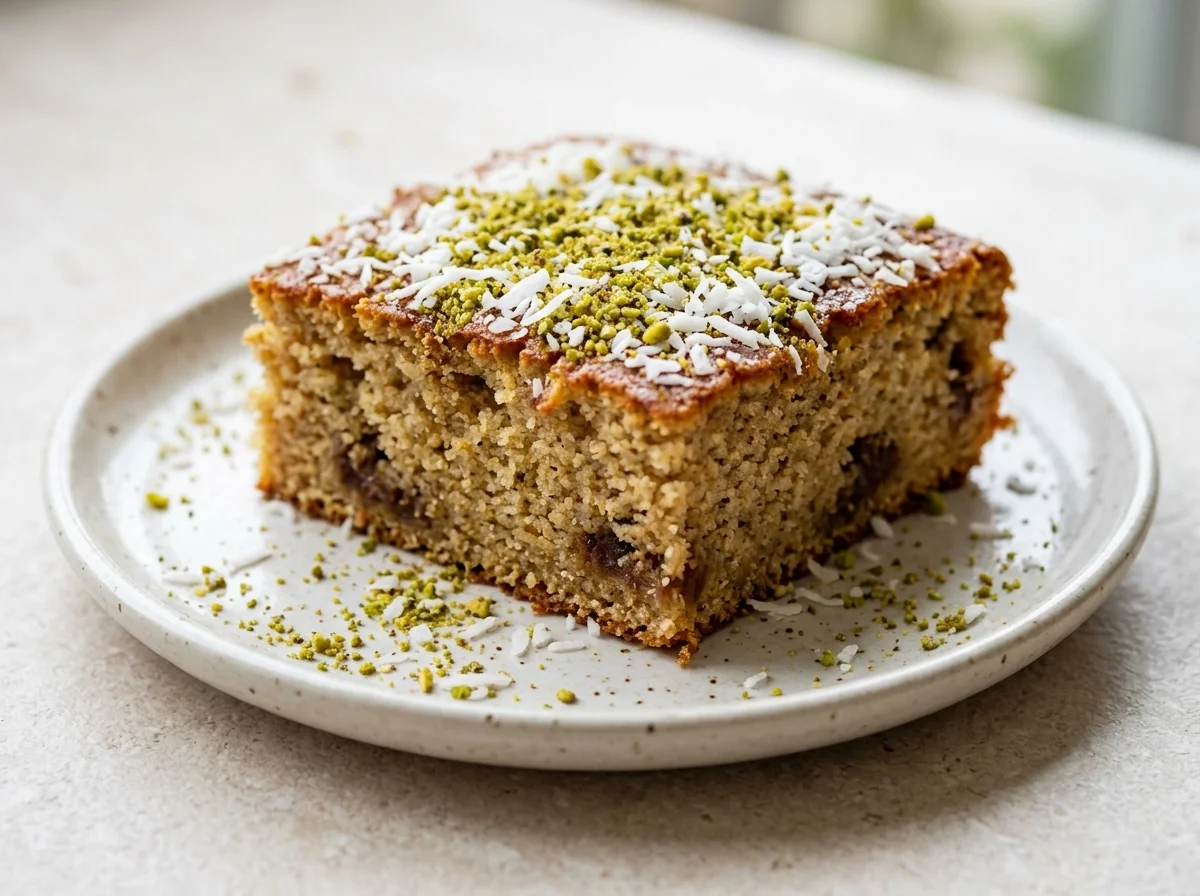
Millet flour is mixed with baking powder and milk powder, then moistened with a blend of water, sugar, and oil. Half of the batter is poured into the pan, spread with date paste flavored with cardamom, covered with the remaining batter, baked, and decorated with coconut and pistachios.
Millet is an ancient grain in southern and Gulf kitchens, returning to tables because it is gluten-free and rich in magnesium.
This cake combines it with dates in two layers rather than one blend, so the dates retain their presence as a dark, sweet line in the middle of the bite instead of dissolving into the batter and vanishing.
Preparation Steps
Sift the dry ingredients
Sift the millet flour into a wide bowl, then mix it with the baking powder and milk powder until the leavening is evenly distributed throughout the blend. Even distribution is what makes the cake rise uniformly without large bubbles in one spot over another.
Whisk the liquids
In an electric blender, whisk the water, sugar, and oil until the sugar dissolves completely and the mixture becomes smooth and uniform. Test it with your fingers before stopping the blender, since any remaining sugar grains will leave a wet bottom in the cake.
Combine the two mixtures
Pour the liquid mixture over the millet blend and stir until the consistency becomes uniform, resembling a thick liquid cake batter that flows off the spoon in a continuous thread. Take care not to over-stir once uniform, or the cake will turn heavy.
Knead the dates with the cardamom
Knead the date paste with the ground cardamom by hand until it softens, becomes fragrant, and is spreadable. If the dates are dry, warm them for a few seconds so they soften in your hands, because firm dates will tear the cake layer beneath them.
Pour the first layer
Lightly grease a baking pan with oil and pour in half the cake batter. Smooth the surface with the back of a spoon so the thickness is even across the whole pan.
Spread the date layer
Flatten the kneaded date paste and distribute it evenly over the cake layer. Gentle spreading is better here than pressing hard, so the dates do not sink into the batter and disappear into the bottom.
Cover with the remaining batter
Pour the rest of the cake batter over the dates so it covers them completely. Give the pan a light tap on the kitchen counter so the surface levels out and the large air bubbles rise.
Bake and decorate
Place the pan in an oven at 200 degrees for 30 to 40 minutes until it is done and the top turns golden and a toothpick comes out clean from the center. Then garnish the top with coconut and Aleppo pistachios while it is still warm, so they stick to it.
Blood Sugar Impact
The glycemic index (GI) measures how quickly a food raises blood sugar, while the glycemic load (GL) measures how much a full serving raises it. Together they give the complete picture.
Glycemic Index
GI
60Medium
Low0–55Medium56–69High70+
A low value (≤55) means a gradual rise in blood sugar — the most suitable range for diabetes and insulin resistance.
Glycemic Load
GL
36High
Low0–10Medium11–19High20+
Glycemic load reflects the impact of the full serving. To lower it: take half a serving, or pair the recipe with a source of protein and fiber.
Nutritional Information
Per ServingMakes 8 servings · one serving is about 140 g of raw ingredients
Calories537 kcal27%of Daily Value*
Protein9 g18%of Daily Value*
Carbohydrates63 g23%of Daily Value*
Fat29 g37%of Daily Value*
Fiber3 g11%of Daily Value*
Sodium155 mg7%of Daily Value*
* Percent Daily Values are based on a 2,000-calorie diet per FDA food-label reference values — your daily needs may be higher or lower. Values are derived from the recipe's ingredients via the USDA database.
Troubleshooting
The most common problems when preparing Millet and Date Cake, and how to fix them:
The dates sank to the bottom
The first cake layer was too runny or the dates were pressed too firmly. Smooth the first layer and let it rest for a moment to settle before gently spreading the dates over it.
The top burned while the middle was still raw
The heat was too high or the pan was too close to the broiler. Move the rack to the middle of the oven, and cover the top with foil in the final ten minutes if the color deepens before the center is done.
The cake turned out dry and crumbly
Millet absorbs more liquid than wheat, and long baking dries it out. Take it out at the first clean exit of the toothpick and do not extend the baking time as insurance.
The flavor carries an earthy grittiness
That is the nature of millet itself. The cardamom in the dates is what balances it, so do not reduce it. A pinch of cinnamon with the cardamom does the same job for those who want a milder flavor.
Storage and Make-Ahead
Room temperature
In an airtight container for two days, and it tastes best on its first day.
Refrigerator (4°)
Up to five days, and it should be taken out half an hour before serving so it regains its softness.
Freezing
Freeze sliced in sealed bags for up to three months, and thaw at room temperature.
Serving
With Arabic coffee or tea, and this cake holds up well when cut into small squares.
Tested Ingredient Substitutions
Original Ingredient
Tested Substitute
Ratio
Flavor Difference
vegetable oil
melted butter
164 g
Richer flavor and slightly heavier texture, and the method does not change.
sugar
two-thirds of the amount
100 g
The dates carry enough sweetness, and reducing it brings out the millet flavor more clearly.
millet flour
oat flour
238 g
Smoother texture and a milder flavor, while still wheat-free.
date paste
pitted dates, mashed
147 g
The direct homemade substitute, and it needs softening with a spoon of warm water.
How Much Does It Make? Scaling Guide
Servings
Millet flour
Sugar
Date paste
Oil
4 servings (half amount)
119 g
75 g
74 g
82 g
8 servings (base)
238 g
150 g
147 g
164 g
16 servings (double)
476 g
300 g
294 g
328 g
EEINA Nutrition Tip
The millet batter thickens quickly if left standing, so pour it into the pan as soon as it becomes uniform and do not let it wait while you prepare the dates. That is why we knead the dates first, then mix the cake, so it goes into the oven at the consistency we want.
Add This Recipe to Your Plan
The EEINA app saves your favorite recipes, calculates them from their real ingredients, and shows your daily numbers toward your goal. Try it free now.
A small yellow grain grown in the south and the Horn of Africa, and the source notes that it is available at grain and spice shops. It is sold as whole grain to be ground at home, or as ready-made flour.
How much does one cup of millet flour weigh?
119 grams, which is the cup weight in the USDA table for millet flour. The source mentioned two cups without a weight, so we took the documented cup weight and did not estimate.
Is it gluten-free?
All its ingredients are gluten-free, but millet flour is often ground in mills that also grind wheat. Anyone with celiac disease should buy flour labeled as gluten-free.
How long should it bake and at what temperature?
The source sets 200 degrees for 30 to 40 minutes until it is done and turns golden. Differences between ovens make the toothpick more reliable than the clock.
Why water instead of milk?
Because milk powder is already in the dry blend, and water dissolves it. In practice it is a milk cake but in a different order that extends the life of the dry blend.
Sources: USDA · University of Sydney · Our methodology · Updated on