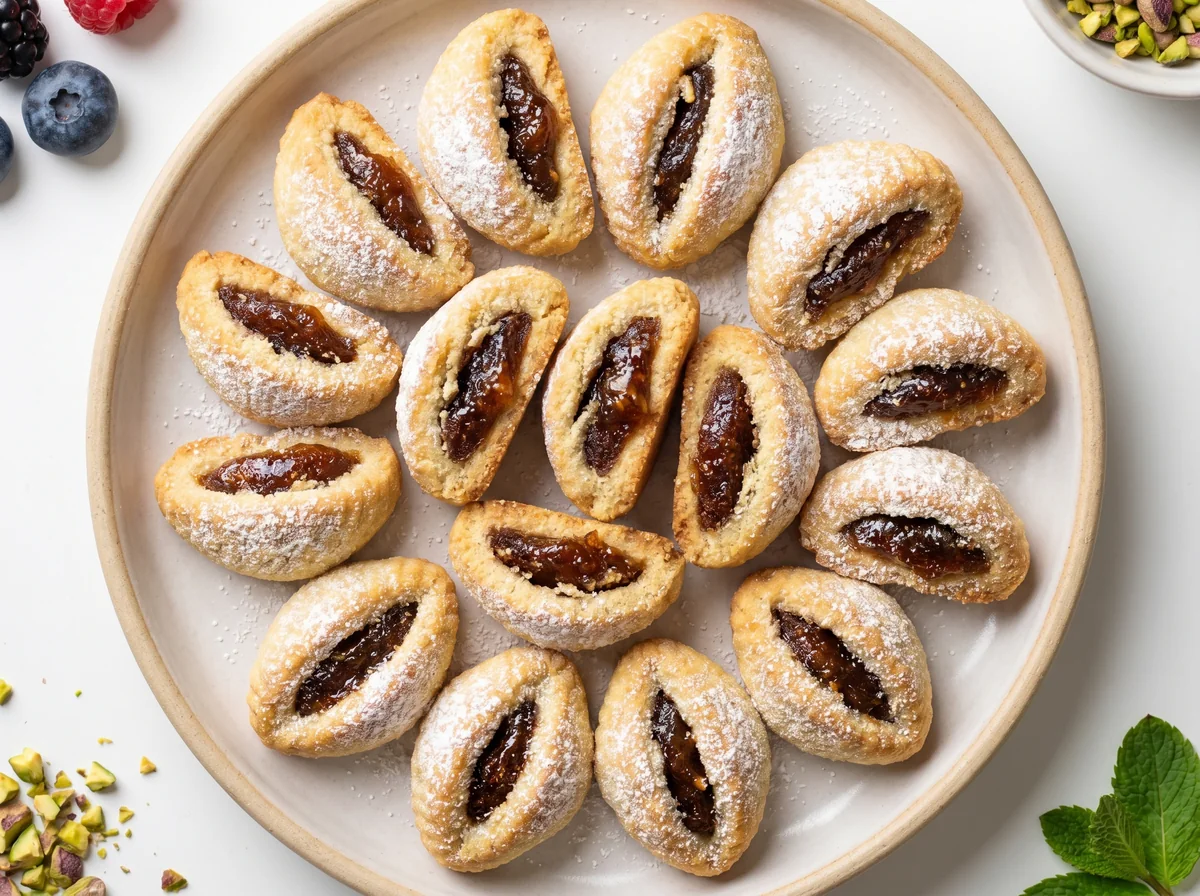
The Levantine and Gulf Eid sweet — discs of semolina dough with ghee stuffed with date paste and orange blossom water, shaped in a carved mould and baked until golden. A celebration sweet; moderate glycemic load thanks to the dates and fibre. Contains gluten and dairy.
Maamoul is the Eid sweet across the Levant and Gulf — semolina discs filled with dates, walnuts, or pistachios, shaped in carved wooden moulds that are passed down through families. It is tied to Eid Al-Fitr and Eid Al-Adha, and also to Christian feasts, making it a shared sweet that unites tables.
The mould carvings are not just decoration — traditionally they distinguish the type of filling. The date version is the oldest and most widespread across the Arabian Peninsula, where dates reign supreme.
Preparation Steps
Rub semolina with ghee
In a wide bowl, rub the semolina and flour with the melted ghee using your fingertips until the semolina is fully saturated with fat and feels like damp sand. Cover the mixture and leave it to rest for two hours to overnight. This resting period is the secret to maamoul: it allows the semolina to absorb the ghee and swell, giving a crumbly, tender dough rather than a hard one.
Complete the dough
Dissolve the yeast and sugar in the warm milk and leave for five minutes until foamy. Add to the rested semolina mixture along with the orange blossom water and rose water. Knead gently and as briefly as possible until the dough just holds together (over-kneading makes maamoul hard). If it feels dry, add a splash of milk.
Prepare the date filling
Knead the date paste with the cinnamon or cardamom and a little ghee until soft and shapeable. Roll into small balls the size of a walnut. If the dates are dry, warm them slightly or add a few drops of ghee to soften them and make them easier to fill.
Fill and shape
Take a ball of semolina dough slightly larger than the date ball. Hollow it out in the palm of your hand like a nest. Place the date ball in the centre, then close the dough around it completely and roll gently. Press the ball into the carved maamoul mould, then invert the mould and tap it on the edge of the table to release the piece with its pattern. Arrange on a baking tray.
Bake
Preheat the oven to 170°C. Bake the maamoul on the middle rack for fifteen to twenty minutes. Maamoul should not colour much: it stays pale with a lightly golden base and very slightly browned edges. Leaving it until the top browns means it is overbaked and will be hard and dry. Start checking from minute twelve.
Cool and serve
Leave the maamoul to cool completely on the tray before moving — it is fragile when hot and firms up as it cools. Dust with icing sugar if you like. Serve with Arabic coffee or tea. Maamoul improves in flavour after a day as the notes meld together — the quintessential Eid sweet.
Blood Sugar Impact
The glycemic index (GI) measures how quickly a food raises blood sugar, while the glycemic load (GL) measures how much a full serving raises it. Together they give the complete picture.
Glycemic Index
GI
59Medium
Low0–55Medium56–69High70+
A low value (≤55) means a gradual rise in blood sugar — the most suitable range for diabetes and insulin resistance.
Glycemic Load
GL
19Medium
Low0–10Medium11–19High20+
Glycemic load reflects the impact of the full serving. To lower it: take half a serving, or pair the recipe with a source of protein and fiber.
Nutritional Information
Per ServingMakes 20 servings · one serving is about 60 g of raw ingredients
Calories244 kcal12%of Daily Value*
Protein4 g8%of Daily Value*
Carbohydrates36 g13%of Daily Value*
Fat9 g12%of Daily Value*
Fiber3 g11%of Daily Value*
Sodium2 mg0%of Daily Value*
* Percent Daily Values are based on a 2,000-calorie diet per FDA food-label reference values — your daily needs may be higher or lower. Values are derived from the recipe's ingredients via the USDA database.
Troubleshooting
The most common problems when preparing Maamoul with Date Filling, and how to fix them:
Maamoul is hard instead of crumbly
The dough was over-kneaded or not rested. Rub the semolina with ghee and rest for two hours to overnight, then knead as briefly as possible until it just holds together. Over-kneading activates the gluten and makes maamoul hard.
Maamoul cracked during baking
Dough is too dry, or the filling is too large. Add a splash of milk to the dough to moisten it, make an even layer of dough around the date that is not too thin, and seal it well with no air pockets.
Pattern is faint or stuck to the mould
Dough is sticky or the mould was not dusted. Dust the mould with a little flour and shake off the excess before each press. Press the dough firmly, then tap the mould sharply to release the piece with its full pattern.
Maamoul is dry after baking
Overbaked or oven too hot. Bake at 170°C and remove while still pale with a lightly golden base — not with a browned top. Maamoul continues to firm up outside the oven as it cools.
Filling is dry and hard
Date paste is old or dry. Warm it slightly and knead with a few drops of ghee and a pinch of cinnamon until soft and shapeable — dry dates are hard to fill and stay firm.
Storage and Make-Ahead
Room temperature
Keep in an airtight container at room temperature for two to three weeks — flavour improves after a day. Separate layers with baking paper. This is a sweet made days before Eid.
Freezer (-18°C)
Baked maamoul freezes for three months in an airtight container. Raw shaped maamoul can also be frozen (bake directly from frozen). This allows preparation well in advance of the occasion.
Meal prep
Rub the semolina with ghee and rest overnight, prepare the date balls in advance, then shape and bake the next day. Splitting the work makes preparing a large Eid batch manageable.
Texture note
Do not store maamoul while still warm or in a container before it has fully cooled — trapped steam softens it and it loses its delicate crumb. Always cool on the tray first.
Tested Ingredient Substitutions
Original Ingredient
Tested Substitute
Ratio
Flavor Difference
Ghee
Unsalted butter
same amount
Milder flavour; ghee is closer to the traditional taste and has a higher smoke point
Date filling
Walnut or pistachio filling with sugar and orange blossom water
same amount
Changes the variety but adds nut allergens and more added sugar
White semolina
Mix in a little whole-wheat flour
replace a quarter of it
Slightly higher fibre; the texture may become denser — adjust the liquid accordingly
How Much Does It Make? Scaling Guide
Number of pieces
Semolina
Ghee
Date paste
10 (half recipe)
1.5 cups
1/3 cups
200 g
20 (base)
3 cups
0.75 cup
400 g
40 (Eid quantity)
6 cups
1.5 cups
800 g
EEINA Nutrition Tip
Date maamoul is a celebration sweet, not everyday food — but it is wiser than many: dates sweeten it naturally with their fibre (not much added sugar), so the glycemic load is moderate for a single piece. Moderation is the key — one or two pieces with coffee is enough. For people with diabetes: a small piece on occasion with careful attention, since semolina and dates both raise blood sugar despite the fibre.
Add This Recipe to Your Plan
The EEINA app saves your favorite recipes, calculates them from their real ingredients, and shows your daily numbers toward your goal. Try it free now.
The rest (two hours to overnight) lets the semolina absorb the ghee and swell, resulting in a crumbly, tender dough. Skipping this step produces hard, dry maamoul — it is the secret to the right texture.
Why should maamoul not brown much?
Good maamoul stays pale with a lightly golden base — its pale colour signals its tenderness. Waiting until the top browns means it is overbaked and will be hard and dry.
Is date maamoul suitable for people with diabetes?
With caution and moderation. Dates sweeten it naturally with fibre and the glycemic load is moderate for one piece, but semolina and dates both raise blood sugar. One small piece on occasion with careful attention — no more.
How do I keep it fresh for a long time?
Let it cool completely then keep in an airtight container at room temperature for two to three weeks, or freeze for three months. Never seal it while warm — trapped steam causes it to lose its crumb.