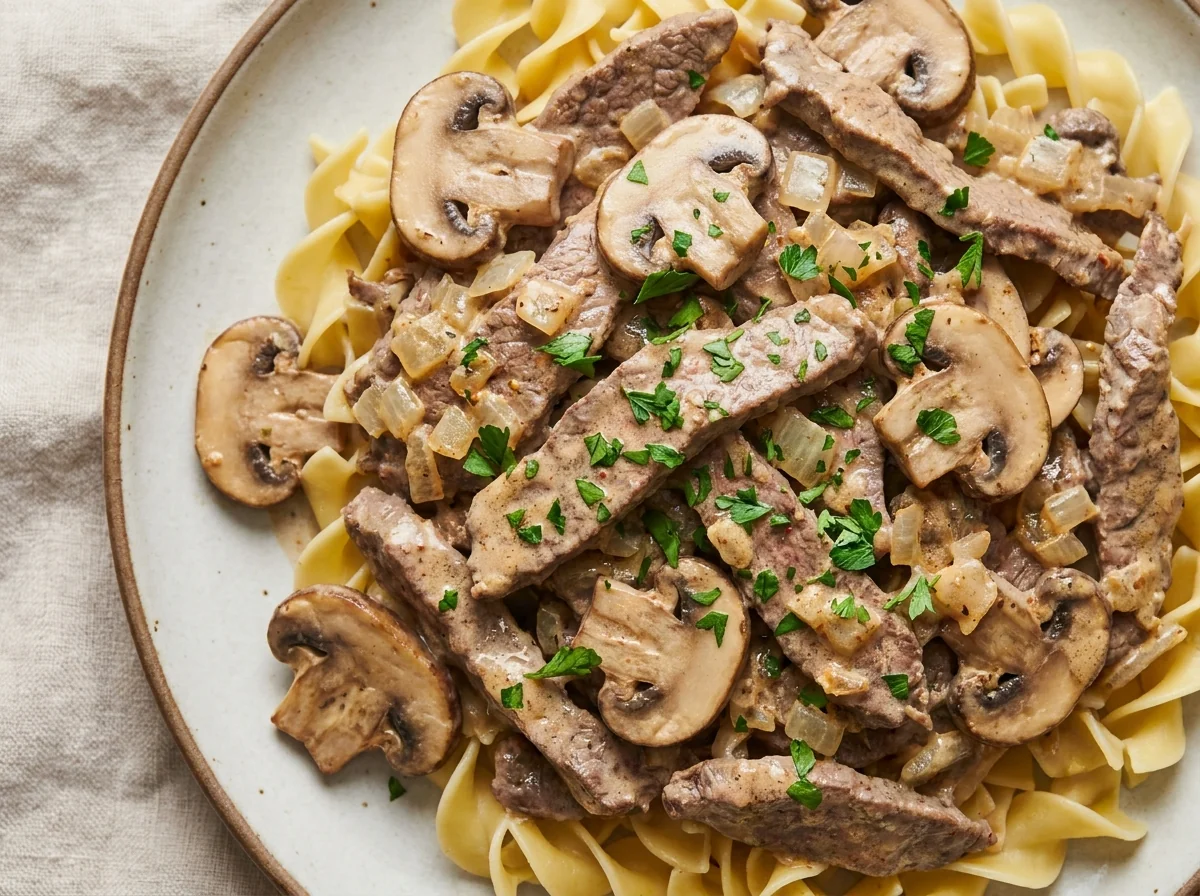
Beef stroganoff is Russia's aristocratic dish that conquered the world's kitchens.
Slices of meat and mushrooms in a creamy sour sauce. Our version replaces the sour cream with Greek yogurt so it keeps its distinctive original sourness at half the richness.
Preparation Steps
Sear the meat slices quickly
Dry the thin slices, salt them, and sear them in half the fat over the highest heat, one minute per side, in two batches. They brown and stay pink at the heart and are lifted: stroganoff meat visits the heat and does not dwell in it.
Brown the mushrooms hungry
In the rest of the fat the mushrooms in a layer without stirring for two minutes until they brown, then the onion and garlic until softened. The eternal mushroom lesson: patience before the spoon.
Build the sauce with the flour and stock
Sprinkle the flour over the mushrooms and stir it for a minute, then the stock gradually while stirring until it thickens into a smooth brown sauce, with the mustard and paprika in it.
Enrich with the yogurt off the heat. The heart of the lightening
Turn off the heat and wait half a minute then stir in the lukewarm Greek yogurt. It replaces the heavy sour cream with the very same original stroganoff sourness and half its richness, and over a live flame it curdles, so turning off the heat is a creed.
Return the meat and serve over the ribbons
The slices with their juices for half a minute of warmth, and parsley over the pasta or rice. The Russian tsars' dish from a single skillet in a third of an hour.
Blood Sugar Impact
The glycemic index (GI) measures how quickly a food raises blood sugar, while the glycemic load (GL) measures how much a full serving raises it. Together they give the complete picture.
Glycemic Index
GI
28Low
Low0–55Medium56–69High70+
A low value (≤55) means a gradual rise in blood sugar — the most suitable range for diabetes and insulin resistance.
Glycemic Load
GL
3Low
Low0–10Medium11–19High20+
Glycemic load reflects the impact of the full serving. To lower it: take half a serving, or pair the recipe with a source of protein and fiber.
Nutritional Information
Per ServingMakes 3 servings · one serving is about 410 g of raw ingredients
Calories508 kcal25%of Daily Value*
Protein37 g74%of Daily Value*
Carbohydrates13 g5%of Daily Value*
Fat33 g42%of Daily Value*
Fiber2 g7%of Daily Value*
Sodium1069 mg46%of Daily Value*
Potassium1196 mg25%of Daily Value*
Phosphorus555 mg44%of Daily Value*
* Percent Daily Values are based on a 2,000-calorie diet per FDA food-label reference values — your daily needs may be higher or lower. Values are derived from the recipe's ingredients via the USDA database.
Troubleshooting
The most common problems when preparing Lighter Beef Stroganoff, and how to fix them:
The yogurt curdled in the sauce
A live flame or cold yogurt that was shocked. Turning off the heat and lukewarmness, and a spoonful of the sauce whisked into it first is extra protection.
The meat came out tough
Thick slices or a long stay. The paper-thin slicing, the quick searing, and the final return.
The sauce is thin
Flour shaken off or too much stock. The full spoon fried on the mushrooms. That is the whole texture.
The mushrooms boiled pale
Crowding and stirring. The layer and the patience, the perpetual mushroom commandment.
Storage and Make-Ahead
Immediately
With its warm sourness over its ribbons.
In the refrigerator
One day. Reheated carefully without a boil that splits its yogurt.
Not suitable for freezing
The yogurt sauce splits.
Tested Ingredient Substitutions
Original Ingredient
Tested Substitute
Ratio
Flavor Difference
Greek yogurt
Labneh thinned with a spoonful of milk
~
A deeper sourness from our pantry
Beef
Sliced chicken breast
1:1
The lighter chicken stroganoff
Ribbon pasta
Rice or mashed potato
~
Its three historic bases
Mustard
Always keep it
~
Its hidden signature. Not omitted
How Much Does It Make? Scaling Guide
Ingredient
3 servings
1 1/2 servings
6 servings
Beef
450 g
225 g
900 g
Mushrooms
250 g
125 g
500 g
Yogurt
150 g
75 g
300 g
EEINA Nutrition Tip
The Greek yogurt lukewarm and off the heat. The heart of this dish and its danger together: its sourness is the historic soul of stroganoff, and its sensitivity to heat is higher than cream's, so turning off the heat and the half-minute is a non-negotiable law; and whoever rushes reaps a curdled sauce.
Add This Recipe to Your Plan
The EEINA app saves your favorite recipes, calculates them from their real ingredients, and shows your daily numbers toward your goal. Try it free now.
How does it differ from our cream and mushroom chicken?
That one is sweet, rich cream with a French leaning; while stroganoff has a sour sauce of yogurt and mustard with a Russian passport, mushrooms and protein in two philosophies.
How much lighter is our version?
Traditional sour cream is double the richness of Greek yogurt, and the distinctive sourness remains entirely: the lightening here is with no notable loss.
Which cut of meat suits it?
The tender ones only (fillet or ribeye). A one-minute dish does not give working cuts time to tenderize.
Its aristocratic story?
It is attributed to the noble Russian Stroganov family in the nineteenth century. The dish of palaces that became homes' quick dinner: the democracy of the kitchen at its finest.