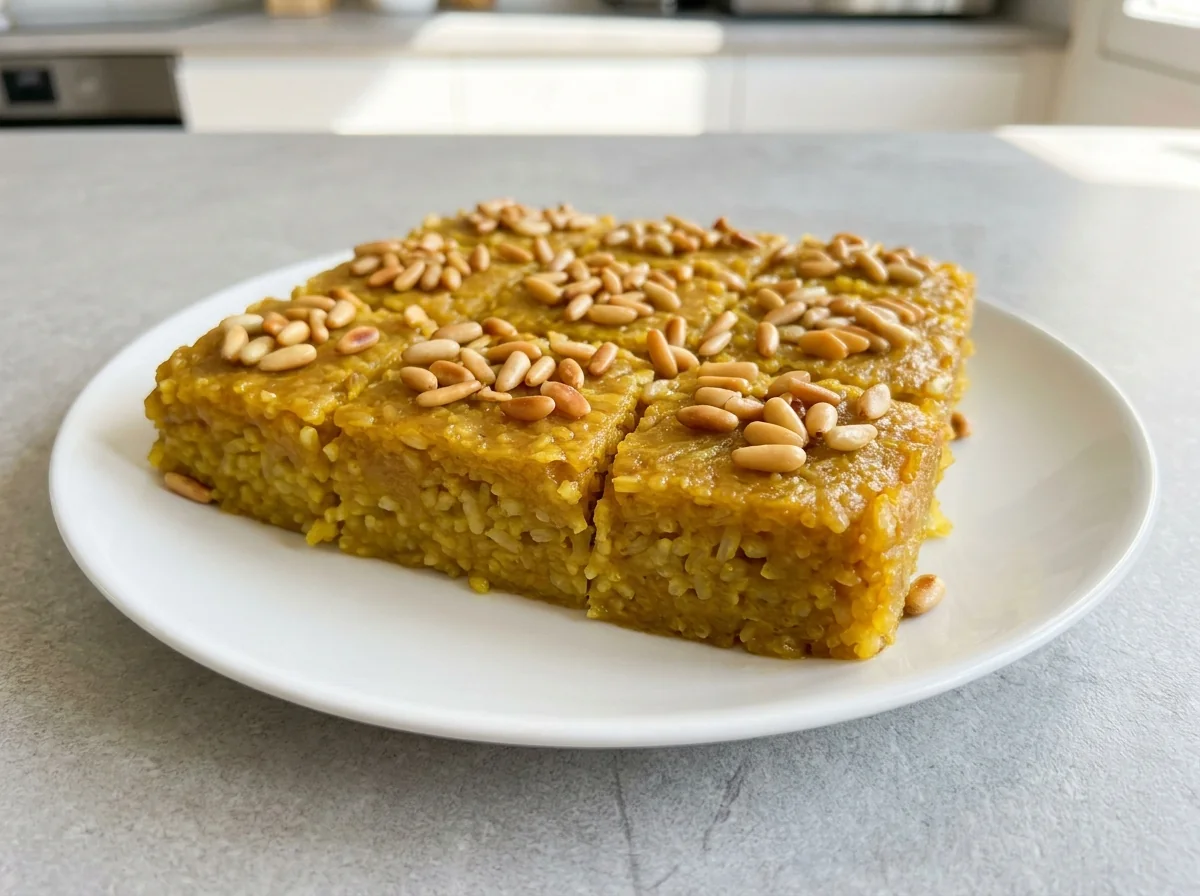
Beiruti Moufattaka · a yellow rice sweet with turmeric, tahini, pine nuts, and mastic, cooked and cooled then cut into squares. A time-honored Lebanese sweet, with values from the Lebanese University lab analysis.
Moufattaka is a time-honored Beiruti sweet distinguished by its yellow color from turmeric and the taste of tahini, pine nuts, and mastic. It was traditionally tied to feasts and special occasions in Beirut.
Its secret is cooking the rice until fully broken down and adding the tahini over low heat until the mixture sets. EEINA's version keeps the method, and its values are from the Lebanese University lab analysis; it is a high-sugar sweet eaten in moderate portions.
Preparation Steps
Cook the rice with turmeric
Wash the rice and cook it in the water with the turmeric over low heat until fully soft and broken down; the turmeric gives Moufattaka its signature yellow color.
Add sugar and tahini
Add the sugar and stir until dissolved, then the tahini and ground mastic, and keep stirring over low heat until the mixture is smooth and thickened.
Add the pine nuts
Add most of the pine nuts, reserving some for garnish, and stir until distributed.
Pour and cool
Spread the mixture in a tray, level the surface, scatter the reserved pine nuts, and let it cool and set in the refrigerator.
Cut and serve
Cut the Moufattaka into squares and serve cold. A high-sugar sweet, eaten in moderate portions.
Blood Sugar Impact
The glycemic index (GI) measures how quickly a food raises blood sugar, while the glycemic load (GL) measures how much a full serving raises it. Together they give the complete picture.
Glycemic Index
GI
70High
Low0–55Medium56–69High70+
A low value (≤55) means a gradual rise in blood sugar — the most suitable range for diabetes and insulin resistance.
Glycemic Load
GL
41High
Low0–10Medium11–19High20+
Glycemic load reflects the impact of the full serving. To lower it: take half a serving, or pair the recipe with a source of protein and fiber.
Nutritional Information
Per ServingMakes 8 servings · one serving is about 65 g of raw ingredients
Calories332 kcal17%of Daily Value*
Protein6 g12%of Daily Value*
Carbohydrates59 g21%of Daily Value*
Fat10 g13%of Daily Value*
* Percent Daily Values are based on a 2,000-calorie diet per FDA food-label reference values — your daily needs may be higher or lower. Values are derived from the recipe's ingredients via the USDA database.
Troubleshooting
The most common problems when preparing Beiruti Moufattaka, and how to fix them:
The Moufattaka does not set
The rice was undercooked or the mixture did not thicken. Cook the rice until broken down and keep stirring until it thickens before cooling.
The tahini clumped
It was added over high heat. Lower the heat and stir constantly when adding the tahini.
The color is pale
Too little turmeric. Add a little more turmeric for the signature yellow without overdoing the taste.
Too sweet
The sugar can be reduced to two-thirds, as the tahini and mastic give depth of flavor.
Storage and Make-Ahead
Refrigerator (4°)
Four days in an airtight container; eaten cold.
Freezer
Not recommended, as the texture changes after thawing.
Make ahead
Prepare a day ahead and chill so it sets well before cutting.
Tested Ingredient Substitutions
Original Ingredient
Tested Substitute
Ratio
Flavor Difference
Sugar
One-third less sugar
two-thirds
Lowers calories and the glycemic load
White rice
Brown rice
same weight
Adds fiber, with a coarser texture
Pine nuts
Ground pistachios
same weight
An available Levantine-flavored substitute
Mastic
Orange blossom water
a pinch
An aroma substitute when mastic is unavailable
How Much Does It Make? Scaling Guide
Number of servings
Rice
Sugar
Tahini
4 (half recipe)
100 g
100 g
30 g
8 (base)
200 g
200 g
60 g
16 (gathering)
400 g
400 g
120 g
EEINA Nutrition Tip
Tahini and pine nuts add healthy fats and plant protein to the sweet, but it remains high in sugar and carbohydrates with a high glycemic index. Eat it in small portions; the sugar can be cut to two-thirds.
Add This Recipe to Your Plan
The EEINA app saves your favorite recipes, calculates them from their real ingredients, and shows your daily numbers toward your goal. Try it free now.