A famous Palestinian sweet — soft cheese between two layers of butter-soaked kunafa pastry drenched in fragrant syrup and scattered with pistachios. A rich celebration dessert with a high glycemic load, contains gluten, dairy, and tree nuts.
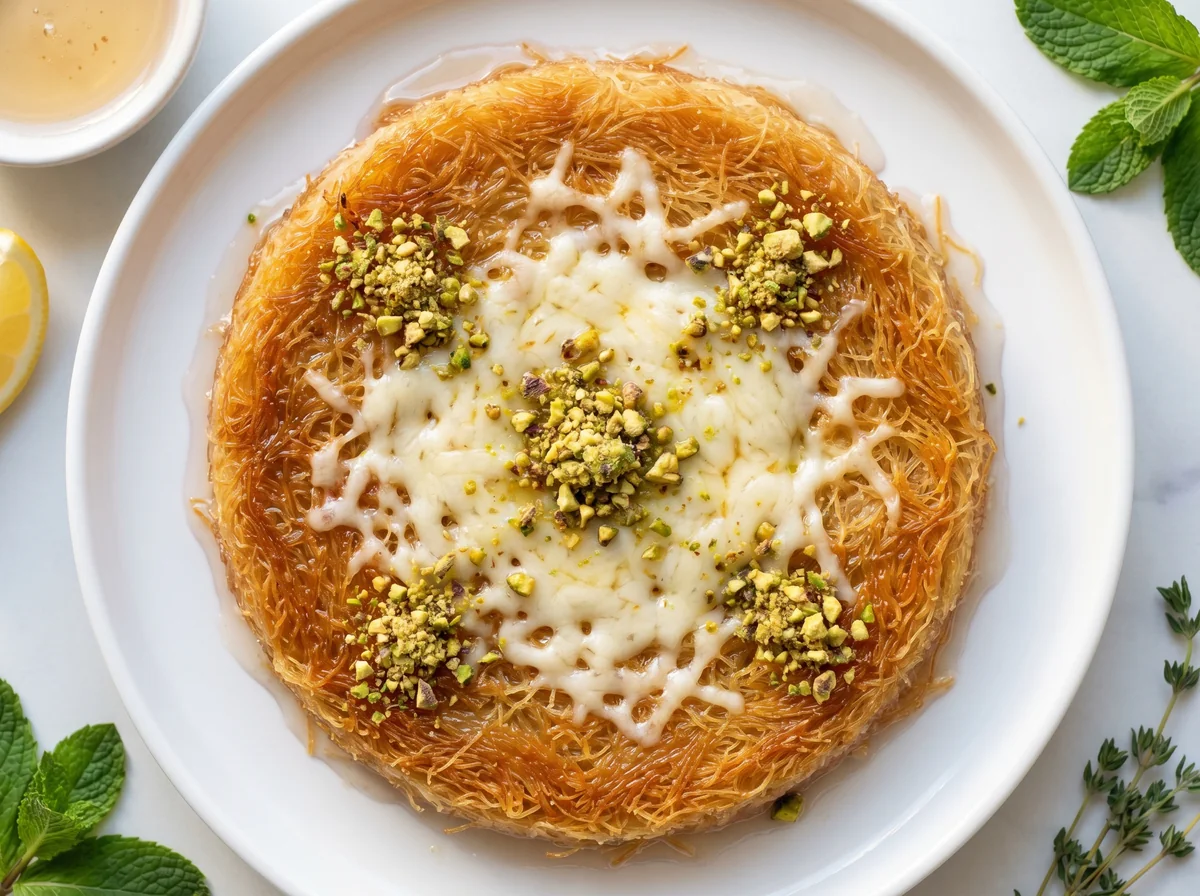
Kunafa Nabulsia is the jewel of Palestinian sweets, named after the city of Nablus which became famous for it and its white cheese. It stands out with its layer of melted cheese between fine kunafa pastry in its signature orange color, drenched in syrup and scattered with pistachios, served hot so the cheese is still stretchy and melted.
It became a symbol of hospitality and celebrations in Palestine and the Levant, made in large trays in pastry shops. Its secret lies in the balance between the gentle saltiness of the cheese, the sweetness of the syrup, and the crunch of the pastry.
Preparation Steps
Make the syrup first
Golden rule: the syrup must be cold and the kunafa hot (or vice versa) to keep it crispy. Bring the sugar and water to a boil, add the lemon juice as soon as it boils (prevents crystallization), and let it simmer on low heat for ten minutes until it thickens slightly, then add the orange blossom water and turn off. Leave it to cool completely while you prepare the kunafa.
Prepare the kunafa pastry
Shred the fine kunafa pastry by hand or in a food processor until it becomes small crumbs, then rub it thoroughly with the melted ghee until every strand is coated (enough ghee is what gives the crunch and golden color). If you want the traditional Nabulsia orange color, dissolve a pinch of food coloring in the ghee.
Prepare the pan
Grease a round pan or baking tray well with ghee. Spread half the kunafa pastry across the bottom and press it firmly with the back of a cup to form an even, compact layer. Good pressing prevents the kunafa from falling apart when inverted.
Layer the cheese
If the cheese is salty (akkawi), soak it in water and change the water several times to draw out the salt. Spread the grated or sliced cheese over the kunafa layer evenly, leaving a small border, then cover it with the remaining pastry and press the surface gently. Unsalted or soaked cheese gives a balanced flavor that allows the syrup's sweetness to shine through.
Bake
Bake the kunafa in an oven preheated to 200°C for twenty-five to thirty minutes until the top is golden (you can broil the top under the upper grill for a few extra minutes). Alternatively, cook it on the stovetop in a pan over low heat until the bottom is golden, then invert it. The golden color signals crispiness.
Pour the syrup and serve
The moment the hot kunafa comes out, invert it onto a serving platter (if baked in a pan), then pour the cold syrup over it evenly. Hot kunafa and cold syrup = crunch. Scatter the crushed pistachios immediately and serve hot — the cheese will be stretchy and melted in its first minutes. This is a dessert meant to be eaten hot and fresh.
Blood Sugar Impact
The glycemic index (GI) measures how quickly a food raises blood sugar, while the glycemic load (GL) measures how much a full serving raises it. Together they give the complete picture.
Glycemic Index
GI
65Medium
Low0–55Medium56–69High70+
A low value (≤55) means a gradual rise in blood sugar — the most suitable range for diabetes and insulin resistance.
Glycemic Load
GL
51High
Low0–10Medium11–19High20+
Glycemic load reflects the impact of the full serving. To lower it: take half a serving, or pair the recipe with a source of protein and fiber.
Nutritional Information
Per ServingMakes 8 servings · one serving is about 220 g of raw ingredients
Calories688 kcal34%of Daily Value*
Protein19 g38%of Daily Value*
Carbohydrates79 g29%of Daily Value*
Fat34 g44%of Daily Value*
Fiber1 g4%of Daily Value*
Sodium544 mg24%of Daily Value*
Potassium131 mg3%of Daily Value*
Phosphorus278 mg22%of Daily Value*
* Percent Daily Values are based on a 2,000-calorie diet per FDA food-label reference values — your daily needs may be higher or lower. Values are derived from the recipe's ingredients via the USDA database.
Troubleshooting
The most common problems when preparing Kunafa Nabulsia (Palestinian Cheese Kunafa), and how to fix them:
Kunafa went soft and did not crisp
The syrup was poured hot onto hot kunafa, or there was too much of it. The rule: hot kunafa and cold syrup (or vice versa), and a moderate amount. Pouring hot syrup onto hot kunafa steams away the crunch and makes it spongy.
Cheese is firm and does not stretch
Wrong type of cheese, or the kunafa cooled down. Use a cheese that melts and stretches (soaked akkawi with the salt drawn out, or unsalted mozzarella), and serve the kunafa hot immediately — the cheese sets and hardens when it cools.
Kunafa is too salty
The cheese was not soaked. Akkawi cheese is salty — soak it in cold water and change the water several times (or for several hours) until the salt reduces, or use unsalted mozzarella.
Syrup crystallized
Lemon juice was not added, or the syrup was stirred after boiling. Add the lemon juice as soon as it starts to boil (prevents crystallization), and do not stir the syrup after it boils. Leave it to simmer gently until thickened.
Bottom did not color and surface is pale
Not enough ghee or temperature too low. Rub the pastry with enough ghee and press it well, then bake at high heat or broil the top under the upper grill for a few minutes. Ghee and golden color go hand in hand.
Storage and Make-Ahead
Room temperature
Kunafa is best eaten hot and fresh on the day it is made, for the best texture (melted cheese and crispy pastry). It keeps at room temperature for one day but loses its crunch and the cheese sets firm.
Refrigerator (4°C)
Keeps for two to three days, but the cheese hardens and the pastry softens. Reheat in the oven or a pan to restore some crunch and soften the cheese before serving.
Freezer
You can prepare unbaked kunafa (pastry and cheese assembled in the pan) and freeze it, then bake from frozen. Baked and syruped kunafa does not freeze well.
Advance preparation
Prepare the syrup ahead (keeps in the fridge for two weeks) and rub the pastry with ghee, then assemble and bake fresh at serving time. Kunafa is one of those sweets best served the moment it is made.
Tested Ingredient Substitutions
Original Ingredient
Tested Substitute
Ratio
Flavor Difference
Akkawi cheese
Unsalted mozzarella and a little cream cheese
Same weight
Melts and stretches without saltiness — a common blend for a well-balanced kunafa
Ghee
Melted butter
Same amount
A lighter flavor; ghee is closer to the traditional taste and has a higher smoke point
Full amount of syrup
Less syrup (pour lighter)
To taste
Reduces sugar and calories; the kunafa remains delicious with less syrup
How Much Does It Make? Scaling Guide
Number of servings
Kunafa dough
Cheese
Ghee
Sugar (syrup)
4 (half recipe)
200 g
250 g
0.25 cup
1 cup
8 (base)
400 g
500 g
0.5 cup
2 cups
16 (large tray)
800 g
1 kg
1 cup
4 cups
EEINA Nutrition Tip
Kunafa is a celebration sweet par excellence — high in sugar, fat, and calories, so it is not an everyday food. Moderation is its key: one small piece at a special occasion is enough for enjoyment. The cheese adds protein and calcium, but the syrup raises its glycemic load. For people with diabetes: a very small piece on a rare occasion with caution, or reduce the syrup by pouring it more lightly. Enjoy it as a festive sweet, nothing more.
Add This Recipe to Your Plan
The EEINA app saves your favorite recipes, calculates them from their real ingredients, and shows your daily numbers toward your goal. Try it free now.
The golden rule: hot kunafa and cold syrup (or vice versa), a moderate amount of syrup, and enough ghee rubbed into the pastry. Pouring hot syrup onto hot kunafa steams away the crunch and makes it spongy.
What cheese is best for kunafa?
A cheese that melts, stretches, and is not salty — such as akkawi soaked to remove its salt, or unsalted mozzarella, sometimes blended with a little cream cheese. Salty cheese must be soaked first.
Why is Nabulsia kunafa orange?
Traditionally a pinch of orange food coloring (or a little red tahini) is added to the ghee so the top takes on its distinctive color. It is a traditional, optional color that does not affect the flavor.
Is kunafa suitable for people with diabetes?
It is a high-sugar celebration sweet, so it is not a choice for people with diabetes except as a very small piece on a rare occasion with care. You can reduce the syrup, but it remains a festive sweet to be enjoyed in moderation.