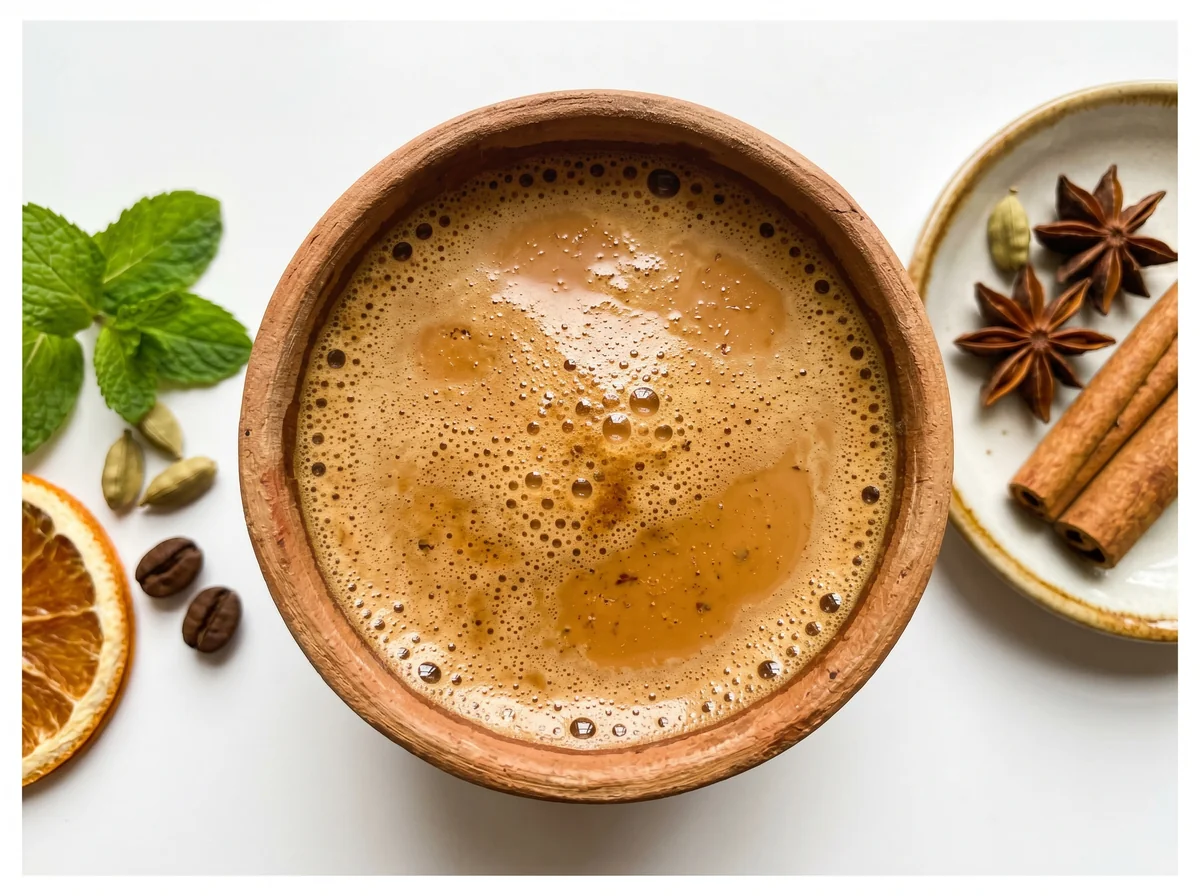
The Gulf's beloved spiced milk tea — black tea simmered with cardamom, saffron and cinnamon, then blended with evaporated milk into a rich, fragrant brew. Energizing and comforting; moderate glycemic load; contains dairy.
Karak tea is the Gulf's most beloved daily drink — a ritual with deep social and cultural roots. Its origin traces back to Indian chai culture brought to the Gulf by South Asian workers and merchants, where the Gulf version was adapted with local spices: cardamom (the star), saffron, cinnamon, and sometimes cloves. The name 'karak' comes from a type of strong Indian black tea.
Today karak is synonymous with the Gulf social fabric — every chaikhana (tea stall), office break, and guest gathering begins with karak. It is the drink of hospitality and warmth, from Bahrain and Qatar to the UAE and Kuwait. The Gulf has elevated karak into an icon, with dedicated karak stalls everywhere.
Preparation Steps
Simmer the spices
Place the water in a small pot with the crushed cardamom (and saffron and cinnamon if using) and bring to a boil. Cardamom is the heart of karak — its warm, aromatic flavor is what makes karak distinctive. Saffron adds a golden color and luxurious fragrance. Simmer the spices for two to three minutes to release their aromas.
Add the tea
Add the black tea to the boiling spiced water and continue simmering over medium heat for three to four minutes until the water turns a deep reddish-brown. Do not stir the tea excessively while it brews (stirring releases too much tannin and turns it bitter). Assam or Ceylon varieties are best for karak (strong and malty).
Add the milk
Pour in the evaporated milk (or full-fat milk) and bring back to the boil, then simmer for two to three minutes so the tea, spices and milk are fully integrated. Evaporated milk gives karak its rich, creamy, characteristic texture — more so than fresh milk. The tea should be a rich, deep golden-brown color.
Sweeten, strain and serve
Add sugar to taste (karak is usually moderately sweet). Strain the tea through a fine strainer into cups. Serve hot. Karak is the Gulf's most beloved daily drink — a small cup of spiced, milky tea that warms the soul, whether in the morning, at a break or after a meal. Its name comes from 'karaka' (special black tea) via Indian influence.
Blood Sugar Impact
The glycemic index (GI) measures how quickly a food raises blood sugar, while the glycemic load (GL) measures how much a full serving raises it. Together they give the complete picture.
Glycemic Index
GI
49Low
Low0–55Medium56–69High70+
A low value (≤55) means a gradual rise in blood sugar — the most suitable range for diabetes and insulin resistance.
Glycemic Load
GL
5Low
Low0–10Medium11–19High20+
Glycemic load reflects the impact of the full serving. To lower it: take half a serving, or pair the recipe with a source of protein and fiber.
Nutritional Information
Per ServingMakes 4 servings · one serving is about 250 g of raw ingredients
Calories89 kcal4%of Daily Value*
Protein4 g8%of Daily Value*
Carbohydrates10 g4%of Daily Value*
Fat4 g5%of Daily Value*
Fiber0 g0%of Daily Value*
Sodium52 mg2%of Daily Value*
Potassium161 mg3%of Daily Value*
Phosphorus102 mg8%of Daily Value*
* Percent Daily Values are based on a 2,000-calorie diet per FDA food-label reference values — your daily needs may be higher or lower. Values are derived from the recipe's ingredients via the USDA database.
Troubleshooting
The most common problems when preparing Karak Tea (Gulf Spiced Milk Tea), and how to fix them:
Karak is too bitter
Over-brewed or too much tea. Simmer the tea for no more than three to four minutes (longer releases more tannins and increases bitterness) and use the right ratio of tea. Add more milk to balance, or reduce the tea next time.
Karak is pale and lacks flavor
Too little tea or spices, or tea not simmered long enough. Use enough strong black tea (Assam or Ceylon), simmer the spices before adding the tea, and let the tea brew to a deep color. A strong tea base is essential.
The milk curdled
Heat too high or tea too acidic. Add the milk after reducing the heat slightly, and stir gently while adding. Evaporated milk handles heat better than fresh milk (it is more stable from the concentration process).
Saffron flavor not coming through
Not enough saffron or added too late. Soak the saffron in a tablespoon of warm water for a few minutes before adding (blooming releases more color and flavor), and add it at the beginning with the other spices.
Storage and Make-Ahead
Drink fresh
Karak is best drunk fresh and hot right after preparation. Prepare a cup when needed — it takes only ten minutes. Fresh karak is richer and more fragrant. Leftovers can be refrigerated for a day and reheated.
Refrigerator
Prepared karak keeps refrigerated for one day. Reheat over medium heat (do not boil vigorously). The flavor and texture may change slightly but it is acceptable. Prepare fresh for the best experience.
Spice prep
Prepare a mix of karak spices (cardamom, cinnamon, a little cloves) in advance in a jar — grind and store sealed. A quick karak is: spice mix + tea + water + milk. The premixed spices save time.
Food safety
Karak contains milk — serve hot and do not leave it at room temperature for more than two hours. Refrigerate leftovers and reheat. Use fresh, clean milk and unspoiled tea.
Tested Ingredient Substitutions
Original Ingredient
Tested Substitute
Ratio
Flavor Difference
Evaporated milk
Full-fat milk or low-fat milk
Same amount
Evaporated milk gives a richer, creamier karak; full-fat milk is lighter; low-fat further reduces calories — the flavor is slightly different but still delicious
Sugar
Honey or sweetener substitute
To taste
Reduces the glycemic load; honey adds a natural flavor note; eliminating sugar makes karak a very low-calorie drink with a low glycemic load
Saffron (optional)
A pinch of turmeric
Very small pinch
For golden color without saffron's expense; the flavor differs (turmeric is earthy, saffron is floral) but both give a warm, golden color
How Much Does It Make? Scaling Guide
Number of cups
Water
Tea
Milk
2 (half recipe)
1 cup
1.5 tsp
1 cup
4 (base)
2 cups
3 tsp
2 cups
8 (gathering)
4 cups
6 tsp
4 cups
EEINA Nutrition Tip
Karak can be a moderate-calorie drink (mainly from milk and sugar). To lighten it: use low-fat evaporated milk or fresh milk (instead of full-fat), reduce the sugar (sweetness habit can change), or sweeten with a little honey. The spices (cardamom, cinnamon, saffron) are antioxidants with no calories, so use them generously. The caffeine in black tea is a consideration for those sensitive to it — a smaller cup or less tea. Without sugar or with minimal sugar, karak is a very reasonable drink. Enjoy it daily in moderation.
Add This Recipe to Your Plan
The EEINA app saves your favorite recipes, calculates them from their real ingredients, and shows your daily numbers toward your goal. Try it free now.
Karak is distinguished by: (1) Gulf spices — especially cardamom (essential), plus saffron and cinnamon; (2) the technique — simmering tea and spices together for minutes for deep flavor; (3) evaporated milk — giving it a rich, creamy texture. Regular milk tea has none of these. Karak is a distinct drink with its own deep Gulf cultural identity.
What is the best tea for karak?
Strong, malty black tea varieties: Assam (India, the most popular for karak) or Ceylon (Sri Lanka). Both are robust and hold their flavor against the spices and milk. Avoid delicate teas (green, white) — they disappear under the spices. Loose-leaf tea gives better flavor than teabags.
Is karak healthy?
Moderate daily drink: the spices (cardamom, saffron, cinnamon) are antioxidants with no calories. The calories come from milk and sugar. To lighten it: low-fat milk, less sugar. Without or with minimal sugar, karak is a reasonable drink. Caffeine is a consideration for those sensitive. Enjoy daily in moderation.
Why does karak sometimes turn bitter?
From over-brewing the tea (too long or too much tea releases tannins). Simmer for no more than three to four minutes and use the right ratio of tea. More milk softens bitterness. Assam and Ceylon are robust but not overly bitter with proper brewing.