Karak is Indian in origin (from the word karak, meaning strong) and spread across the Gulf until it became one of its most famous popular drinks.
The queues at its cafeterias at dawn during Ramadan have become part of the Gulf Suhoor scene.
Preparation Steps
Boil the tea with the aromatics
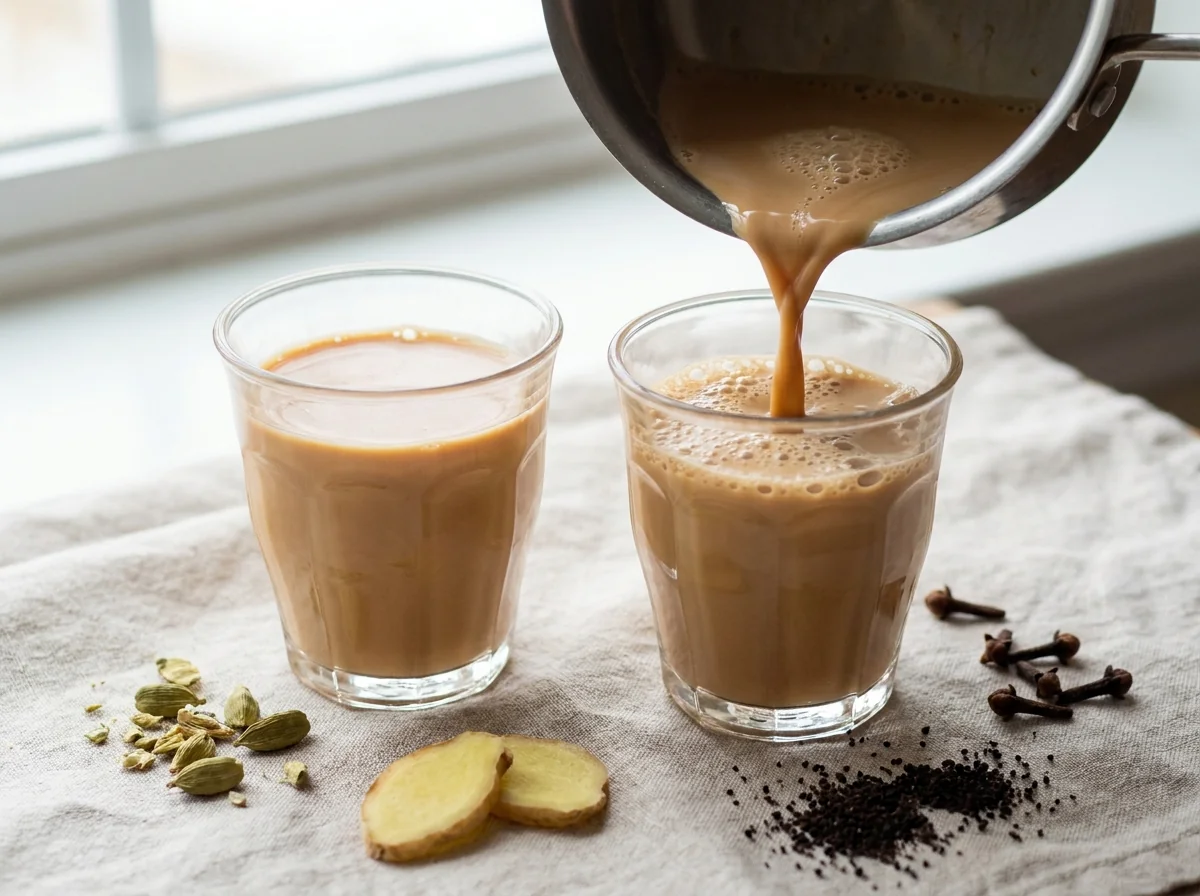
Crush the cardamom pods and slice the ginger. In a kettle over heat boil the water with the tea, cardamom, ginger, and cloves for five minutes until the brew turns dark and saturated with the aroma of the spices. Karak needs a strong, concentrated tea.
Add the evaporated milk and sugar
Add the evaporated milk and the sugar and bring it back to a boil. Evaporated milk is what gives karak its creamy texture that regular milk does not.
Cook it over low heat, lifting and pouring
Lower the heat and let it simmer gently for ten minutes, lifting it with the ladle and pouring it from a height several times. This motion concentrates it and gives it its foam and caramel color.
Strain it and pour from a height
Strain out the tea and aromatics and pour it into small glass cups from a height of about a hand-span, so a light foam rises and the aroma of the cardamom lifts.
Blood Sugar Impact
The glycemic index (GI) measures how quickly a food raises blood sugar, while the glycemic load (GL) measures how much a full serving raises it. Together they give the complete picture.
Glycemic Index
GI
56Medium
Low0–55Medium56–69High70+
A low value (≤55) means a gradual rise in blood sugar — the most suitable range for diabetes and insulin resistance.
Glycemic Load
GL
8Low
Low0–10Medium11–19High20+
Glycemic load reflects the impact of the full serving. To lower it: take half a serving, or pair the recipe with a source of protein and fiber.
Nutritional Information
Per ServingMakes 4 servings · one serving is about 240 g of raw ingredients
Calories101 kcal5%of Daily Value*
Protein3 g6%of Daily Value*
Carbohydrates15 g5%of Daily Value*
Fat3 g4%of Daily Value*
Fiber0 g0%of Daily Value*
Sodium43 mg2%of Daily Value*
* Percent Daily Values are based on a 2,000-calorie diet per FDA food-label reference values — your daily needs may be higher or lower. Values are derived from the recipe's ingredients via the USDA database.
Troubleshooting
The most common problems when preparing Gulf Karak Tea, and how to fix them:
It came out as a pale milky tea
You used regular milk or rushed the boil. Use evaporated milk and let it simmer gently for ten minutes.
Its taste is bitter and astringent
The tea boiled longer than needed or its quantity is too much. Five minutes for the base is enough.
It boiled over onto the stove
Milk boils over quickly. Lower the heat after adding it, watch it, and lift the kettle when it rises.
The aromatics overpowered the tea
Cardamom is essential but in moderation. Six pods per kettle suffice, and the ginger in a small amount.
Storage and Make-Ahead
Hot right after pouring
Karak is served hot with its foam.
In a sealed thermos
Two hours while keeping its quality, suitable for Suhoor outings.
Not suitable for the refrigerator
It loses its texture and flavor, and it cooks fresh in twenty minutes.
Tested Ingredient Substitutions
Original Ingredient
Tested Substitute
Ratio
Flavor Difference
Evaporated milk
Concentrated powdered milk
60 g with less water
A method known in the cafeterias
Full sugar
Half or a third of it
~
A less sweet karak
Fresh ginger
A few saffron threads
~
Karak for occasions
Granulated tea
Strong tea bags
4 bags
An alternative when granulated is unavailable
How Much Does It Make? Scaling Guide
Ingredient
4 cups
2 cups
8 cups
Water
500 ml
250 ml
1 L
Evaporated milk
400 ml
200 ml
800 ml
Tea
10 g
5 g
20 g
EEINA Nutrition Tip
Use concentrated evaporated milk, not regular milk, for it is what gives karak its texture and color. And the gentle boil with lifting and pouring from a height is what turns milk tea into karak.
Add This Recipe to Your Plan
The EEINA app saves your favorite recipes, calculates them from their real ingredients, and shows your daily numbers toward your goal. Try it free now.
A cup of karak carries the caffeine of a strong tea, a stimulant that comforts Suhoor, but overdoing it before sleep causes insomnia. One cup is appropriate.
What is the difference between it and Adeni milk tea?
Adeni is Yemeni with regular milk and a gentler boil, while karak is Gulf-Indian with concentrated evaporated milk and a longer boil. Two different textures.
Can it be sweetened with sweetened condensed milk instead of sugar?
A method known in many cafeterias, and the sugar is then dropped entirely.
What is the secret of the caramel color?
Boiling the evaporated milk with the strong tea for a sufficient time, with no dye or additives.