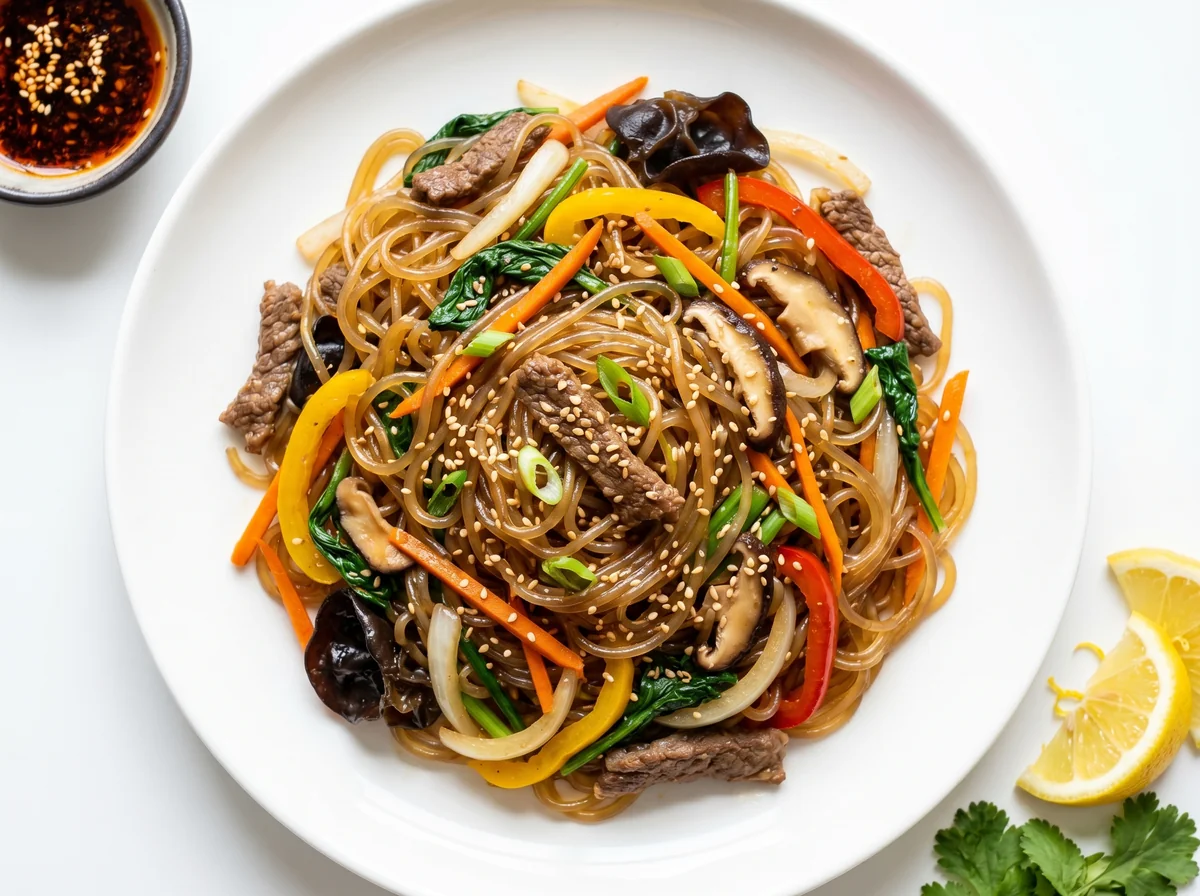
Sweet potato starch noodles stir-fried with beef and colorful vegetables in a soy-sesame sauce — a festive Korean dish bursting with color, loaded with vegetables and rich in protein.
Japchae is a colorful Korean celebration dish: transparent noodles made from sweet potato starch are stir-fried with an array of vegetables and beef.
The abundance of vegetables raises the fiber content, while sesame and sesame oil lend the distinctive flavor of Korean cuisine.
Preparation Steps
Cook the noodles
Boil the sweet potato glass noodles until soft and translucent, then drain and cut them slightly for easier eating. Translucency signals they are cooked through.
Prepare the beef
Marinate the beef with a little soy sauce, garlic and sugar. Sear quickly in a wok over high heat, then set aside. Pre-marinating gives the beef deep flavor.
Stir-fry the vegetables
Stir-fry each vegetable separately (onion, carrot, mushrooms, bell pepper) until just tender while keeping their color, then the spinach until wilted. Cooking each separately preserves each vegetable's color.
Make the sauce and combine
Mix the remaining soy sauce, sugar and sesame oil, then toss the noodles, beef and all the vegetables together with the sauce in the wok over low heat until everything is well combined and glossy.
Serve
Fold in the green onions and scatter the toasted sesame seeds on top. Serve warm or at room temperature — a colorful Korean celebration dish.
Blood Sugar Impact
The glycemic index (GI) measures how quickly a food raises blood sugar, while the glycemic load (GL) measures how much a full serving raises it. Together they give the complete picture.
Glycemic Index
GI
60Medium
Low0–55Medium56–69High70+
A low value (≤55) means a gradual rise in blood sugar — the most suitable range for diabetes and insulin resistance.
Glycemic Load
GL
59High
Low0–10Medium11–19High20+
Glycemic load reflects the impact of the full serving. To lower it: take half a serving, or pair the recipe with a source of protein and fiber.
Nutritional Information
Per ServingMakes 3 servings · one serving is about 480 g of raw ingredients
Calories567 kcal28%of Daily Value*
Protein19 g38%of Daily Value*
Carbohydrates106 g39%of Daily Value*
Fat7 g9%of Daily Value*
Fiber8 g29%of Daily Value*
Sodium1283 mg56%of Daily Value*
* Percent Daily Values are based on a 2,000-calorie diet per FDA food-label reference values — your daily needs may be higher or lower. Values are derived from the recipe's ingredients via the USDA database.
Troubleshooting
The most common problems when preparing Japchae (Korean Sweet Potato Glass Noodles), and how to fix them:
Sticking to the pan
Too little oil or a cold pan. Heat the pan and add enough oil before the ingredients, and don't overcrowd the pan.
Vegetables turned wilted and watery
Heat too low or cooked too long. Stir-fry over high heat for a short time to keep the vegetables crisp and brightly colored.
Taste lacks depth
Not enough salt or seasoning. Season well and taste, then add fresh herbs or a squeeze of lemon to lift all the flavors.
Storage and Make-Ahead
Refrigerator (4°C)
Three days in an airtight container after cooling. Reheat thoroughly before serving.
Freezer (-18°C)
One to two months in individual portions. Thaw in the refrigerator before reheating.
Meal prep
Prep and chop the ingredients in advance and refrigerate; assembly and cooking takes only minutes at serving time.
Reheating
Over gentle heat with a splash of water, or in a moderate oven until hot. Do not leave cooked food out of the refrigerator for more than two hours [2].
Tested Ingredient Substitutions
Original Ingredient
Tested Substitute
Ratio
Flavor Difference
Beef
Ground chicken or lentils
Same weight
Leaner or plant-based, rich in fiber
Wheat component
Gluten-free alternative (rice/lentil/whole wheat depending on the dish)
Same amount
For those sensitive to gluten
Oil/fat
Extra-virgin olive oil
Same amount
Monounsaturated fats, better for heart health
Salt
Herbs, spices and lemon juice
To taste
Reduces sodium while delivering plenty of flavor
How Much Does It Make? Scaling Guide
Number of servings
Ratio
2 (individual × 2)
Half the quantities
4 (base)
Quantities as listed
6 (family)
1.5×
8 (entertaining)
Double the quantities
EEINA Nutrition Tip
Sweet potato glass noodles are naturally gluten-free, but they are starchy so keep the portion moderate. The colorful vegetables boost fiber and vitamin C. We reduced the sugar and use low-sodium soy sauce.
Add This Recipe to Your Plan
The EEINA app saves your favorite recipes, calculates them from their real ingredients, and shows your daily numbers toward your goal. Try it free now.
With caution — its glycemic index is low and the protein and fiber slow sugar absorption. Keep to a moderate portion and serve with vegetables or a salad, and avoid large amounts of white starch alongside it.
How do I store leftovers?
In an airtight container in the refrigerator for a few days, or in the freezer for future portions (excluding salads and seafood dishes, which have a shorter shelf life). Reheat thoroughly once.
Can I adapt it to fit my diet?
Yes — check the substitutions table: you can swap the protein, make it dairy-free or gluten-free, or reduce the salt and fat without losing flavor.
Sources: USDA · University of Sydney · Gulf GSO · Our methodology · Updated on