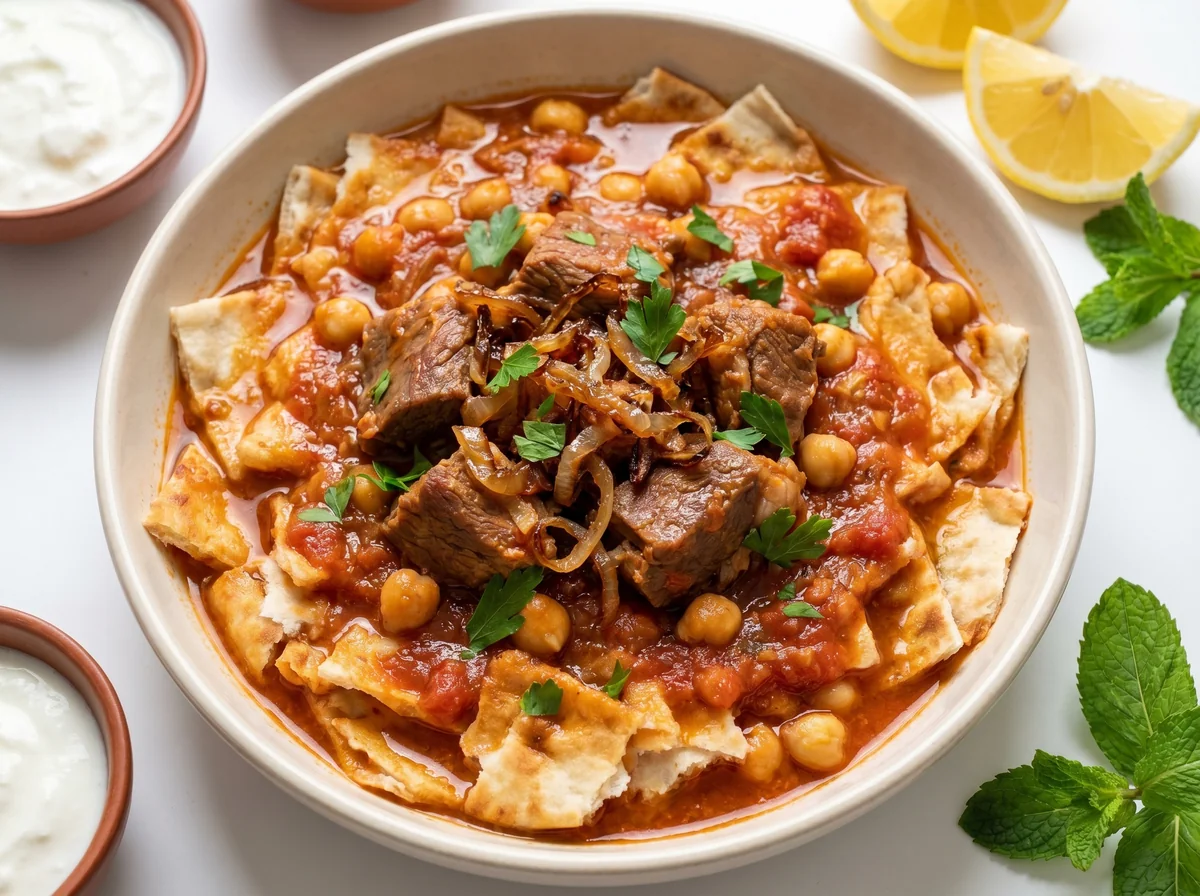
A beloved Iraqi comfort dish — thin flatbread soaked in a rich lamb and white bean (or chickpea) broth spiced with tomatoes and loomi (dried black lime) until soft. A warm, hearty lunch, moderate carbohydrates, contains gluten.
Tashreeb is a beloved, warm, hearty Iraqi comfort dish (with Gulf counterparts like Thareed, the bread-soaked stew), its name coming from the act of soaking or drinking in (soaking the bread in broth until it absorbs it). Thin Iraqi flatbread (day-old samoon or tandoor bread) is broken into a dish and soaked in a rich lamb broth spiced with tomatoes, loomi (dried black lime), and baharat (Gulf spice blend), along with white beans or chickpeas, until the bread absorbs the broth and softens. Tashreeb is a clever, ancient way to use stale bread and create a warm, filling meal (an economical, generous dish).
It comes in many versions (bean tashreeb, chickpea, bajila/fava, chicken, lentil). It is usually eaten from a communal dish. Bread soaked in spiced broth with meat and legumes is a warm delight — a symbol of the popular Iraqi kitchen and its generous table.
Preparation Steps
Brown the meat
Fry the onion in the ghee, add the meat and brown it, then add the tomato paste, baharat (Gulf spice blend), and loomi (dried black lime) and stir. Tashreeb is a rich-broth dish in which bread is soaked (its name comes from the act of drinking in / soaking) — the broth is its heart, and the bread absorbs it to become soft.
Simmer the broth and meat
Add the grated tomatoes, soaked beans or chickpeas, and water, then leave the meat and legumes to cook until tender (about one and a half hours). Make plenty of well-seasoned broth (the bread will absorb a lot of it) — enrich it with the meat, tomatoes, and loomi (dried black lime) and adjust the salt.
Reduce the broth
Allow the broth to concentrate slightly, capturing the flavor of the meat, beans, and tomatoes (it should remain generous but rich). The loomi gives the characteristic deep, smoky tang that defines Iraqi broth. Make sure the meat and legumes are tender before adding the bread.
Break the bread
Break the thin Iraqi flatbread (day-old samoon or tandoor bread) into pieces in a deep serving dish or bowl. Day-old or thin bread absorbs the broth best (tashreeb is a clever way to use up stale bread) — it soaks through and becomes delicious.
Soak the bread
Ladle the hot broth over the broken bread pieces to cover them, then leave for a few minutes until the bread absorbs the broth and softens. This is the heart of tashreeb: the dry bread transforms through the broth into a warm, satisfying texture. Do not leave it too long (it will get mushy).
Serve
Arrange the meat and beans over the soaked bread, ladle on more broth, and serve hot (typically from a communal dish). This is a beloved, warm, hearty Iraqi street and home dish — a family lunch staple and comes in many versions (with white beans, chickpeas, meat, or chicken). Bread soaked in spiced broth with meat and legumes is a warm delight — a symbol of the popular Iraqi kitchen and its generous table.
Blood Sugar Impact
The glycemic index (GI) measures how quickly a food raises blood sugar, while the glycemic load (GL) measures how much a full serving raises it. Together they give the complete picture.
Glycemic Index
GI
44Low
Low0–55Medium56–69High70+
A low value (≤55) means a gradual rise in blood sugar — the most suitable range for diabetes and insulin resistance.
Glycemic Load
GL
7Low
Low0–10Medium11–19High20+
Glycemic load reflects the impact of the full serving. To lower it: take half a serving, or pair the recipe with a source of protein and fiber.
Nutritional Information
Per ServingMakes 5 servings · one serving is about 235 g of raw ingredients
Calories355 kcal18%of Daily Value*
Protein23 g46%of Daily Value*
Carbohydrates20 g7%of Daily Value*
Fat20 g26%of Daily Value*
Fiber4 g14%of Daily Value*
Sodium235 mg10%of Daily Value*
* Percent Daily Values are based on a 2,000-calorie diet per FDA food-label reference values — your daily needs may be higher or lower. Values are derived from the recipe's ingredients via the USDA database.
Troubleshooting
The most common problems when preparing Iraqi Tashreeb (Bread-Soaked Stew), and how to fix them:
The bread is still hard and did not soften
Not enough broth or it was not left to soak. Cover the bread with hot, generous broth and let it sit for several minutes to absorb and soften. Stale bread needs broth and time to soften — do not rush serving.
The bread got mushy (porridge-like)
It was left soaking too long. Add the bread shortly before serving (not too early) — prolonged soaking makes it mushy. The goal is soft, intact, soaked bread, not a purée.
The broth is bland
Not enough loomi (dried black lime), baharat (Gulf spice blend), or tomatoes. The broth is the flavor (the bread absorbs it) — make it rich: loomi, Iraqi baharat (Gulf spice blend), tomatoes, tomato paste, and sufficient salt. Taste and adjust before soaking the bread.
Not enough broth (too dry)
It evaporated or you made too little. Make plenty of broth (the bread and legumes absorb a lot) and add hot, seasoned water if it runs low. Tashreeb should be served wet and brothy.
The beans or chickpeas are still firm
Not soaked long enough. Soak the beans or chickpeas overnight (or use canned) and cook until fully tender. Legumes that are not properly soaked will not soften in time.
Storage and Make-Ahead
Separate storage (best)
Store the broth with meat and legumes in one container and the bread dry and separate, soaking them in hot broth at serving time (pre-soaked bread stored in the refrigerator turns to mush). The broth keeps refrigerated for 3 days; dry bread keeps for weeks.
Freezer
Freeze the broth with meat and legumes for two months — excellent results. Thaw, reheat, and soak fresh bread. Freeze the broth and prepare the soaking fresh each time. Very practical for weekday meals.
Advance preparation
Prepare the broth with meat and legumes a day before the occasion (it improves overnight), then soak the bread at serving time. The slow cooking for the meat and legumes is worth doing in advance.
Food safety
Cook the meat until fully done, cool the broth quickly, do not leave the dish at room temperature for more than two hours, and reheat the broth thoroughly before soaking and serving.
Tested Ingredient Substitutions
Original Ingredient
Tested Substitute
Ratio
Flavor Difference
White wheat bread
Whole-wheat bread
same amount
Adds fiber and lowers the glycemic index; white bread is traditional, whole-wheat is healthier. Tashreeb is generally a good way to use up stale bread of any kind
Lamb
Chicken or lean meat
same amount
Chicken tashreeb is common and lighter; lean meat is healthier; lamb is the traditional, most flavorful option
White beans
Chickpeas, fava beans, or lentils
same amount
Tashreeb has many versions based on the legume — all add plant protein and fiber, so use whatever is available
How Much Does It Make? Scaling Guide
Number of servings
Bread
Meat
Legumes
3 (small)
for 3
400 g
1/2 cup
5 (base)
for 5
600 g
1 cup
10 (banquet)
for 10
1200 g
2 cups
EEINA Nutrition Tip
Tashreeb is a relatively complete dish (bread, meat, and legumes in one dish), and the white beans or chickpeas add plant protein and fiber (lowering the glycemic index and keeping you full), while loomi (dried black lime) provides antioxidants. The challenges are carbohydrates and a moderate load (white wheat bread), fat (ghee and lamb), and sodium. For a better version: use whole-wheat bread if possible, increase the legumes (fiber and protein), use lean meat, reduce the ghee, and adjust the salt. A hearty comfort dish whose balance comes from the legumes — in moderate portions.
Add This Recipe to Your Plan
The EEINA app saves your favorite recipes, calculates them from their real ingredients, and shows your daily numbers toward your goal. Try it free now.
A beloved Iraqi comfort dish — thin flatbread (day-old samoon or tandoor bread) broken and soaked in a rich lamb broth spiced with tomatoes and loomi (dried black lime), with white beans or chickpeas, until the bread absorbs the broth and softens. A warm, hearty lunch, a clever way to use stale bread, and it comes in many versions depending on the legumes.
What is the difference between tashreeb and fatteh?
Both involve bread soaked in broth, but Iraqi tashreeb uses thin flatbread soaked in a meat-and-legume broth (like a stew) — generally without yogurt or garlic. Fatteh (Egyptian and Levantine) usually has layers (bread, rice, yogurt or tomato sauce, garlic, and vinegar). Tashreeb is simpler and closer to a rich soaked broth.
What is loomi and why is it used?
Loomi (dried black lime) is a lime that is boiled and then dried until it turns black, acquiring a deep, smoky, tangy flavor distinctive to Iraqi and Gulf cuisine. It is added to the broth to give it acidity, warmth, and depth. It is an essential flavor in tashreeb, Kabsa (Saudi spiced rice dish), and many other Iraqi and Gulf dishes.
Is tashreeb healthy?
Relatively complete (bread, meat, and legumes), and the beans or chickpeas add protein, fiber, and lower the glycemic index while keeping you full. The challenges are carbohydrates (white bread, moderate load), fat, and sodium. Increase the legumes, use whole-wheat bread and lean meat, reduce the ghee, and watch the portion size. A hearty comfort dish whose balance comes from the legumes — in moderation.
Sources: University of Sydney · Gulf GSO · Our methodology · Updated on