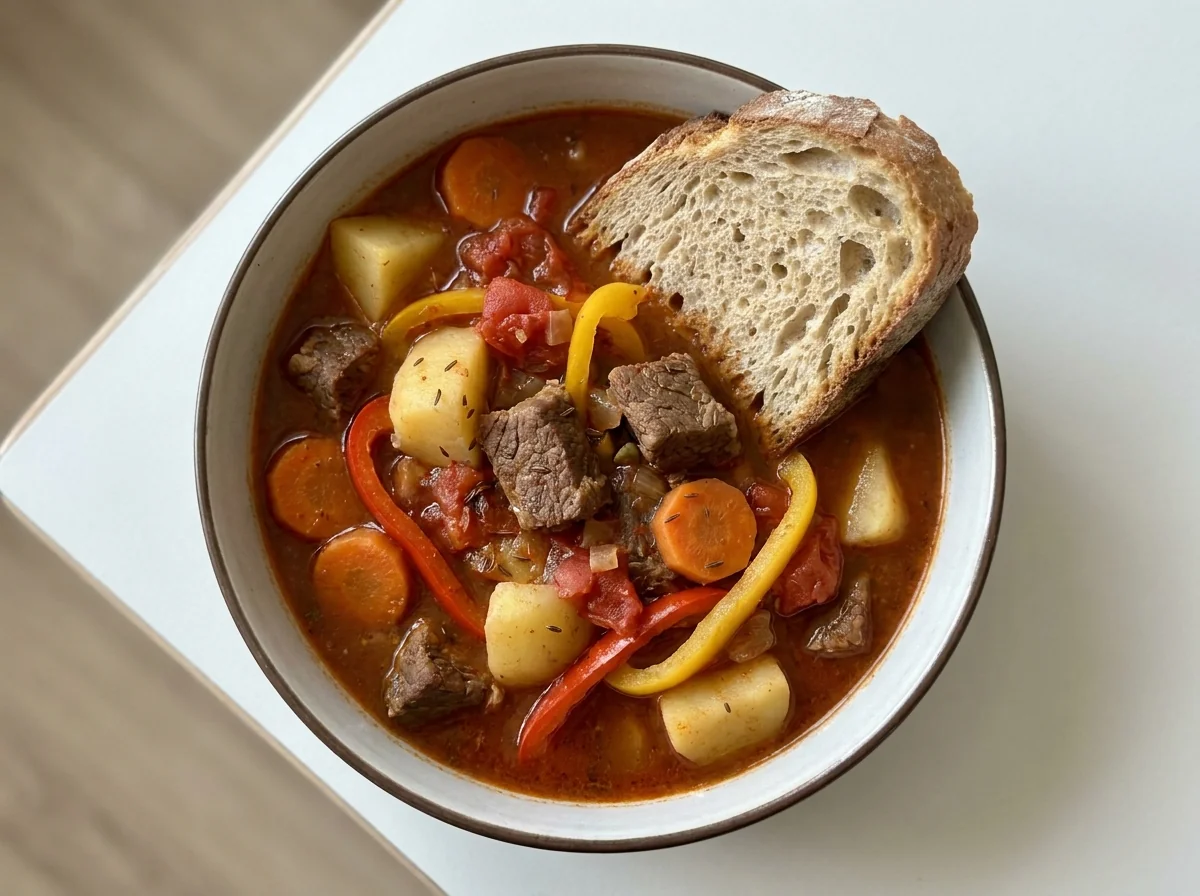
Goulash is Hungary's national dish, and its origin is from the cattle herders who used to cook meat in pots over open fire on the plains. Its name derives from the word gulyas, meaning cattle herder.
It evolved with the entry of paprika into Hungarian cuisine, which became its distinctive flavor. The authentic version is a meat stew with paprika, vegetables, and potatoes whose consistency is between soup and stew, and it differs entirely from the American dish that carries the same name and is cooked with pasta.
Preparation Steps
Brown the onion then the meat
In a thick-bottomed pot, heat the olive oil and stir the chopped onion over medium heat for eight minutes until it softens and turns golden. Add the salted beef cubes and brown them on all sides for five minutes.
Add the paprika over low heat
Lower the heat or lift the pot off the burner, then add the sweet paprika, garlic, and caraway and stir them for just one minute until their aroma opens up. This is an essential step in authentic goulash because paprika burns quickly over high heat and turns bitter, and it is the dish's main flavor.
Add the tomatoes and stock and cook slowly
Add the diced tomatoes, bell pepper, bay leaves, and beef stock until they cover the ingredients, bring them to a boil, then lower the heat, cover the pot, and cook for an hour and a half until the meat is tender and falls apart easily.
Add the potato and carrot
Add the diced potato and carrot and continue cooking for twenty minutes until the potato is done and absorbs the flavor of the sauce, and the goulash reaches a consistency between thick soup and stew. Taste and adjust the salt and pepper.
Serve
Remove the bay leaves and let the goulash rest for five minutes, and serve it hot in deep bowls with rustic bread.
Blood Sugar Impact
The glycemic index (GI) measures how quickly a food raises blood sugar, while the glycemic load (GL) measures how much a full serving raises it. Together they give the complete picture.
Glycemic Index
GI
42Low
Low0–55Medium56–69High70+
A low value (≤55) means a gradual rise in blood sugar — the most suitable range for diabetes and insulin resistance.
Glycemic Load
GL
12Medium
Low0–10Medium11–19High20+
Glycemic load reflects the impact of the full serving. To lower it: take half a serving, or pair the recipe with a source of protein and fiber.
Nutritional Information
Per ServingMakes 5 servings · one serving is about 690 g of raw ingredients
Calories534 kcal27%of Daily Value*
Protein35 g70%of Daily Value*
Carbohydrates36 g13%of Daily Value*
Fat27 g35%of Daily Value*
Fiber7 g25%of Daily Value*
Sodium912 mg40%of Daily Value*
Potassium1904 mg41%of Daily Value*
Phosphorus534 mg43%of Daily Value*
* Percent Daily Values are based on a 2,000-calorie diet per FDA food-label reference values — your daily needs may be higher or lower. Values are derived from the recipe's ingredients via the USDA database.
Troubleshooting
The most common problems when preparing Authentic Hungarian Paprika Goulash, and how to fix them:
It turned bitter
The paprika burned over high heat. Add it after lifting the pot off the heat and stir it for only seconds before adding the liquid.
The meat stayed tough
The cooking time was not enough or the heat was high. Choose cuts for slow cooking and cook them over low heat until they fall apart easily, and they may need more time depending on the cut.
The consistency is too watery
There was too much liquid or the lid stayed on the whole time. Uncover the pot for the last quarter hour to thicken, or mash some of the potato into the sauce.
The color is pale
The paprika is old or too little. Use fresh Hungarian paprika in a sufficient amount, as it is the source of both color and flavor.
Storage and Make-Ahead
Immediately
Served hot in deep bowls with rustic bread.
In the refrigerator
Keeps for three days in an airtight container, and its flavor improves the next day.
Freezing
Freezes for up to two months, and it is best to freeze it before adding the potato because the potato falls apart after freezing.
Tested Ingredient Substitutions
Original Ingredient
Tested Substitute
Ratio
Flavor Difference
Beef
Lamb for slow cooking
1:1
A common version with a deeper flavor
Potato
More carrot and turnip
~
To reduce the carbohydrates while keeping the consistency
Sweet paprika
A mix of sweet and a little hot paprika
~
For anyone who likes a touch of heat
Beef stock
Vegetable stock
1:1
A lighter, lower-salt alternative
How Much Does It Make? Scaling Guide
Ingredient
5 servings
2 1/2 servings
10 servings
Beef
700 g
350 g
1400 g
Onion
400 g
200 g
800 g
Potato
450 g
225 g
900 g
Stock
1200 ml
600 ml
2400 ml
EEINA Nutrition Tip
Paprika is made from dried red peppers and contains antioxidants from the carotenoid family, which dissolve in fats so the body absorbs more of them when cooked with oil or meat. On the safety side, beef should be cooked until it reaches an internal temperature of at least 63 degrees Celsius per food safety guidelines, and the slow cooking in this recipe exceeds that.
Add This Recipe to Your Plan
The EEINA app saves your favorite recipes, calculates them from their real ingredients, and shows your daily numbers toward your goal. Try it free now.
The authentic Hungarian version has a consistency between the two: thicker than soup and moister than a dry stew, and it is eaten with a spoon along with bread.
What is the difference between Hungarian and American goulash?
The Hungarian is a meat stew with paprika, vegetables, and potatoes. The American is an entirely different dish cooked with ground meat, pasta, and tomato sauce, and it has no relation to this recipe other than the name.
Why is the paprika added after lifting the pot off the heat?
Because paprika burns quickly over high heat and turns bitter, and it is the main flavor in the dish, so care is taken not to burn it.
Can it be cooked in a pressure cooker?
Yes, it shortens the time for the meat to become tender. Cook the meat stage under pressure then add the potato and carrot and finish over regular heat so they do not fall apart.