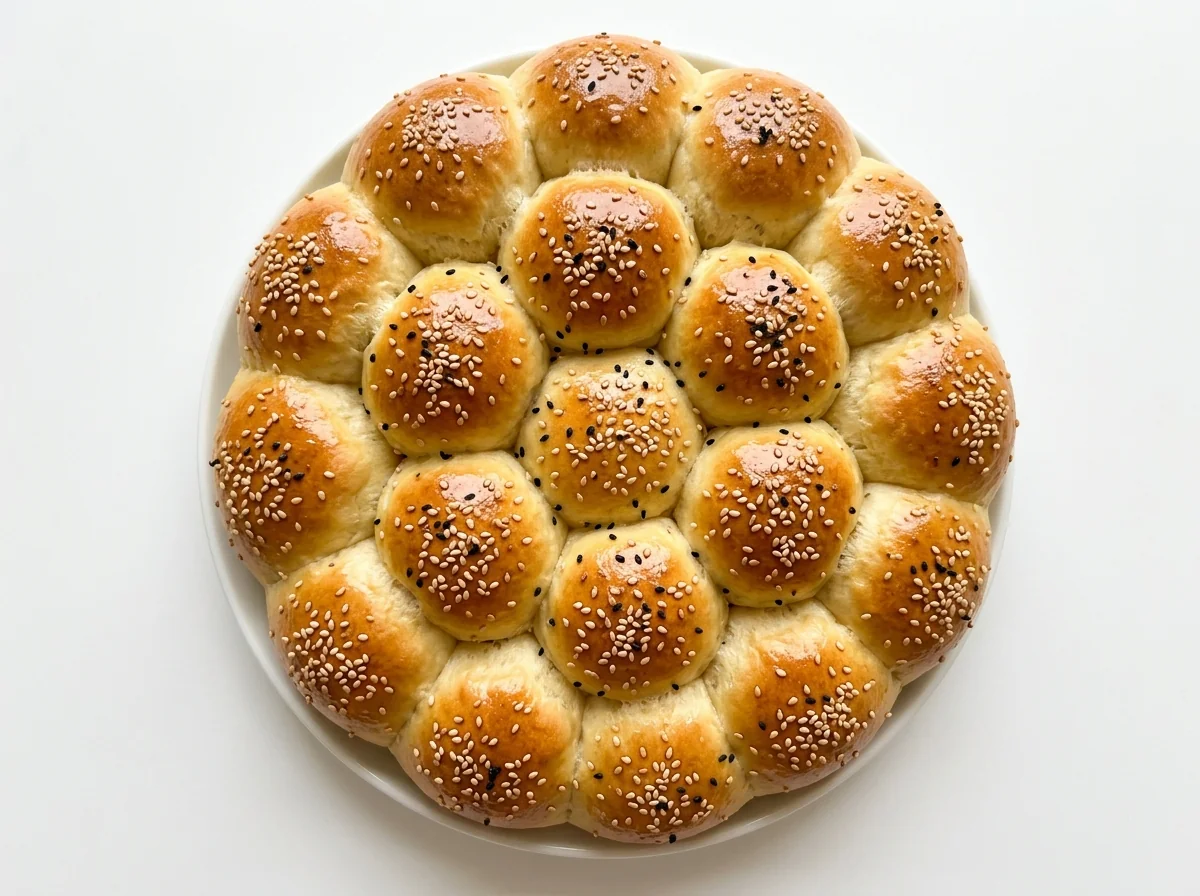
Balls of yeasted dough stuffed with cream cheese and packed side by side in a round pan until they look like a honeycomb, then brushed with egg, sprinkled with sesame, and baked at 200°C until golden.
A sweet-looking bread named after its shape: equal balls packed side by side in a round pan puff up as they bake and fuse at the edges until they look like a honeycomb.
The filling is cream cheese that stays soft inside each ball, and the top is brushed with egg and sprinkled with sesame so it comes out glossy and golden.
Preparation Steps
Knead the ingredients
Add the baking powder, yeast, vegetable oil, yogurt, salt, milk powder, and sugar over the flour, and knead with the lukewarm water.
Let the dough rise
Leave the dough for a full hour until it rises.
Shape and stuff the balls
Form balls of equal size and stuff them with the cream cheese.
Arrange in the pan
Line up the cheese-stuffed balls in a round pan greased with oil, leaving a small gap between each one and the next.
Brush the top
Brush the tops of the balls with the beaten egg and sprinkle with sesame seeds.
Bake
Place in the oven at 200°C until golden.
Blood Sugar Impact
The glycemic index (GI) measures how quickly a food raises blood sugar, while the glycemic load (GL) measures how much a full serving raises it. Together they give the complete picture.
Glycemic Index
GI
65Medium
Low0–55Medium56–69High70+
A low value (≤55) means a gradual rise in blood sugar — the most suitable range for diabetes and insulin resistance.
Glycemic Load
GL
55High
Low0–10Medium11–19High20+
Glycemic load reflects the impact of the full serving. To lower it: take half a serving, or pair the recipe with a source of protein and fiber.
Nutritional Information
Per ServingMakes 6 servings · one serving is about 335 g of raw ingredients
Calories973 kcal49%of Daily Value*
Protein37 g74%of Daily Value*
Carbohydrates89 g32%of Daily Value*
Fat52 g67%of Daily Value*
Fiber4 g14%of Daily Value*
Sodium1079 mg47%of Daily Value*
Potassium631 mg13%of Daily Value*
Phosphorus809 mg65%of Daily Value*
* Percent Daily Values are based on a 2,000-calorie diet per FDA food-label reference values — your daily needs may be higher or lower. Values are derived from the recipe's ingredients via the USDA database.
Troubleshooting
The most common problems when preparing Cream Cheese-Filled Honeycomb Bread, and how to fix them:
The dough did not rise after an hour
The water was hot and killed the yeast, or the room is cold. Use lukewarm water your hand can bear, and set the dough in a warm spot away from drafts.
The filling leaked out of the balls during baking
The ball was not sealed well or holds too much filling. Use a moderate amount, close the dough edges over the cheese, and roll the ball between your palms until the surface is smooth.
The top browned while the center is still raw
The heat is too high or the pan sits on the top rack. Move the pan to the middle of the oven, and cover it with foil if the top darkens before the inside is done.
The bottom stuck to the pan
Not enough grease. Oil the pan well as in step four, or line it with baking paper.
Storage and Make-Ahead
At room temperature
In a sealed bag for two days, though they are best eaten the same day; cheese-stuffed pastries lose their softness quickly.
Refrigerator (4°C)
Up to 4 days in a sealed container, because of the cheese filling.
Reheating
In the oven at 150°C for five minutes to bring back their softness, not in the microwave, which turns them rubbery.
Freezing
Freeze baked for up to a month in a sealed bag, and reheat straight in the oven without thawing.
Tested Ingredient Substitutions
Original Ingredient
Tested Substitute
Ratio
Flavor Difference
Cream cheese
Strained cottage cheese
540 g
Much more protein and much less fat, with a slightly less smooth texture.
White flour
Whole wheat flour
Half whole wheat, half white
More fiber; a full swap makes the dough heavy and slow to rise.
Vegetable oil
Light olive oil
165 ml
Higher in monounsaturated fat, and its flavor shows in the baked bread.
Sesame seeds
Nigella seeds
A little
A common swap in pastries, and it suits anyone with a sesame allergy.
How Much Does It Make? Scaling Guide
Servings
Flour
Cream cheese
Lukewarm water
Yeast
3 servings (half amount)
300 g
270 g
155 ml
8 g
6 servings (base)
600 g
540 g
310 ml
15 g
12 servings (double)
1200 g
1080 g
620 ml
30 g
EEINA Nutrition Tip
The small gap between the balls is a requirement, not a decoration: the dough expands as it bakes, and if the balls touch from the start they come out fused with no visible outlines. And the water must be lukewarm, not hot — high heat kills the yeast before it can work.
Add This Recipe to Your Plan
The EEINA app saves your favorite recipes, calculates them from their real ingredients, and shows your daily numbers toward your goal. Try it free now.
The source sets the temperature at 200°C and the cue is a golden top; it gives no fixed time. Watching by eye is more accurate than a timer, because the size of the balls and the thickness of the pan change the time.
Why does it have both yeast and baking powder?
That is how the source lists it. The yeast gives rise and flavor through fermentation, and the baking powder adds a quick lift as it enters the oven.
Can the dough be made the night before?
Yes. Keep it covered in the refrigerator and take it out half an hour before shaping so it returns to room temperature. The slow cold rise improves the flavor.
What is it served with?
At breakfast or with tea, and it suits the Ramadan table because it can be made ahead and reheated quickly.
Sources: USDA · University of Sydney · Our methodology · Updated on