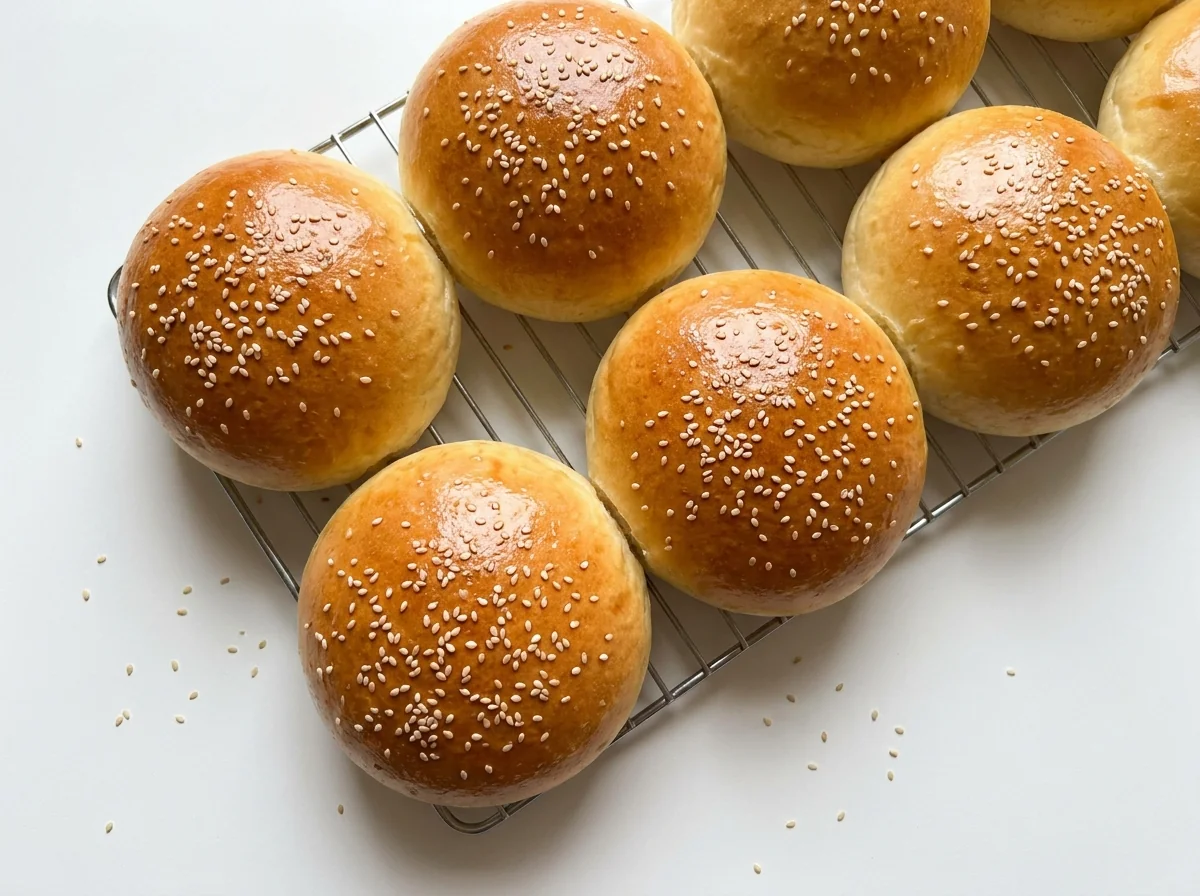
The soft burger bun with its glossy dome and sesame is half the experience of any sandwich, and making it at home is a lightened brioche dough that outdoes bags of preserved buns in tenderness and taste, serving our burgers and all our egg and chicken sandwiches.
Preparation Steps
Knead a light brioche dough
Mix the flour, yeast, sugar, and salt, add the warm milk and the egg and knead for five minutes, then the soft butter in additions and another five minutes until you have a silky, stretchy dough that extends without tearing. Its moderate richness from egg and butter is the tenderness of the bun to come.
First rise
Cover it for an hour and a quarter until doubled in an oiled bowl.
Weigh equal balls and tighten them
Divide it into eight equal pieces, since the scale is fairer than the eye, and round each piece by pulling its surface down to its base until it is a tight, smooth-topped ball: this tightening is the dome of the bun later.
Second rise and glazing the top
Arrange the balls spaced on a parchment tray and cover them for forty-five minutes until they puff up almost shoulder to shoulder. Glaze them fully with the egg-and-milk mixture and scatter the sesame.
Bake until glossy golden
In an oven preheated to 180 degrees, sixteen to eighteen minutes until they dome glossy golden like restaurant buns. Cool them fully on a rack before splitting, so their steam completes their tenderness.
Blood Sugar Impact
The glycemic index (GI) measures how quickly a food raises blood sugar, while the glycemic load (GL) measures how much a full serving raises it. Together they give the complete picture.
Glycemic Index
GI
72High
Low0–55Medium56–69High70+
A low value (≤55) means a gradual rise in blood sugar — the most suitable range for diabetes and insulin resistance.
Glycemic Load
GL
34High
Low0–10Medium11–19High20+
Glycemic load reflects the impact of the full serving. To lower it: take half a serving, or pair the recipe with a source of protein and fiber.
Nutritional Information
Per ServingMakes 8 servings · one serving is about 110 g of raw ingredients
Calories314 kcal16%of Daily Value*
Protein9 g18%of Daily Value*
Carbohydrates49 g18%of Daily Value*
Fat9 g12%of Daily Value*
Fiber2 g7%of Daily Value*
Sodium322 mg14%of Daily Value*
Potassium130 mg3%of Daily Value*
Phosphorus126 mg10%of Daily Value*
* Percent Daily Values are based on a 2,000-calorie diet per FDA food-label reference values — your daily needs may be higher or lower. Values are derived from the recipe's ingredients via the USDA database.
Troubleshooting
The most common problems when preparing Soft Homemade Burger Buns, and how to fix them:
They came out flat with no dome
Loose rounding or a second rise that overshot. The glossy tightening and shoulder-to-shoulder touching, no further. Two timing markers.
They dried out by their second day
An over-long bake or a late wrap. Lift them at the first full golden and wrap them tightly the moment they cool; their butter guards two days.
The sesame deserted the top
A stingy glaze. The full egg mixture is its glue, and scatter over a wet glaze, not a dry one.
The bottom paled while the top finished
A high tray. The middle rack, and an empty second tray beneath protects the bottoms from a harsh-bottomed oven.
Storage and Make-Ahead
At room temperature
Two days in a sealed bag fully tender.
In the freezer
Split and ready two months. From freezer to toaster: a month of buns from a single batch.
Reviving on the third day
A spritz of water and three minutes in a hot oven. They come back as fresh.
Tested Ingredient Substitutions
Original Ingredient
Tested Substitute
Ratio
Flavor Difference
Half the flour
fine whole-wheat flour
1:1 for the half
A browner bun that suits a healthy burger
Sesame
nigella seeds or rolled oats
~
Alternative tops for a sesame allergy
Bun size
twelve small balls
~
Slider buns for children and hosting
Their destination in our kitchen
grilled chicken burger and egg sandwich
~
All our sandwich bases are elevated by them
How Much Does It Make? Scaling Guide
Ingredient
8 rounds
4 rounds
16 rounds
Flour
450 g
225 g
900 g
Milk
200 ml
100 ml
400 ml
butter
50 g
25 g
100 g
EEINA Nutrition Tip
Round by pulling the surface down to the base until the ball is glossy and tight. This tightening is the engineering of the dome: a tight surface traps the puffing so it domes upward; a slack ball puffs sideways into a flat bun that shies before the filling.
Add This Recipe to Your Plan
The EEINA app saves your favorite recipes, calculates them from their real ingredients, and shows your daily numbers toward your goal. Try it free now.
Market bags are preserved with emulsifiers that stretch their shelf life for weeks, while your bun is fresh brioche whose bread you can smell: the difference at the first bite needs no explanation.
Why is it counted on the breakfast axis?
It is the base of the morning egg-and-cheese sandwich and its siblings. The morning bun before it is the dinner bun.
Should I cut its sugar?
Down to twenty grams safely. Its light sweetness balances the savory and browns the top, and below that it loses its brioche character.
How much does the Friday batch save?
Sixteen frozen buns for the price of a single premium bag, and a month of sandwiches with a tenderness the shelf does not know.