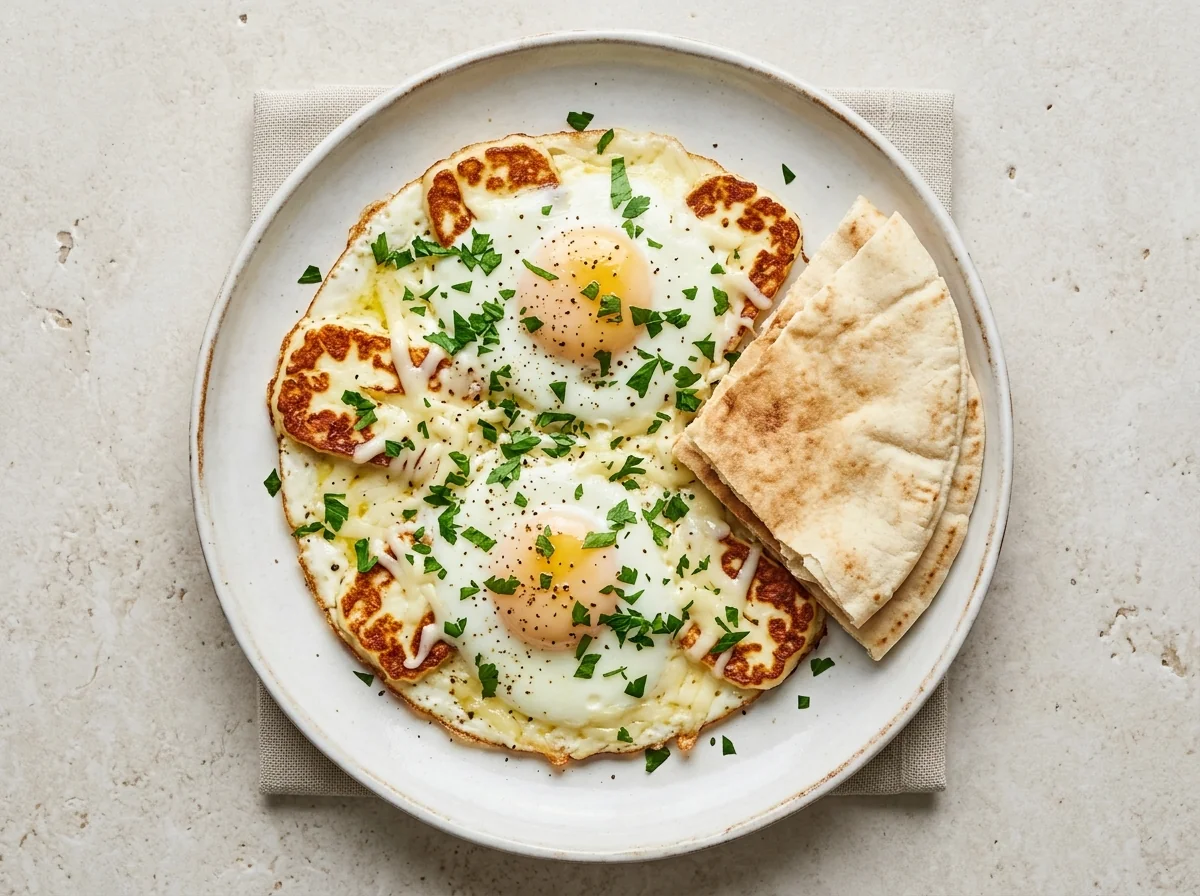
Two eggs fried sunny-side up with intact runny yolks, wrapped in slices of halloumi and strands of melted mozzarella in a single pan. A one-person breakfast plate ready in ten minutes and scooped up with Arabic bread — the protein of eggs and cheese together, without whisking or breaking the eggs apart.
Our library has scrambled eggs with halloumi and tomato in the Levantine style, and this Sayidaty Kitchen plate takes the same pairing in the opposite direction: the eggs stay fried sunny-side up with intact runny yolks, the halloumi softens in slices around them, and the mozzarella pulls its strands over the whites.
We kept the source's butter-and-oil duo for the frying and set the halloumi at fifty grams for a single-person plate.
Preparation Steps
Slice the halloumi and prepare the parsley
Cut the halloumi into two even slices half a centimeter thick so they heat in the pan at the same rate, and finely chop the parsley, setting it aside for serving.
Melt the butter with the oil
Melt the butter in a small pan over medium heat for about half a minute, then add the vegetable oil and swirl the pan until the base is coated. The oil raises the butter's burning point so it fries without blackening.
Fry the eggs sunny-side up
Crack the two eggs into the pan side by side and sprinkle the black pepper over them. Nudge the edges of the whites gently with a spoon for about two minutes, without touching the yolks, until the whites set and turn opaque while the yolks stay liquid and glossy.
Add the cheese and cover until it melts
Arrange the halloumi slices around the eggs and scatter the mozzarella over the whites, avoiding the yolks. Gently fold the edges of the whites into the cheese with a spoon without breaking the yolks, then cover the pan for one to two minutes on the same heat until the mozzarella pulls into strands and the halloumi softens with browning edges.
Scatter the parsley and serve with bread
Take the pan off the heat, scatter the chopped parsley, and move the dish to a serving plate right away. Eat hot, scooped up with Arabic bread — halloumi toughens as it cools, and the runny yolk is the peak of the plate.
Blood Sugar Impact
The glycemic index (GI) measures how quickly a food raises blood sugar, while the glycemic load (GL) measures how much a full serving raises it. Together they give the complete picture.
Glycemic Index
GI
53Low
Low0–55Medium56–69High70+
A low value (≤55) means a gradual rise in blood sugar — the most suitable range for diabetes and insulin resistance.
Glycemic Load
GL
19Medium
Low0–10Medium11–19High20+
Glycemic load reflects the impact of the full serving. To lower it: take half a serving, or pair the recipe with a source of protein and fiber.
Nutritional Information
Per ServingMakes 1 servings · one serving is about 190 g of raw ingredients
Calories521 kcal26%of Daily Value*
Protein26 g52%of Daily Value*
Carbohydrates36 g13%of Daily Value*
Fat30 g38%of Daily Value*
Fiber1 g4%of Daily Value*
Sodium1141 mg50%of Daily Value*
* Percent Daily Values are based on a 2,000-calorie diet per FDA food-label reference values — your daily needs may be higher or lower. Values are derived from the recipe's ingredients via the USDA database.
Troubleshooting
The most common problems when preparing Halloumi Fried Eggs, and how to fix them:
The yolk broke when cracking into the pan
Crack each egg into a small cup first, then pour it from just above the pan's surface — pouring from a height is what breaks the yolk.
The halloumi came out tough and rubbery
It heated too long or cooled on the plate. Keep it to one or two minutes under the lid and serve immediately — halloumi toughens the longer it cools.
The whites cooked but the top stayed translucent
The pan had no lid, so the steam never reached the top. Cover for the final minute, or splash a teaspoon of water at the pan's edge before covering — the rising steam cooks the surface.
The plate is too salty
Halloumi and mozzarella are salty by nature. Let the halloumi's own saltiness season the eggs on its own, and anyone who finds it salty should drop any added salt entirely.
Storage and Make-Ahead
Right away
Serve hot from the pan — the runny yolk and soft halloumi do not tolerate waiting.
Do not store
Fried eggs dry out on reheating and halloumi toughens when chilled. Making it from scratch takes ten minutes, so cook it fresh each time.
Tested Ingredient Substitutions
Original Ingredient
Tested Substitute
Ratio
Flavor Difference
Butter with vegetable oil
Olive oil alone
5 g + 5 ml → 10 ml
Unsaturated fat instead of saturated, and the butter flavor is lost.
Mozzarella
Omit it entirely
—
Slightly less fat and sodium, and the halloumi remains the star of the plate; only the stretching cheese strands are lost.
Halloumi
Low-fat halloumi
1:1
Less fat and fewer calories with a comparable texture, and it softens just as fast.
White Arabic bread
Whole wheat Arabic bread
1:1
More fiber and longer fullness at roughly the same calories.
How Much Does It Make? Scaling Guide
Ingredient
1 person
2 people
4 people
Eggs
2 eggs (50 g)
4 eggs (200 g)
8 eggs (400 g)
Halloumi
50 g
200 g
400 g
Mozzarella
15 g
30 g
60 g
Butter and oil
5 g + 5 ml
10 g + 10 ml
15 g + 15 ml (wide pan)
EEINA Nutrition Tip
Covering the pan in the final minute is what melts the mozzarella and steams the top of the whites without flipping the eggs, so the yolk comes out liquid and the surface cooked at once. If you prefer a set yolk, add one more minute under the lid. And we add no salt at all — the halloumi's saltiness carries the whole plate; for a milder version, soak the halloumi slices in cold water for ten minutes before cooking.
Add This Recipe to Your Plan
The EEINA app saves your favorite recipes, calculates them from their real ingredients, and shows your daily numbers toward your goal. Try it free now.
How is this plate different from the scrambled eggs with halloumi in our library?
The method, not the ingredients: there the eggs are scrambled into curds folded around browned halloumi cubes with tomato; here the eggs stay fried sunny-side up with runny yolks, the halloumi softening in slices around them with melted mozzarella.
Should the halloumi be browned before adding?
The source adds it in slices directly, so it softens in the pan's heat and browns where it touches the base. For a fully browned crust, sear the slices in the pan a minute per side before cracking the eggs, then return them on top.
Does it work for suhoor?
Yes; the protein of eggs and cheese together sustains fullness through the fasting hours, and prep is fifteen minutes in one pan.
Why butter and oil together?
The butter is for flavor and the oil raises its burning point, so the eggs fry over medium heat without the butter blackening and passing on a burnt taste.