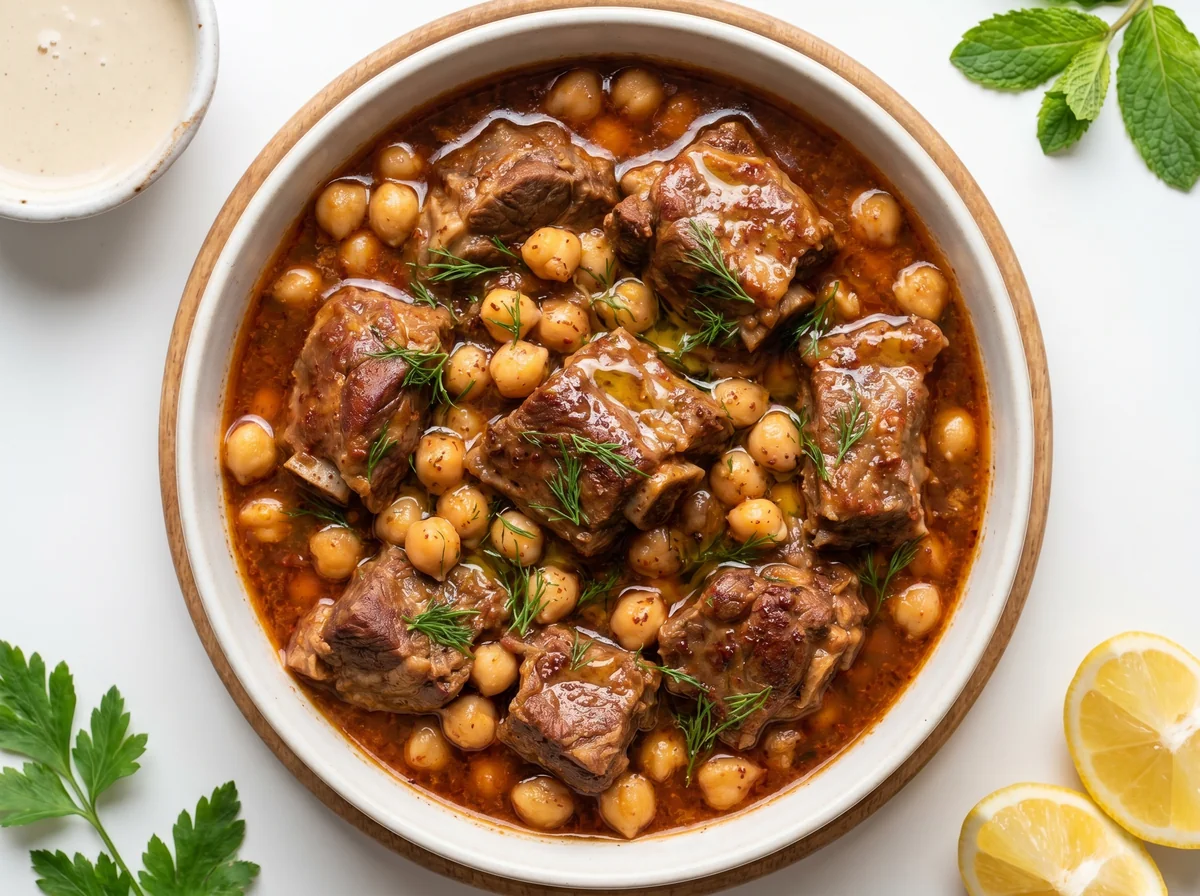
A Gazan celebratory dish — Swiss chard, chickpeas, and meat cooked in a sumac (tart purple spice) and tahini sauce with dill and hot chilli. Rich in flavour and perfect for feasts, low glycaemic load, and contains sesame and gluten.
Sumaghiyya is a venerable Gazan Palestinian celebratory dish and an icon of Gazan cuisine, named after sumac (tart purple spice), the essential tart spice it uses. Swiss chard, chickpeas, and meat are combined in a rich sauce of sumac water and tahini, seasoned with the Gazan hot spice paste (garlic, dill, and hot chilli).
It is prepared especially for Eid al-Adha and special occasions, and distributed to family and neighbours (a dish of generosity and solidarity). Its uniquely tangy sumac-tahini-dill flavour sets it apart from every other dish, and it is a symbol of Gaza's culinary identity, generosity, and resilience — a dish that carries the city's memory and heritage.
Preparation Steps
Cook the meat and chickpeas
Cook the meat until tender (with onion and spices), then reserve the broth. Use pre-cooked chickpeas. Tender meat and chickpeas are the foundation of Sumaghiyya — Gaza's rich celebratory dish.
Soak the sumac
Soak the sumac (tart purple spice) in warm water, then strain and reserve the deep-red tart liquid (discard the pulp). The sumac water is the soul of Sumaghiyya and its distinctive tart flavour (the name comes from it). sumac is packed with antioxidants.
Make the sumac and tahini sauce
Mix the sumac water with the tahini, flour (for thickening), and water until a smooth sauce forms. The tahini and flour thicken the sauce and give it its rich body. This tangy, creamy combination is what makes Sumaghiyya unique.
Sauté and wilt the chard
Sauté the chopped Swiss chard in olive oil until wilted, then add the spiced paste (crushed garlic, dill, and hot chilli) and stir. Dill and hot chilli are distinctive Gazan flavours that give Sumaghiyya its character.
Combine and cook
Add the meat, chickpeas, and the sumac-tahini sauce to the chard, then stir over low heat until the mixture thickens, comes together, and reaches a gentle boil (tahini and flour thicken it). Stir continuously to prevent the tahini from sticking. Taste and adjust tartness and salt.
Serve
Pour the Sumaghiyya into bowls and let it cool slightly (it is eaten warm or at room temperature — it firms up when cold). Serve with bread. This is a famous Gazan celebratory dish, prepared especially for Eid and special occasions and distributed to family and neighbours (a dish of generosity and solidarity). Its uniquely tangy sumac-tahini-dill flavour makes it an icon of Gazan cuisine — a symbol of Gaza's generosity, heritage, and resilience.
Blood Sugar Impact
The glycemic index (GI) measures how quickly a food raises blood sugar, while the glycemic load (GL) measures how much a full serving raises it. Together they give the complete picture.
Glycemic Index
GI
28Low
Low0–55Medium56–69High70+
A low value (≤55) means a gradual rise in blood sugar — the most suitable range for diabetes and insulin resistance.
Glycemic Load
GL
3Low
Low0–10Medium11–19High20+
Glycemic load reflects the impact of the full serving. To lower it: take half a serving, or pair the recipe with a source of protein and fiber.
Nutritional Information
Per ServingMakes 6 servings · one serving is about 145 g of raw ingredients
Calories441 kcal22%of Daily Value*
Protein23 g46%of Daily Value*
Carbohydrates19 g7%of Daily Value*
Fat33 g42%of Daily Value*
Fiber9 g32%of Daily Value*
Sodium384 mg17%of Daily Value*
* Percent Daily Values are based on a 2,000-calorie diet per FDA food-label reference values — your daily needs may be higher or lower. Values are derived from the recipe's ingredients via the USDA database.
Troubleshooting
The most common problems when preparing Gazan Sumaghiyya, and how to fix them:
The sauce did not thicken
Not enough tahini or flour. Mix the sumac water with tahini and flour, and let the mixture simmer gently while stirring until thickened — these are what give Sumaghiyya its rich, thick consistency.
The tahini curdled or stuck
Heat was too high or it was not stirred. Stir continuously over low heat once the tahini is added (it separates and sticks at high heat without stirring). Gentle heat and constant stirring give a smooth sauce.
Not tart enough
Not enough sumac water. sumac is the soul of Sumaghiyya, so add more sumac-infused water until it is refreshingly tangy (it is naturally a tart dish). Soak enough sumac.
Bitter or earthy taste
Poor-quality sumac or old tahini. Use good sumac (tart, not earthy) and fresh tahini, and strain the sumac seeds well (the seeds cause bitterness — use only the liquid).
Tough meat
Not cooked long enough. Cook the meat until fully tender before adding (an hour, or use a pressure cooker) — chard and chickpeas cook faster. Tender meat is essential.
Storage and Make-Ahead
Refrigerator (4°C)
Store in an airtight container in the refrigerator for 3 days — the flavour improves as the sumac and garlic deepen. It firms up when cold, so reheat gently with a splash of water. Eaten warm or at room temperature.
Freezer
Freeze for two to three months in an airtight container (holds up well). Thaw and reheat gently, stirring as it warms. Practical for preparing large Eid batches (traditionally distributed).
Meal prep
Cook the meat and chickpeas and soak the sumac in advance, then assemble the Sumaghiyya at serving time. The flavour improves with resting, making it ideal for preparing ahead for Eid and special occasions.
Food safety
Cook the meat until fully done, cool the dish quickly, and do not leave it out of the refrigerator for more than two hours. Wash the chard well (it traps soil), and use fresh tahini.
Tested Ingredient Substitutions
Original Ingredient
Tested Substitute
Ratio
Flavor Difference
Meat
Reduce it or make a vegetarian version (more chickpeas)
As desired
More chickpeas makes it lighter and more plant-protein-dependent, or use chicken instead of red meat
Swiss chard
Spinach or molokhia
Same quantity
Chard is traditional; spinach is a milder alternative — both are leafy greens that suit the tangy sauce
Thickening flour
Cornstarch (gluten-free)
1 tablespoon
Makes the dish gluten-free (sesame from tahini remains) and thickens the sauce in the same way
How Much Does It Make? Scaling Guide
Servings
Meat
Swiss chard
Sumac
3 (half recipe)
250 g
half a bunch
1/4 cup
6 (base)
500 g
1 bunch
1/2 cup
12 (holiday)
1 kg
2 bunches
1 cup
EEINA Nutrition Tip
Sumaghiyya is a balanced, nourishing dish: Swiss chard is a leafy green rich in iron and vitamins; chickpeas provide plant protein and fibre; meat provides protein; tahini provides healthy fats and calcium; sumac (tart purple spice) is rich in antioxidants (and its tartness helps iron absorption); and the glycaemic load is low. The challenge is the tahini, olive oil (calorie-dense), and sodium. Adjust the tahini and salt. A relatively balanced celebratory dish.
Add This Recipe to Your Plan
The EEINA app saves your favorite recipes, calculates them from their real ingredients, and shows your daily numbers toward your goal. Try it free now.
A Gazan Palestinian celebratory dish of Swiss chard, chickpeas, and meat in a rich sauce of sumac water and tahini, seasoned with the hot spice paste (garlic, dill, and chilli). Named after sumac (tart purple spice), it is prepared for Eid and distributed to family — an icon of Gazan cuisine.
What is sumac and what role does it play?
Sumac (tart purple spice) is a tart red spice made from the berries of the sumac tree (rich in antioxidants). In Sumaghiyya, sumac is soaked in water and the deep-red tart liquid is strained out to form the base of the sauce (the dish is named after it). Its unique tartness defines Sumaghiyya and sets it apart.
Is Sumaghiyya healthy?
Yes, it is balanced and nourishing: chard provides iron and vitamins; chickpeas provide plant protein and fibre; meat provides protein; tahini provides healthy fats; sumac is antioxidant-rich (and its tartness improves iron absorption); and the glycaemic load is low. The challenge is tahini, oil, and sodium — adjust them. A nourishing celebratory dish.
Is it eaten warm or cold?
It is eaten warm or at room temperature — it firms up when cold (tahini and flour thicken it). The flavour improves with resting, so cold after a few hours is delicious. Traditionally distributed at Eid at room temperature, scooped with bread.
Sources: University of Sydney · Gulf GSO · Our methodology · Updated on