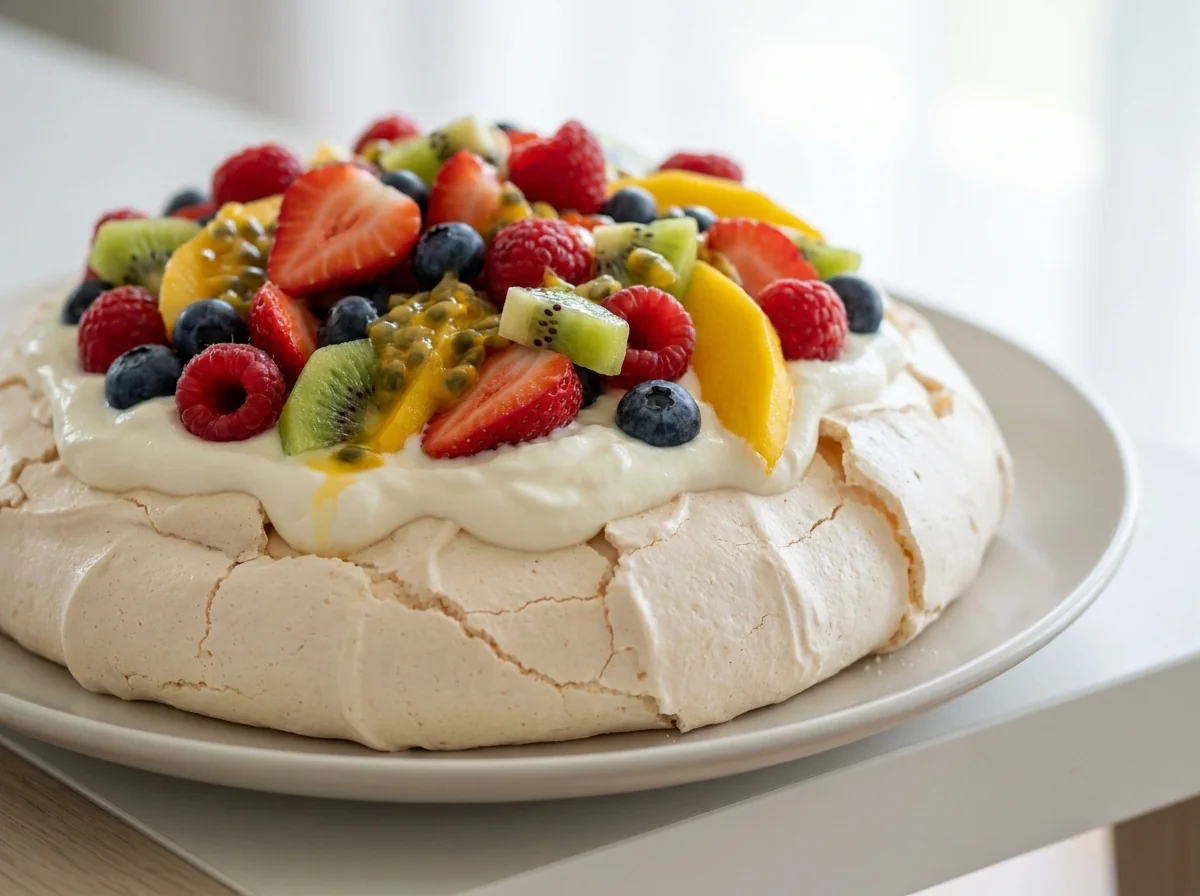
A festive dessert named in honor of the ballerina Anna Pavlova, a meringue disc crisp on the outside and soft inside, crowned with cream and fruit.
EEINA's version uses Greek yogurt instead of heavy cream to lighten the richness.
Preparation Steps
Heat the oven
Heat the oven to 120 degrees Celsius, line a tray with baking paper, and draw a circle as a guide, because the low heat dries the meringue without burning it.
Whip the whites
Whip the egg whites with the salt to soft peaks, as room-temperature whites give greater volume and better stability.
Add the sugar
Add the sugar a spoonful at a time while continuing to whip until firm glossy peaks, because the gradual addition dissolves the sugar so it does not stay grainy.
Add the stabilizers
Add the cornstarch, vinegar, and vanilla and whip gently until combined, as the starch and vinegar give the pavlova a soft center under a crisp shell.
Shape the disc
Spread the meringue inside the drawn circle and make a slight hollow in the center, because the hollow holds the cream and fruit later.
Bake
Bake about 75 minutes until the shell dries and becomes firm to the touch without changing color, as the pale white color is the sign of correct baking.
Cool slowly
Turn off the oven and leave the pavlova inside with the door ajar until it cools completely, because sudden cooling cracks the shell.
Prepare the cream layer
Whip the Greek yogurt or cream until smooth, and spread it in the hollow of the cooled pavlova.
Add the fruit
Arrange the fresh sliced fruit generously over the cream layer, as the varied colors give the dish its joyful look.
Serve
Serve the pavlova immediately after garnishing, because the shell begins to absorb moisture and softens over time.
Blood Sugar Impact
The glycemic index (GI) measures how quickly a food raises blood sugar, while the glycemic load (GL) measures how much a full serving raises it. Together they give the complete picture.
Glycemic Index
GI
61Medium
Low0–55Medium56–69High70+
A low value (≤55) means a gradual rise in blood sugar — the most suitable range for diabetes and insulin resistance.
Glycemic Load
GL
21High
Low0–10Medium11–19High20+
Glycemic load reflects the impact of the full serving. To lower it: take half a serving, or pair the recipe with a source of protein and fiber.
Nutritional Information
Per ServingMakes 8 servings · one serving is about 135 g of raw ingredients
Calories178 kcal9%of Daily Value*
Protein6 g12%of Daily Value*
Carbohydrates35 g13%of Daily Value*
Fat2 g3%of Daily Value*
Fiber1 g4%of Daily Value*
Sodium94 mg4%of Daily Value*
* Percent Daily Values are based on a 2,000-calorie diet per FDA food-label reference values — your daily needs may be higher or lower. Values are derived from the recipe's ingredients via the USDA database.
Troubleshooting
The most common problems when preparing Pavlova with Fruit, and how to fix them:
The pavlova cracked
It cooled too fast or the whites were over-whipped. Let it cool inside the switched-off oven gradually, and some cracking is natural and gets covered by the fruit.
Syrup is leaking from the meringue
The sugar did not dissolve well. Add it more slowly and whip until you no longer feel its grains between your fingers.
The disc is sticky on the outside
The humidity is high or the baking was short. Extend the baking time and avoid making it on a very humid day.
The center is dry, not soft
The baking time was too long. Reduce the time slightly and rely on the firmness of the shell, not the color.
Storage and Make-Ahead
The meringue disc
Keep the undecorated meringue disc in an airtight container at room temperature for up to two days, away from moisture.
After decorating
Serve as soon as the cream and fruit are added, as the decorated disc softens within hours.
Freezing
Freezing the pavlova is not recommended, because its fragile texture is ruined.
Tested Ingredient Substitutions
Original Ingredient
Tested Substitute
Ratio
Flavor Difference
Whipping cream
Full-fat Greek yogurt
1:1
Lightens the richness and adds a pleasant tartness that balances the sweetness of the meringue.
White vinegar
Fresh lemon juice
1:1
Plays the same role in stabilizing the meringue and gives a light aroma.
Caster sugar
Lightly ground regular sugar
1:1
Dissolves slower; grind it a little to bring it closer to the fineness of caster sugar.
How Much Does It Make? Scaling Guide
Ingredient
2 servings
4 servings
8 servings (base)
Egg whites
38 g
75 g
150 g
Caster sugar
50 g
100 g
200 g
Cornstarch
3 g
5 g
10 g
Mixed fruit
100 g
200 g
400 g
EEINA Nutrition Tip
The secret to a successful pavlova is slow cooling inside the switched-off oven, as the sudden move from heat to cold causes the shell to crack and shrink.
Add This Recipe to Your Plan
The EEINA app saves your favorite recipes, calculates them from their real ingredients, and shows your daily numbers toward your goal. Try it free now.