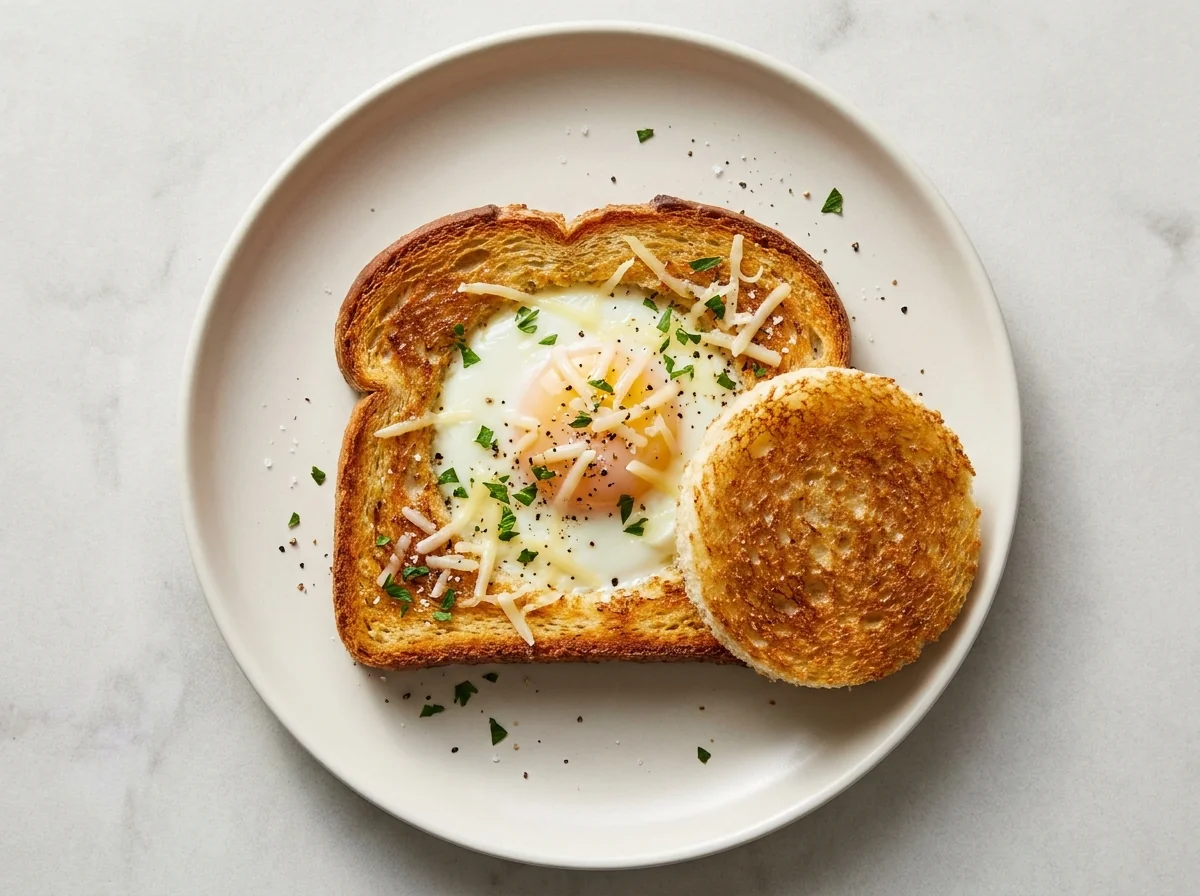
The egg in its nest, or 'egg in a basket' as the Western kitchens call it.
One of the most charming and fastest international breakfast dishes: a window in the toast cradling an egg that cooks with it in a single skillet. A beloved morning trick, especially for children.
Preparation Steps
Open the window of the nest
With a small cup or a round cutter, cut a circle from the heart of each toast slice. Keep the cut-out circle, as it is the 'nest lid' and we will toast it beside it, so nothing of the bread is wasted.
Toast the first side in butter
In a wide skillet, melt half the butter over gentle medium heat and place the two slices and their circles, a minute until the bottom side turns golden, then flip everyone and spread the rest of the butter.
Crack the egg into the window
Crack an egg into the heart of each window from up close, so the white settles in the frame of the bread and the yolk in its center, a sun in its nest, and sprinkle the salt and pepper.
Cook covered until the nest sets
Cover the skillet for three to four minutes over gentle heat. The trapped steam cooks the top of the egg while the bread crisps underneath, so we gain a firm white and a soft yolk with no dangerous flip.
Serve it with its lid
Move each nest with a wide spatula to its plate and tuck the toasted circle beside it for dipping in the yolk, and scatter the cheese and parsley. The single-skillet breakfast that the little ones laugh at and that speeds the grown-ups' morning.
Blood Sugar Impact
The glycemic index (GI) measures how quickly a food raises blood sugar, while the glycemic load (GL) measures how much a full serving raises it. Together they give the complete picture.
Glycemic Index
GI
50Low
Low0–55Medium56–69High70+
A low value (≤55) means a gradual rise in blood sugar — the most suitable range for diabetes and insulin resistance.
Glycemic Load
GL
7Low
Low0–10Medium11–19High20+
Glycemic load reflects the impact of the full serving. To lower it: take half a serving, or pair the recipe with a source of protein and fiber.
Nutritional Information
Per ServingMakes 2 servings · one serving is about 110 g of raw ingredients
Calories272 kcal14%of Daily Value*
Protein14 g28%of Daily Value*
Carbohydrates17 g6%of Daily Value*
Fat16 g21%of Daily Value*
Fiber3 g11%of Daily Value*
Sodium486 mg21%of Daily Value*
Potassium178 mg4%of Daily Value*
Phosphorus219 mg18%of Daily Value*
* Percent Daily Values are based on a 2,000-calorie diet per FDA food-label reference values — your daily needs may be higher or lower. Values are derived from the recipe's ingredients via the USDA database.
Troubleshooting
The most common problems when preparing Egg in a Toast Nest in the Skillet, and how to fix them:
The bread burned and the egg is raw
High heat. Gentle medium heat turns the bread golden and cooks the egg at the same timing. This is the whole equation of the dish.
The white ran outside the window
A small window or a thin slice. A circle seven centimeters in diameter and thick toast make a wall that holds.
The yolk broke at cracking
We cracked from a height. Crack the egg into a cup first, then slide it into the window in complete safety.
The bottom of the nest soaked through and did not crisp
Too little butter or a lukewarm skillet. Heat it beforehand and grease it with butter on both sides.
Storage and Make-Ahead
Immediately
The nest is eaten hot and its yolk glistens. A dish of the moment.
Not stored
The bread softens and the egg sets firm. Made fresh in its eight minutes.
Smart prep
The slices with the windows cut out tolerate freezing. From the bag straight to the skillet on a rushed morning.
Tested Ingredient Substitutions
Original Ingredient
Tested Substitute
Ratio
Flavor Difference
Whole-wheat toast
A thick slice of rustic bread
1:1
A grander nest with the same idea
Butter
Olive oil
1:1
Lighter, and butter gives a more fragrant crisp
Grated cheese
A slice of melting cheese placed in the last minute
~
A melted lid over the nest
The soft top of the egg
A final flip for a few seconds
~
For whoever wants a fully cooked yolk for the little ones
How Much Does It Make? Scaling Guide
Ingredient
2 servings
1 serving
4 servings
Toast
2 slices
1 slice
4 slices
Eggs
2
1
4
Butter
20 g
10 g
40 g
EEINA Nutrition Tip
Gentle heat and the lid is a must. The lid cooks the top of the egg with its steam so it sets without flipping the nest upside down; uncovered forces you to flip it, so the yolk breaks in its finest moments.
Add This Recipe to Your Plan
The EEINA app saves your favorite recipes, calculates them from their real ingredients, and shows your daily numbers toward your goal. Try it free now.
How does it differ from scrambled-egg toast (savory French toast)?
There the bread is dipped in beaten egg and the whole thing is fried; here the egg keeps its full shape and sits in the window of the bread and they cook together. An egg that shows its eye, not a mixture.
Can it be made in the oven for a large number?
Yes: the nests on a buttered tray in a 200°C oven for eight minutes. One tray feeds an entire family at breakfast.
How do I ensure a cooked yolk for a young child?
An extra minute under the lid or piercing the yolk with the tip of a knife before covering. It cooks fully and the nest stays a nest.
Why does it succeed with kids who refuse breakfast?
Shape comes before taste for the little ones. An egg in a window and a lid to dip is a game that whets the appetite before the first bite.