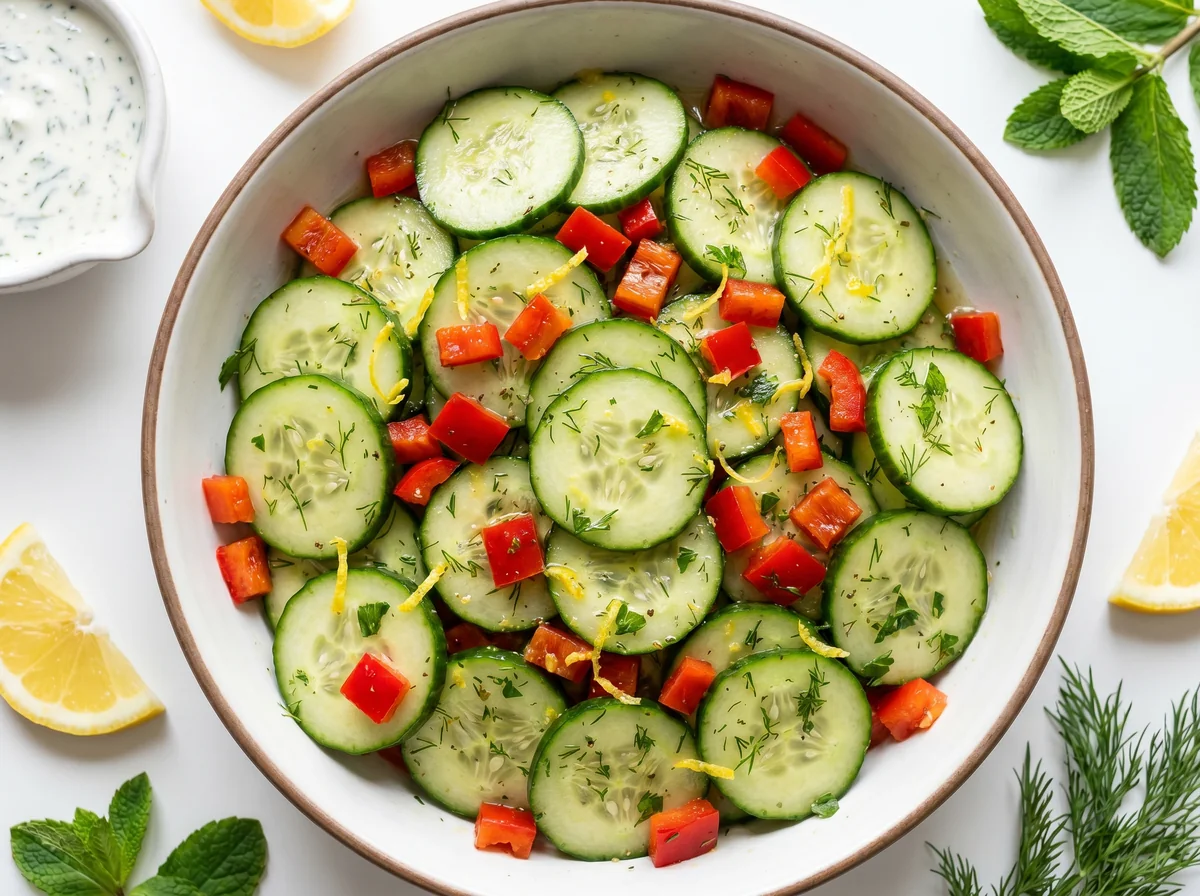
Cold crunchy salads are a fixture of the Arab table in summer heat, when people look for a refreshing dish to balance heavier fare. This version swaps the usual tomatoes for a base of sweet red pepper, giving a gentle sweetness and vibrant colour while keeping the dish light on the kidneys.
Peeled cucumber and lemon-soaked onion create a watery, crunchy texture, while the fresh herbs add an aromatic layer that makes salt unnecessary. It is a salad that proves a renal diet does not mean giving up flavour — just rearranging the ingredients cleverly.
Preparation Steps
Prepare the cucumber
Peel the cucumber completely, rinse, and slice into half-rounds 5 mm thick. Peeling removes part of the potassium concentrated in the skin while keeping the watery, crunchy flesh.
Slice the pepper and onion
Remove the seeds and white membranes from the red pepper, then slice it into thin strips about 5 mm wide. Slice the red onion very thinly so its flavour stays subtle rather than overpowering.
Soak the onion in lemon juice
Submerge the onion slices in the lemon juice for 5 minutes until they soften in colour and their sharpness mellows. This soak tames the raw onion bite and starts building the acidic dressing that compensates for salt.
Make the dressing
Whisk the lemon juice with the olive oil and black pepper in a small bowl for about a minute until the texture is uniform and glossy. The acidity gives a sense of saltiness without added sodium.
Toss the salad
Combine the cucumber, pepper, and onion in a wide bowl, add the chopped herbs, pour over the dressing, and toss gently for half a minute until every piece is coated. A light toss keeps the vegetables crunchy rather than crushing them.
Chill and serve
Cover the bowl and refrigerate for 15 minutes for the flavours to meld and the salad to chill. The brief chilling integrates the herbs and vegetables while keeping the texture fresh and crunchy. Add the minimum amount of salt to taste at serving time only.
Blood Sugar Impact
The glycemic index (GI) measures how quickly a food raises blood sugar, while the glycemic load (GL) measures how much a full serving raises it. Together they give the complete picture.
Glycemic Index
GI
15Low
Low0–55Medium56–69High70+
A low value (≤55) means a gradual rise in blood sugar — the most suitable range for diabetes and insulin resistance.
Glycemic Load
GL
1Low
Low0–10Medium11–19High20+
Glycemic load reflects the impact of the full serving. To lower it: take half a serving, or pair the recipe with a source of protein and fiber.
Nutritional Information
Per ServingMakes 4 servings · one serving is about 215 g of raw ingredients
Calories106 kcal5%of Daily Value*
Protein2 g4%of Daily Value*
Carbohydrates10 g4%of Daily Value*
Fat7 g9%of Daily Value*
Fiber3 g11%of Daily Value*
Sodium299 mg13%of Daily Value*
Potassium329 mg7%of Daily Value*
Phosphorus47 mg4%of Daily Value*
* Percent Daily Values are based on a 2,000-calorie diet per FDA food-label reference values — your daily needs may be higher or lower. Values are derived from the recipe's ingredients via the USDA database.
Troubleshooting
The most common problems when preparing Cucumber and Red Pepper Salad with Lemon and Herbs, and how to fix them:
Salad became watery and lost its crunch
Cucumber releases water over time. Toss the dressing in right before serving, not hours ahead, and if needed drain the liquid that has collected in the bottom and give it a light re-toss.
Onion taste is sharp and unpleasant
Extend the onion soak in lemon juice to ten minutes, or rinse the onion in cold water before soaking. The thinner the slices, the milder the bite.
Salad tastes dull without salt
Add a little more lemon juice, an extra pinch of black pepper, and more mint and parsley. Acidity and herbs effectively compensate for saltiness.
Herbs turned black or wilted quickly
Chop the herbs right before mixing, not long in advance, and keep them dry. Excess moisture and prolonged acid contact speed up wilting.
Red pepper too soft
Choose firm, glossy pepper and slice it just before serving. Avoid storing the dressed salad for more than a day so the pepper stays crunchy.
Storage and Make-Ahead
Refrigerator before dressing
Store the cut vegetables without dressing in an airtight container in the refrigerator for up to two days, then add the dressing at serving time to keep the crunch.
Refrigerator after dressing
The dressed salad will keep in the refrigerator for up to 24 hours, but it will gradually lose its crunch and become watery.
Advance prep
Prepare the dressing separately in a small airtight container and refrigerate for up to three days, then toss with the vegetables when needed.
Do not freeze
Never freeze this salad — cucumber and pepper are very high in water and will collapse into a soggy texture once thawed.
Tested Ingredient Substitutions
Original Ingredient
Tested Substitute
Ratio
Flavor Difference
Sweet red pepper
Green or yellow pepper
1:1
Both are relatively low in potassium and suitable for a renal diet, with a slight difference in sweetness and colour.
Red onion
Spring onion (white part)
1:1
Spring onion has a milder flavour and is used in the same quantity; use mainly the white part and reduce the green leafy part to manage potassium.
Lemon juice
Apple cider vinegar
1:1
A low-sodium acidic substitute that gives similar tanginess; start with less as it is sharper.
Mint and dill
Basil or fresh coriander
1:1
Any low-sodium fresh herb works as a substitute; choose what suits your taste without changing the total quantity.
Olive oil
Avocado oil
1:1
A neutral, low-sodium oil with a higher smoke point; keeps the dressing light without adding minerals.
How Much Does It Make? Scaling Guide
Ingredient
4 servings
8 servings
12 servings
Peeled cucumber
500 g
1000 g
1500 g
Sweet red pepper
200 g
400 g
600 g
Red onion
60 g
120 g
180 g
Lemon juice
45 ml
90 ml
135 ml
Olive oil
30 ml
60 ml
90 ml
Chopped herbs
30 g
60 g
90 g
EEINA Nutrition Tip
If you are on a strict potassium restriction, soak the peeled cucumber slices in cold water for ten minutes then drain before mixing — this leaches a little of the water-soluble potassium. Keep the portion to about one cup, because a large amount of any vegetable raises the total potassium load regardless of how low the source originally is.
Add This Recipe to Your Plan
The EEINA app saves your favorite recipes, calculates them from their real ingredients, and shows your daily numbers toward your goal. Try it free now.
It is designed to be low in sodium, potassium, and phosphorus by choosing vegetables low in these minerals and avoiding salt, pickles, and cheeses. However, permitted potassium portions differ from patient to patient depending on disease stage and test results, so use a moderate portion and consult your nephrologist and renal dietitian before including it regularly.
Why do we peel the cucumber and not leave the skin on?
Cucumber skin concentrates part of the potassium and some fibre. Peeling it slightly reduces the total potassium load, which is a useful precaution on a strict renal diet, while keeping the watery, crunchy flesh.
Can I add tomatoes to improve the flavour?
Not recommended on a renal diet. Tomatoes, especially concentrated ones, are high in potassium, and adding them raises the mineral load. Compensate for colour and flavour with more red pepper, lemon, and herbs.
How do I compensate for salt without the flavour turning dull?
Rely on acidity from lemon juice or vinegar together with fresh herbs and black pepper. This combination creates a sense of saltiness and depth without adding sodium, and it is the cornerstone of kidney-friendly cooking.
Can I use bottled lemon juice instead of fresh?
Fresh is preferred because some bottled juices contain preservatives that may add sodium or added phosphates. If you use bottled, read the label and make sure it is free from sodium and phosphate additives.