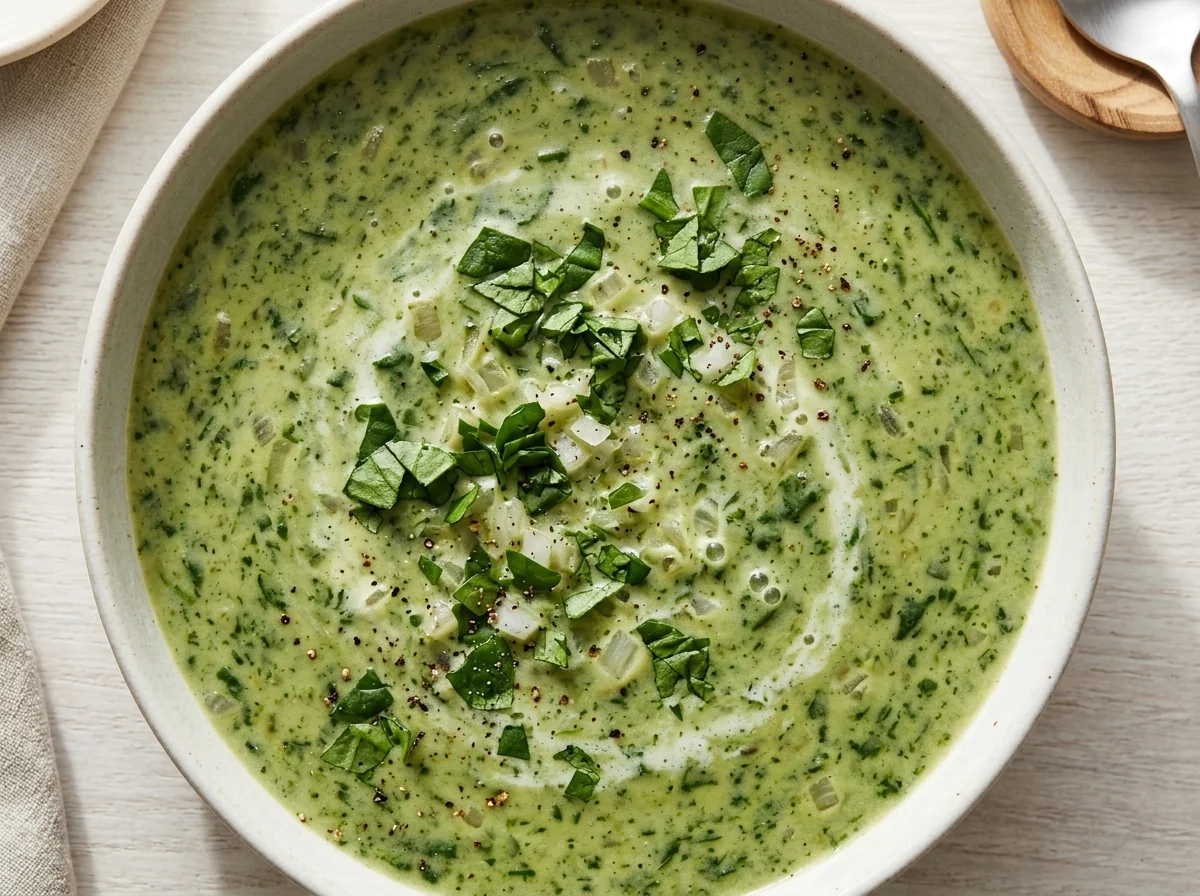
A silky spinach soup whose creamy body rests on low-fat milk instead of cream, so it comes out rich in feel yet light on the calorie count. A warm dish that brings leafy greens and dairy protein together in one bowl, well suited to anyone watching their weight.
The original, from Sayidaty Kitchen, is a classic spinach and milk soup: butter and flour, then milk.
We lightened it honestly for weight management: we replaced the 3 tablespoons of butter with a single tablespoon of olive oil, cut the flour from 4 tablespoons to 2, and used low-fat milk. The creamy body remains — the milk and the modest amount of flour build it together — while the saturated fat dropped considerably.
Preparation Steps
Soften the onion
Heat the olive oil in a large, heavy-bottomed pot over medium heat, and stir the onion for about 4 minutes until it softens and turns translucent without browning.
Wilt the spinach
Add the chopped spinach and the chicken stock, and stir for about 3 minutes until the spinach wilts and softens. Do not overcook it, so the green color stays bright.
Add the flour
Sprinkle the flour over the mixture and stir for a full minute until it is absorbed and its raw trace disappears — this minute is what prevents a raw flour taste in the finished soup.
Add the milk gradually
Pour in the low-fat milk gradually, stirring constantly, until the mixture is smooth and free of lumps. Then leave it over low heat for about 10 minutes until it thickens slightly, stirring often so the milk does not stick to the bottom.
Puree the soup
Take the pot off the heat and let the soup settle for 2 minutes, then puree it with an immersion blender until smooth, creamy, and green. With a regular blender, work in batches and let the steam vent.
Season and serve
Return the pot to low heat, season with the salt and black pepper while tasting, and heat it through without a strong boil to protect the milk. Ladle into bowls and serve hot.
Blood Sugar Impact
The glycemic index (GI) measures how quickly a food raises blood sugar, while the glycemic load (GL) measures how much a full serving raises it. Together they give the complete picture.
Glycemic Index
GI
37Low
Low0–55Medium56–69High70+
A low value (≤55) means a gradual rise in blood sugar — the most suitable range for diabetes and insulin resistance.
Glycemic Load
GL
7Low
Low0–10Medium11–19High20+
Glycemic load reflects the impact of the full serving. To lower it: take half a serving, or pair the recipe with a source of protein and fiber.
Nutritional Information
Per ServingMakes 4 servings · one serving is about 415 g of raw ingredients
Calories234 kcal12%of Daily Value*
Protein11 g22%of Daily Value*
Carbohydrates22 g8%of Daily Value*
Fat11 g14%of Daily Value*
Fiber3 g11%of Daily Value*
Sodium585 mg25%of Daily Value*
* Percent Daily Values are based on a 2,000-calorie diet per FDA food-label reference values — your daily needs may be higher or lower. Values are derived from the recipe's ingredients via the USDA database.
Troubleshooting
The most common problems when preparing Creamy Spinach and Milk Soup, and how to fix them:
The flour clumped and white lumps appeared
The milk was added all at once or without stirring. Pour it in gradually with constant stirring; if lumps appear, the blending in the final step will break them up completely.
The milk stuck to the bottom or burned
The heat was too high or the stirring too infrequent. Keep the heat low after adding the milk and stir roughly every minute. If you smell burning, transfer the soup immediately to a clean pot without scraping the bottom.
The green color faded and turned a dark olive
The spinach was cooked too long. Wilt it for only 3 minutes before the flour and milk go in, and avoid a strong boil at the end — brief cooking preserves both the color and the vitamins.
The texture is thin, not creamy
Leave it over low heat for a few extra minutes with stirring until it thickens — the flour needs enough heat to do its work. Next time, make sure to stir the flour for a full minute before the milk.
The soup is too salty
Ready-made chicken stock carries salt. Use the low-sodium kind and taste before adding any salt; if it turns out too salty, add an extra cup of milk and let it heat through.
Storage and Make-Ahead
Refrigerator (4°C)
Keep in an airtight container for up to 2 days — milk-based soups have a shorter life than stock-based ones. Reheat over low heat with constant stirring and no boil, and never leave it at room temperature for more than 2 hours.
Freezer (-18°C)
We do not recommend freezing it — soups built on milk and flour separate and turn grainy after thawing. For make-ahead, freeze the wilted spinach with the onion on its own, then finish with fresh flour and milk on serving day.
Reheating
Over low heat with constant stirring until hot, without boiling, or in the microwave for a minute and a half, stirring halfway through. If it thickens in storage, loosen it with a splash of milk.
Tested Ingredient Substitutions
Original Ingredient
Tested Substitute
Ratio
Flavor Difference
Flour
Rice flour or cornstarch
1 1/2 tablespoons
Makes the soup gluten-free with a similar texture; dissolve the starch in a little cold milk before adding it.
Low-fat milk
Skim milk
Same amount
Cuts calories further with a slightly thinner body; the flour makes up the difference in thickness.
Chicken stock
Low-sodium vegetable stock
Same amount
Makes it vegetarian for those who do not eat chicken; the flavor stays close given the small amount.
Fresh spinach
Frozen spinach
300 g after draining
Practical and always available, with its value well preserved; thaw and squeeze out the excess water before adding.
How Much Does It Make? Scaling Guide
Servings
Spinach
Milk
Flour
Onion
2 servings
2 cups (200 g)
2 cups (500 ml)
1 tablespoon
1/2 piece (55 g)
4 servings
4 cups (400 g)
4 cups (1000 ml)
2 tablespoons
1 piece (110 g)
6 servings
6 cups (600 g)
6 cups (1500 ml)
3 tablespoons
1.5 pieces (165 g)
EEINA Nutrition Tip
The secret to milk-based soups is the stirring: pour the milk in gradually and stir without stopping as you add it and afterward, because milk sticks to the bottom and burns quickly over strong heat. And a small pinch of nutmeg at serving time is a classic companion to spinach and milk that lifts the flavor without calories.
Add This Recipe to Your Plan
The EEINA app saves your favorite recipes, calculates them from their real ingredients, and shows your daily numbers toward your goal. Try it free now.
How is it different from stock-based spinach soup?
Traditional spinach soup rests on stock and gets its body from mashed potato, while this one is built on milk and a small amount of flour, so it comes out richer in feel and higher in dairy protein. Both are light options with a different calorie profile.
Why did you swap the butter for oil and cut the flour?
The original uses 3 tablespoons of butter and 4 of flour, which raise the saturated fat and calories in a dish we present for weight management. One tablespoon of olive oil and 2 tablespoons of flour create nearly the same texture, and we stated the change honestly.
Can I use plant-based milk?
Yes — unsweetened soy milk is the closest in body and protein, and oat milk gives good thickness but with more carbohydrates. Avoid sweetened varieties, which add sugar the soup does not need.
Is it suitable for children?
Yes — with its simple ingredients and mild milky flavor, it is a gentle way to serve spinach to anyone who refuses it as leaves. Reduce the black pepper for young children.