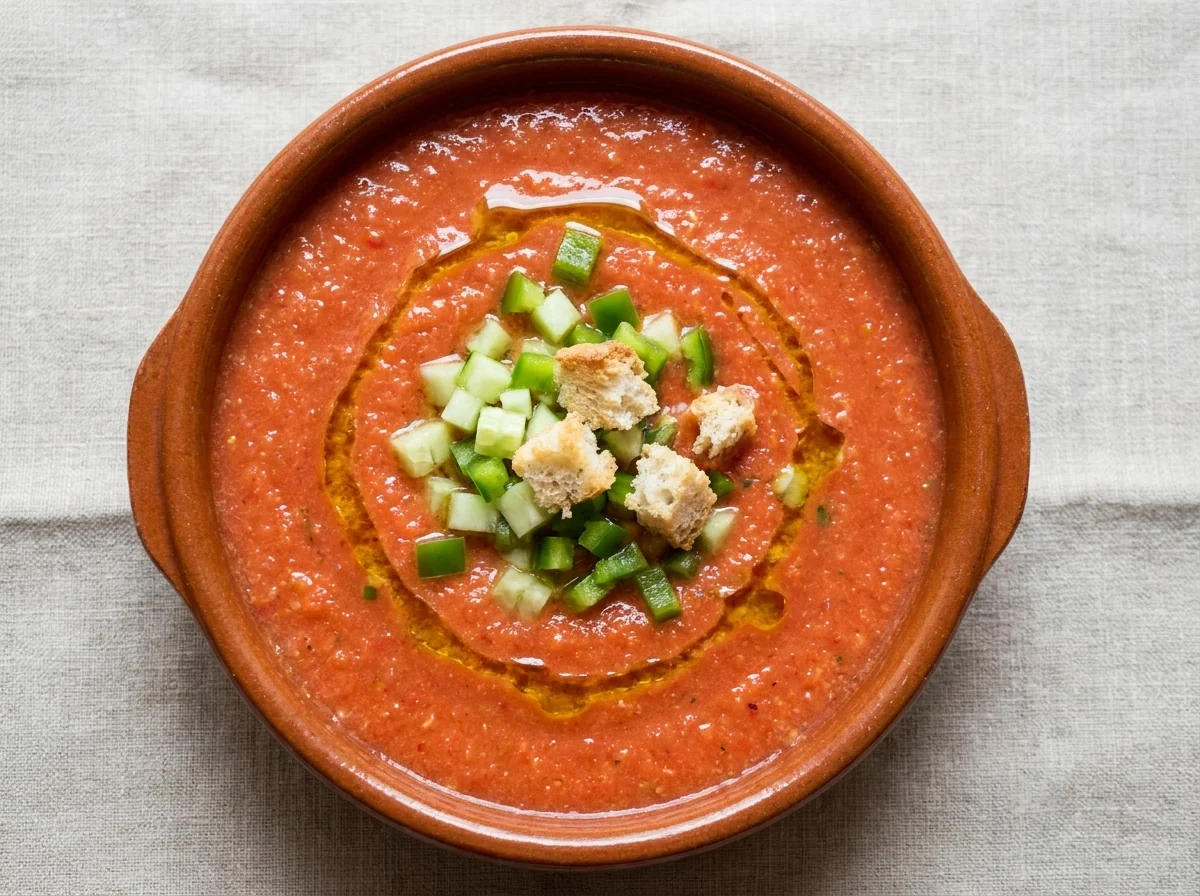
A cold soup from southern Spain, where the summer is long and hot much like ours.
Its people blend tomatoes, cucumber, and pepper with a little stale bread and olive oil, and drink it cold with no fire. We present it here in a lighter version, less bread and extra virgin olive oil, so it stays refreshing and sipped fridge-cold in the peak of the heat.
Preparation Steps
Chop and salt the vegetables
Cut the tomatoes, peeled cucumber, and green pepper into large pieces and place them in a deep bowl with the garlic clove and salt. Let them sit for ten minutes until the tomatoes release their juices; the sign is a pinkish liquid pooling at the bottom. This early salting draws out the tomato juice, enriching the soup's flavor without needing any stock.
Soak the bread
Submerge the stale bread in a little of the pooled vegetable liquid for two minutes until fully softened, then gently squeeze it. Soaked bread gives the gazpacho a smooth, cohesive texture instead of leaving it as a separated, watery liquid, and this is the authentic Andalusian method.
Blend the mixture
Place the vegetables and the squeezed bread in the blender and blend on high speed for two minutes until the mixture is completely smooth and uniform with no chunks. The sign is an even orange-pink color and a texture like thick milk.
Add the oil and vinegar
With the blender running on low speed, pour in the olive oil in a thin stream, then the vinegar. Adding the oil slowly while it runs lets it emulsify into the soup, so it turns out creamy and glossy instead of floating separately on the surface.
Strain and adjust the consistency
Pass the mixture through a medium mesh strainer to remove any skins and seeds, and add the cold water gradually until you reach a consistency you can sip with a spoon, neither thick nor watery. Taste and adjust the salt and vinegar.
Chill and serve
Cover the bowl and chill it in the refrigerator for at least an hour until it is fully cold and the flavors meld. Serve it cold in cups or deep bowls with the diced cucumber and pepper and a drizzle of olive oil on top. The sign is that it is served fridge-cold, not at room temperature, for in summer its coldness is half its delight.
Blood Sugar Impact
The glycemic index (GI) measures how quickly a food raises blood sugar, while the glycemic load (GL) measures how much a full serving raises it. Together they give the complete picture.
Glycemic Index
GI
37Low
Low0–55Medium56–69High70+
A low value (≤55) means a gradual rise in blood sugar — the most suitable range for diabetes and insulin resistance.
Glycemic Load
GL
4Low
Low0–10Medium11–19High20+
Glycemic load reflects the impact of the full serving. To lower it: take half a serving, or pair the recipe with a source of protein and fiber.
Nutritional Information
Per ServingMakes 4 servings · one serving is about 290 g of raw ingredients
Calories135 kcal7%of Daily Value*
Protein3 g6%of Daily Value*
Carbohydrates15 g5%of Daily Value*
Fat7 g9%of Daily Value*
Fiber3 g11%of Daily Value*
Sodium351 mg15%of Daily Value*
Potassium478 mg10%of Daily Value*
Phosphorus74 mg6%of Daily Value*
* Percent Daily Values are based on a 2,000-calorie diet per FDA food-label reference values — your daily needs may be higher or lower. Values are derived from the recipe's ingredients via the USDA database.
Troubleshooting
The most common problems when preparing Cold Tomato Soup (Andalusian Gazpacho), and how to fix them:
The gazpacho is watery and separated
Too little bread or not enough blending. Add a little more soaked bread and blend an extra minute until it emulsifies, for the bread and the long blending are what give it the cohesive texture.
The taste is sharp or too sour
Too much garlic or vinegar. Start with a small garlic clove and a little vinegar, then add to taste, for raw garlic intensifies after chilling.
The color is dull, not bright red
The tomatoes are not ripe enough. Choose red, soft, fragrant tomatoes, for they are the basis of color and sweetness in the absence of any cooking.
Cold but flavorless
It was not left to meld. At least an hour of chilling is essential for the flavors to combine, and tasting should be after chilling, not before, because cold dulls the perception of salt.
Storage and Make-Ahead
Refrigerator
In a sealed container or jar for two to three days; its taste improves on the second day. Stir it before serving as it tends to settle.
Freezer
Not recommended, because the raw vegetables separate and their texture changes after thawing.
Serving
Always served fridge-cold. In intense heat, add an ice cube or serve it in a bowl set over a layer of ice.
Tested Ingredient Substitutions
Original Ingredient
Tested Substitute
Ratio
Flavor Difference
Stale white bread
Stale whole wheat bread
Same weight
Gives a darker texture, deeper flavor, and more fiber, while the result stays smooth after blending.
Green bell pepper
Sweet colored peppers
Same weight
Red or yellow pepper makes the taste a little sweeter and the color brighter, while green is closer to the Andalusian original.
Red wine vinegar
Fresh lemon juice
Similar proportion
Gives a softer, more refreshing acidity, with a slight difference in depth from traditional wine vinegar.
Bread (to be gluten-free)
Omit the bread entirely
Zero
The soup becomes lighter, more watery, and gluten-free; compensate for the texture by adding a little more cucumber and reducing the water.
How Much Does It Make? Scaling Guide
Ingredient
2 servings
4 servings (base)
8 servings
Ripe tomatoes
350 g
700 g
1.4 kg
Peeled cucumber
75 g
150 g
300 g
Extra virgin olive oil
15 ml
30 ml
60 ml
Stale bread
20 g
40 g
80 g
EEINA Nutrition Tip
Tomatoes are a rich source of the antioxidant lycopene, and dissolving the gazpacho with olive oil not only improves its taste but also helps with the absorption of lycopene, since it dissolves in fat rather than water (source: Harvard T.H. Chan · The Nutrition Source). So the drizzle of oil over the bowl is not just a garnish. And because it is a cold dish, be sure to serve it straight from the fridge and return any leftovers to it within two hours.
Add This Recipe to Your Plan
The EEINA app saves your favorite recipes, calculates them from their real ingredients, and shows your daily numbers toward your goal. Try it free now.
It is a light, refreshing soup that works as a summer appetizer or part of a light meal, not a satisfying main dish on its own. To make it more filling, serve it with a boiled egg, a handful of chickpeas, or a slice of whole grain bread.
Does it raise blood sugar?
Its base is raw vegetables low on the glycemic index, and the amount of bread is small, so its blood sugar response is generally calm. Still, the quantity and the overall context of the meal are the deciding factor, and it is best to coordinate with your doctor if you are monitoring your blood sugar.
Do I need a powerful blender?
An ordinary blender is enough with two minutes of blending and straining afterward to remove the skins. A powerful blender saves you the straining because it smooths the skins completely.
Can I serve it to children?
Yes, and it is a nice way to introduce raw vegetables, but reduce the garlic and vinegar, as their sharp taste may not suit little ones.