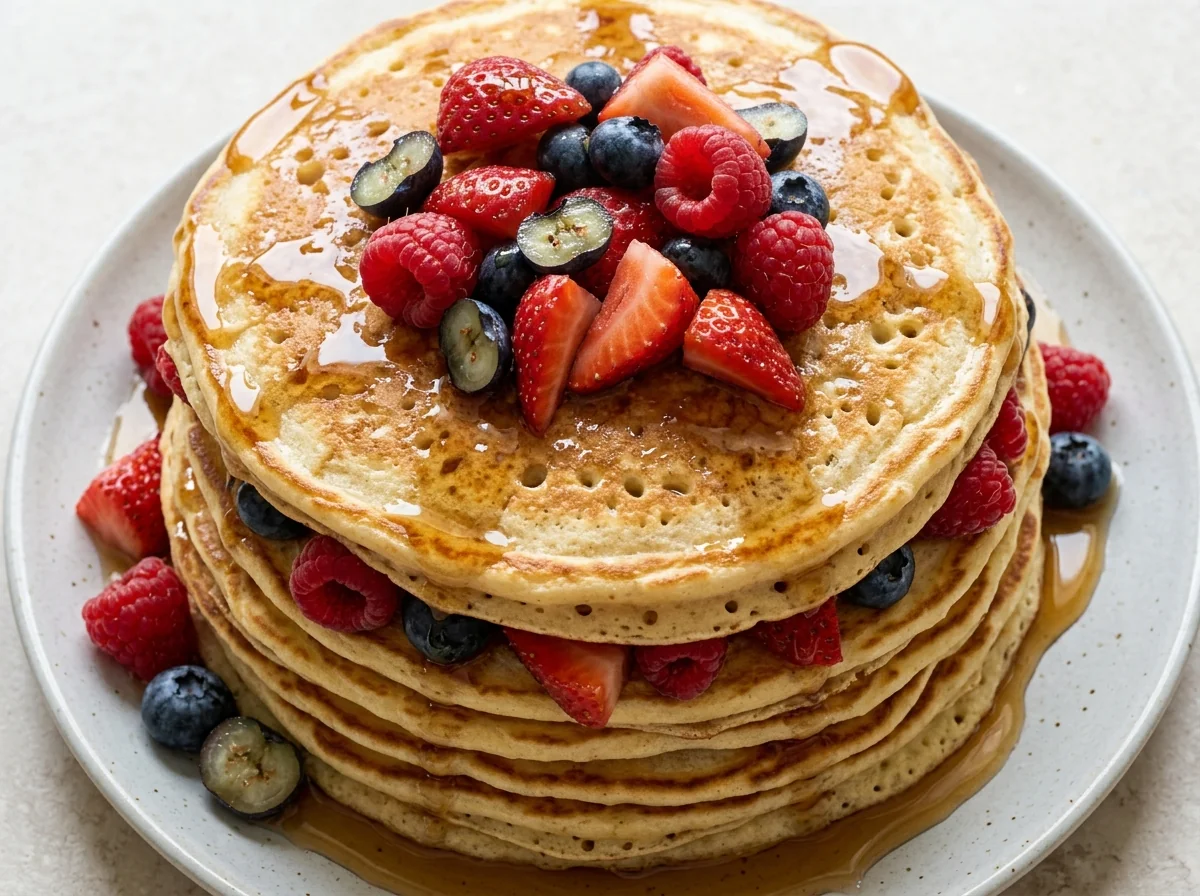
The base every pancake variation is built on: flour, milk, an egg, and melted butter, lifted by three teaspoons of baking powder into thick, fluffy rounds that soak up maple syrup. A one-bowl batter poured ladle after ladle onto a hot skillet — a weekend breakfast for four in half an hour.
Our library has oat pancakes, yogurt pancakes, and banana pancakes — all built on one base that was missing: the classic American pancake itself.
We took it from Sayidaty Kitchen with its seven ingredients as they are — the flour, milk, and baking powder formula the American kitchen has relied on for more than a century — to serve as the reference every healthy variation is measured against.
Preparation Steps
Mix the dry ingredients
Sift the flour into a wide bowl and add the baking powder, sugar, and salt. Stir with a spoon for half a minute until no trace of the baking powder shows and the mixture is one even color — even distribution is what lifts every pancake equally.
Add the liquids into a well
Open a well in the center of the dry mixture and pour in the milk, egg, and melted butter, then whisk from the center outward for about a minute until the batter comes together, thick and pourable, flowing off the spoon in a continuous ribbon. A few small lumps do no harm — overmixing is what toughens the pancakes.
Heat the skillet and test it
Heat a wide nonstick skillet over medium heat for about two minutes with no fat, and test it with a drop of water: if it dances and evaporates in seconds, the heat is right; if it vanishes the instant it lands, lower the heat slightly so the pancakes do not burn before their centers cook.
Pour and flip on the bubbles
Pour a ladle of batter (about 60 ml) per pancake and leave it untouched for two to three minutes until bubbles appear on the surface, pop, and the edges dry — only then is it time to flip. Flip once with a flat spatula and cook the second side for one to one and a half minutes until browned.
Repeat and serve hot
Repeat the pouring and flipping until the batter is finished, stacking the finished pancakes on a plate covered with a clean kitchen towel to hold their heat. Serve hot in stacks with maple syrup and fresh fruit — cold pancakes lose their fluffiness.
Blood Sugar Impact
The glycemic index (GI) measures how quickly a food raises blood sugar, while the glycemic load (GL) measures how much a full serving raises it. Together they give the complete picture.
Glycemic Index
GI
66Medium
Low0–55Medium56–69High70+
A low value (≤55) means a gradual rise in blood sugar — the most suitable range for diabetes and insulin resistance.
Glycemic Load
GL
37High
Low0–10Medium11–19High20+
Glycemic load reflects the impact of the full serving. To lower it: take half a serving, or pair the recipe with a source of protein and fiber.
Nutritional Information
Per ServingMakes 4 servings · one serving is about 195 g of raw ingredients
Calories377 kcal19%of Daily Value*
Protein9 g18%of Daily Value*
Carbohydrates58 g21%of Daily Value*
Fat12 g15%of Daily Value*
Fiber2 g7%of Daily Value*
Sodium858 mg37%of Daily Value*
* Percent Daily Values are based on a 2,000-calorie diet per FDA food-label reference values — your daily needs may be higher or lower. Values are derived from the recipe's ingredients via the USDA database.
Troubleshooting
The most common problems when preparing Classic Fluffy American Pancakes, and how to fix them:
The pancakes came out flat and did not rise
The baking powder is old and has lost its power, or the batter was whisked too long and lost its air. Check the tin's expiry and keep the whisking to one minute.
The surface burned while the center stayed doughy
The heat was too high. Lower it to gentle-medium and wait for the popped-bubble sign before flipping — it is the proof the center has cooked.
The first pancake is always the worst of the batch
Perfectly normal: the skillet's heat had not yet settled. Treat it as the calibration pancake and adjust the heat by its result.
The batter is heavy and will not pour
The flour ran over its measure when scooped. Add milk a tablespoon at a time until the batter flows off the spoon in a continuous ribbon.
Storage and Make-Ahead
Right away
Serve hot from the skillet — the fluffiness peaks in the first minutes.
Refrigerator (4°C)
Leftover pancakes keep in an airtight container for up to two days; reheat in a toaster or dry skillet, a minute per side, to bring back some of the fluff. The microwave softens them without crisping.
Freezing
Freeze the pancakes flat on a tray, then collect them in a sealed bag for up to two months; reheat straight from frozen in the toaster.
Tested Ingredient Substitutions
Original Ingredient
Tested Substitute
Ratio
Flavor Difference
Milk
Laban (yogurt whisked with water)
1:1
The laban's acidity reacts with the baking powder, lifting the pancakes higher and adding a light tang.
Melted butter
Vegetable oil
40 g → 40 ml
More unsaturated fat and a lighter flavor than butter.
White flour
Half whole wheat flour
190 g → 95 + 95 g
Higher fiber and a slightly denser texture; a full swap weighs the pancakes down.
Sugar
Omit it entirely
—
It is only one tablespoon, and the plate's sweetness comes from the maple syrup on top; dropping it passes without notice.
How Much Does It Make? Scaling Guide
Ingredient
4 people
2 people
8 people
Flour
190 g
95 g
380 g
Milk
310 ml
155 ml
620 ml
Eggs
1 egg (50 g)
1 small egg (40 g)
2 eggs (100 g)
Baking powder
12 g
6 g
24 g
EEINA Nutrition Tip
Stop whisking the moment the batter comes together, even if small lumps remain; long whisking activates the flour's gluten and the pancakes come out rubbery instead of fluffy. For taller pancakes, let the batter rest five minutes before pouring so the baking powder starts its work.
Add This Recipe to Your Plan
The EEINA app saves your favorite recipes, calculates them from their real ingredients, and shows your daily numbers toward your goal. Try it free now.
What makes thick American pancakes different from thin crepes?
The baking powder and the heavy batter; a crepe's batter is thin with no leavening, so it spreads paper-thin, while pancake batter is thick and the baking powder lifts it into a fluffy round.
Can the maple syrup be skipped?
Yes — it is optional to begin with; light honey or fresh fruit with yogurt is a common substitute, and every tablespoon of syrup adds about 50 calories, so trimming it is the easiest saving on the plate.
Can the batter be made the night before?
We do not recommend it; baking powder loses its strength over time and the pancakes rise less. Better to mix the dry ingredients at night and add the liquids in the morning — it takes a minute.
Why a full teaspoon of salt in a sweet breakfast?
It is the source's ratio for four people, and the salt here balances the sweetness and sharpens the flavor. Anyone watching their sodium can halve it with no noticeable effect on taste.