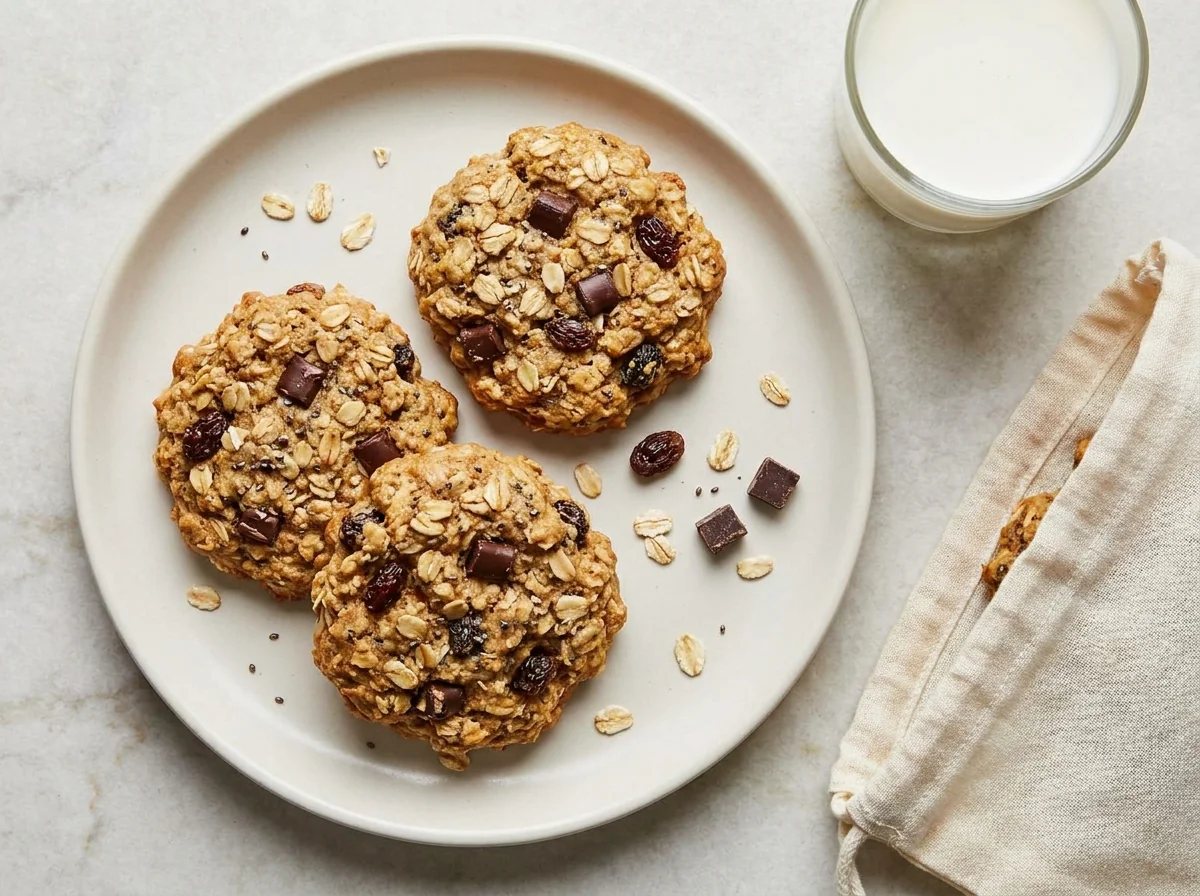
Breakfast cookies are among the most famous waves of healthy baking: an oat and banana disc with no flour, no added sugar, and no egg, which appeared in nutrition blogs and became a solution for rushed mornings and school boxes in many households.
Preparation Steps
Peel the ripe banana and mash it
Peel the speckled ripe banana and mash it smooth with a fork. The banana here plays the role of egg, sugar, and butter together: it binds, sweetens, and moistens.
Mix the dough in one bowl
With the banana, stir the oats, peanut butter, cinnamon, vanilla, salt, and chia until they come together into a moist, cohesive dough, and add the raisins or chocolate at the end. One bowl and one spoon are enough.
Shape into discs and flatten them
Scoop a heaping tablespoon for each cookie onto a tray with parchment paper and press it into a disc with the back of a wet spoon. This dough does not melt or spread in the oven, so the shape of the disc before baking is its shape after.
Bake for fifteen minutes
Bake in an oven preheated to 180 degrees for fifteen minutes until the discs set and their edges brown. They come out soft and firm up a little as they cool on the rack.
Pack for weekday mornings
Keep them in an airtight container. They are breakfast cookies, not a dessert: two discs with a small cup of full-fat breakfast milk or bag fuel on a rushed morning.
Blood Sugar Impact
The glycemic index (GI) measures how quickly a food raises blood sugar, while the glycemic load (GL) measures how much a full serving raises it. Together they give the complete picture.
Glycemic Index
GI
54Low
Low0–55Medium56–69High70+
A low value (≤55) means a gradual rise in blood sugar — the most suitable range for diabetes and insulin resistance.
Glycemic Load
GL
18Medium
Low0–10Medium11–19High20+
Glycemic load reflects the impact of the full serving. To lower it: take half a serving, or pair the recipe with a source of protein and fiber.
Nutritional Information
Per ServingMakes 6 servings · one serving is about 90 g of raw ingredients
Calories233 kcal12%of Daily Value*
Protein8 g16%of Daily Value*
Carbohydrates39 g14%of Daily Value*
Fat6 g8%of Daily Value*
Fiber6 g21%of Daily Value*
Sodium303 mg13%of Daily Value*
Potassium404 mg9%of Daily Value*
Phosphorus229 mg18%of Daily Value*
* Percent Daily Values are based on a 2,000-calorie diet per FDA food-label reference values — your daily needs may be higher or lower. Values are derived from the recipe's ingredients via the USDA database.
Troubleshooting
The most common problems when preparing Breakfast Oat and Banana Cookies, and how to fix them:
They came out wet inside
Too much banana or under-baking. Two medium bananas, no more, and a few extra minutes if the bananas are large.
They crumbled when lifted
They were lifted hot. Let them firm up on the rack for ten minutes before lifting.
They taste flat
The salt was missing or the cinnamon was too little. A pinch of salt in sweet baked goods strengthens the flavor, so do not drop it.
They dried out by the second day
The bake time increased. Take them out at the first browning of the edges while the center is soft, and a slice of apple in their container keeps their moisture for days.
Storage and Make-Ahead
In an airtight container
Three days at room temperature with full softness.
In the fridge
A week, and their softness returns in seconds in the microwave.
In the freezer
Two months in bags, taken out at night to be ready for the morning box.
Tested Ingredient Substitutions
Original Ingredient
Tested Substitute
Ratio
Flavor Difference
Peanut butter
Tahini
1:1
A safe version for peanut allergy, with attention to sesame
Raisins
Finely chopped dates
1:1
Deeper natural sweetness
Whole oats
Half of it ground
same amount
A softer disc that suits young children
Dark chocolate
Dried cranberries
1:1
A light acidity instead of cocoa
How Much Does It Make? Scaling Guide
Ingredient
~12 discs
~6 discs
~24 discs
Banana
240 g
120 g
480 g
Oats
200 g
100 g
400 g
Peanut butter
40 g
20 g
80 g
EEINA Nutrition Tip
Use fully ripe banana with its brown spots, as it is the only sweetener in the recipe. Yellow, firm banana gives flat-tasting cookies that need extra sugar.
Add This Recipe to Your Plan
The EEINA app saves your favorite recipes, calculates them from their real ingredients, and shows your daily numbers toward your goal. Try it free now.
Look at the ingredients, not the name: oats, banana, and peanut butter, that is a bowl of oats with banana pressed into a disc carried by hand, and the name is a way to convince the little ones.
How do they differ from date and oat balls?
The balls are raw, pressed, and chilled, and are concentrated energy, while these are baked into a tender disc closer to baked goods. Two textures for two purposes.
How many discs in a reasonable breakfast?
Two discs with a cup of milk for a child and three for an adult, and with fruit the box is complete.
Do they work for a school that bans nuts?
Yes, with the tahini version instead of peanut butter, with attention to anyone allergic to sesame, and read the school policy first.