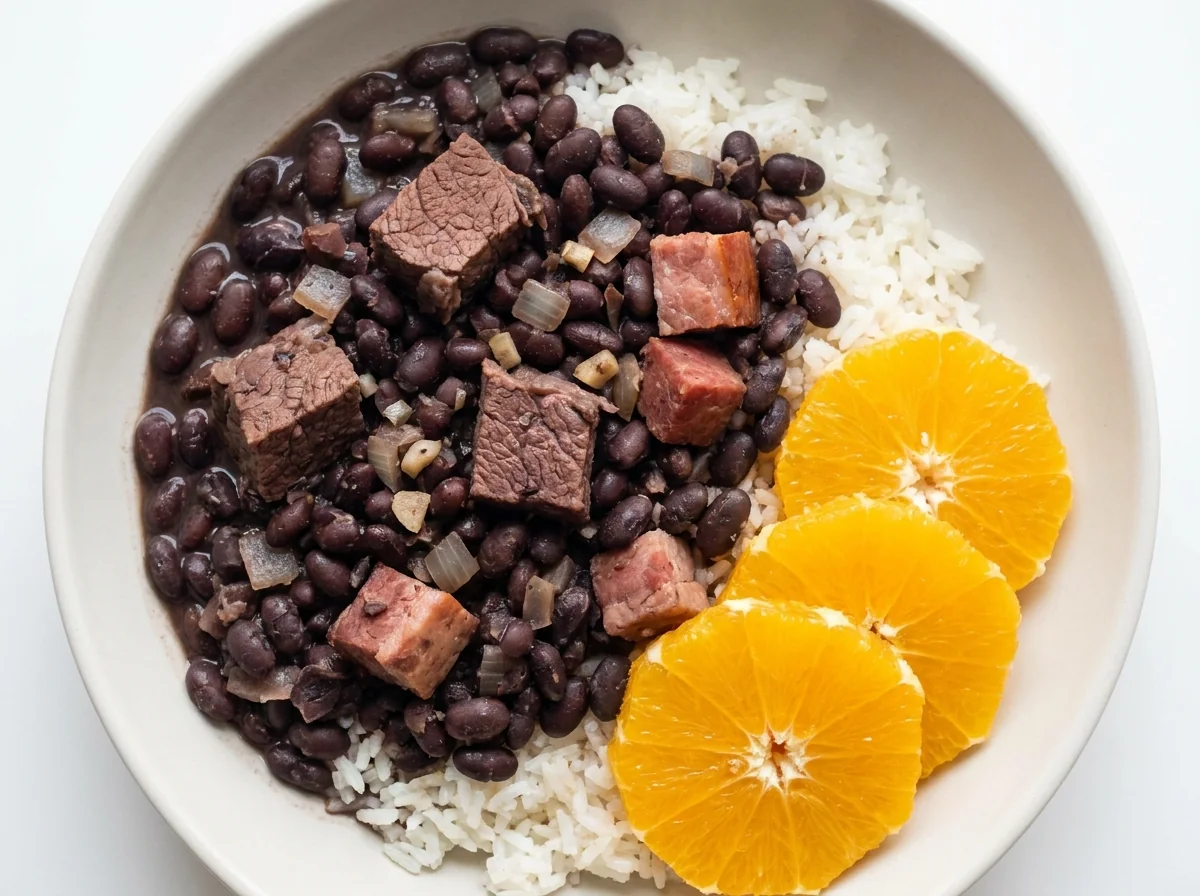
Feijoada is the national dish of Brazil: a black bean stew cooked with an assortment of salted and smoked meats over gentle heat for hours, and served traditionally with rice, orange slices, and fried collard greens.
It is usually cooked on the weekend and gathers the family around one table. And this lighter version of ours replaces the fatty cuts with lean meat and reduces the smoked meats, while preserving the beans' rich texture.
Preparation Steps
Boil the beans until they soften
Drain the soaking water from the black beans, and put them in a pot with water covering them by a few fingers and the two bay leaves, and leave them to boil then over gentle heat for forty-five minutes until they soften without falling apart.
Brown the beef
In a wide pot, heat the olive oil and brown the salted beef cubes until their color turns brown on all sides, then lift them aside.
Saute the onion and garlic
In the same pot, stir the chopped onion for five minutes until it softens and turns golden, then add the garlic and cumin for one minute until their aroma rises.
Combine the ingredients and cook them
Return the beef and add the smoked meat, then add the beans with their water and the two bay leaves. Adjust the salt and pepper and leave the pot over gentle heat for thirty minutes until the meat is cooked and the broth thickens.
Mash a little to increase the consistency
Mash a ladleful of the beans with the back of the spoon and return it to the pot to increase the broth's thickness, and this is a well-known Brazilian method for making feijoada thick without flour.
Serving
Lift out the bay leaves, and serve the feijoada hot over the white rice with fresh orange slices on the side in the Brazilian style.
Blood Sugar Impact
The glycemic index (GI) measures how quickly a food raises blood sugar, while the glycemic load (GL) measures how much a full serving raises it. Together they give the complete picture.
Glycemic Index
GI
55Low
Low0–55Medium56–69High70+
A low value (≤55) means a gradual rise in blood sugar — the most suitable range for diabetes and insulin resistance.
Glycemic Load
GL
24High
Low0–10Medium11–19High20+
Glycemic load reflects the impact of the full serving. To lower it: take half a serving, or pair the recipe with a source of protein and fiber.
Nutritional Information
Per ServingMakes 4 servings · one serving is about 375 g of raw ingredients
Calories531 kcal27%of Daily Value*
Protein30 g60%of Daily Value*
Carbohydrates53 g19%of Daily Value*
Fat22 g28%of Daily Value*
Fiber9 g32%of Daily Value*
Sodium522 mg23%of Daily Value*
* Percent Daily Values are based on a 2,000-calorie diet per FDA food-label reference values — your daily needs may be higher or lower. Values are derived from the recipe's ingredients via the USDA database.
Troubleshooting
The most common problems when preparing Lighter Brazilian Black Bean Feijoada, and how to fix them:
The beans stayed hard
They were not soaked enough or were old. They are soaked overnight and boiled on their own until they soften before adding the rest of the ingredients, as early salt slows their softening.
The broth came out runny
Leave the pot uncovered at the end of cooking, and mash a ladleful of the beans and return it to thicken the broth naturally.
The flavor is flat
Smoked meat is the source of depth in feijoada. If you reduce it, increase the onion and garlic and an extra bay leaf, and let the pot cook longer over gentle heat.
The meat is dry
Cook it over gentle heat, not strong, as a violent boil dries out lean meat. Long, gentle heat keeps it tender.
Storage and Make-Ahead
Immediately
Served hot over the rice with orange slices.
In the fridge
Keeps three days in an airtight container, and its flavor improves the next day.
Freezing
Freezes well up to three months, and is reheated over gentle heat with a little water.
Tested Ingredient Substitutions
Original Ingredient
Tested Substitute
Ratio
Flavor Difference
Smoked beef
Smoked beef or smoked turkey
1:1
A halal substitute that gives the same smoky flavor
The beef
Turkey breast cubes
1:1
Less fat and lighter in calories
Dried beans
Drained canned black beans
300 g dried equals ~700 g canned
Shortens the boiling time; added in the last quarter of cooking
White rice
Brown rice
1:1
Raises the fiber and lowers the glycemic index of the meal
How Much Does It Make? Scaling Guide
Ingredient
4 servings
2 servings
8 servings
Black beans
300 g
150 g
600 g
Beef
250 g
125 g
500 g
Smoked beef
150 g
75 g
300 g
EEINA Nutrition Tip
Black beans are a good source of fiber and plant protein, and eating legumes regularly is linked to benefits for heart health per the nutrition sources. And when cooking meats, you must ensure the beef reaches a safe internal temperature (71 degrees Celsius) per food-safety guidelines.
Add This Recipe to Your Plan
The EEINA app saves your favorite recipes, calculates them from their real ingredients, and shows your daily numbers toward your goal. Try it free now.
We use lean cuts of meat and reduce the amount of smoked and fatty meats that are abundant in traditional feijoada, while keeping black beans as the base of the dish.
Why is orange served with it?
Serving orange slices alongside feijoada is a Brazilian tradition, and its refreshing acidity balances the richness of the dish.
Do I need to soak the beans?
Soaking overnight shortens the boiling time and makes the beans easier to digest. If you forget the soak, you can use canned beans instead.
How does it become a complete meal?
With the rice, orange slices, and a plate of sauteed leafy greens, it becomes a complete meal in the Brazilian style.