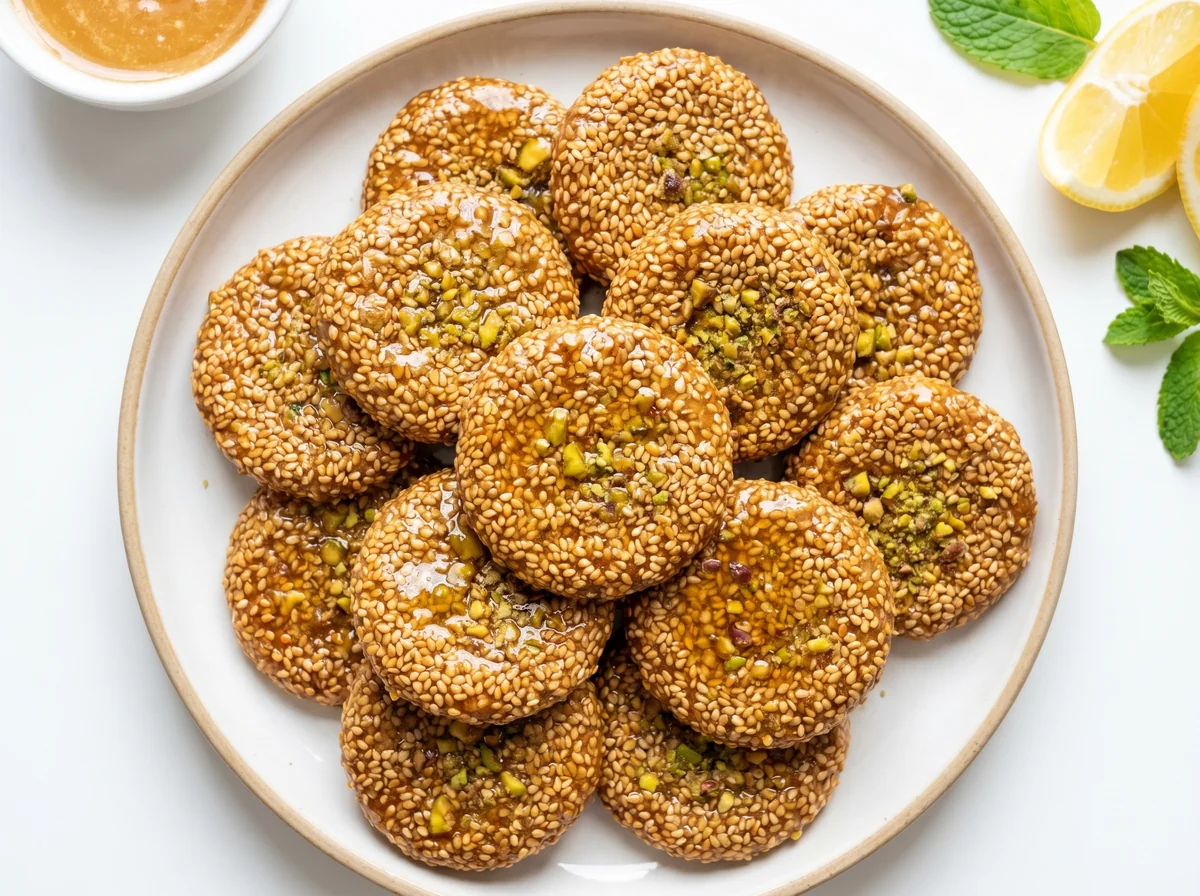
Famous Damascene cookies — thin rounds of dough coated on one side with toasted sesame and on the other with pistachios, baked until golden and crisp. A hospitality treat with a low glycemic load per piece. Contains gluten, sesame, tree nuts, and dairy.
Barazek are a celebrated and ancient Damascene cookie, among the most famous sweets of Syria — exported and gifted around the world. Thin discs of dough coated on one side with toasted sesame and on the other with Aleppo pistachios, baked until crisp.
Damascus and its storied confectioneries made them famous, and they became a symbol of Levantine hospitality and a treasured souvenir. Served with coffee and tea at celebrations and festive occasions. The combination of crisp dough, toasted sesame, and pistachios is the secret behind their worldwide renown.
Preparation Steps
Knead the dough
Mix the flour and sugar, then add the ghee and oil and rub in, followed by the yeast dissolved in the milk and the vanilla. Knead into a soft, cohesive dough. Cover and let it rest for half an hour. The rest makes it easy to roll.
Prepare the sesame and pistachios
Toast the sesame in a dry pan until golden (if not already toasted), then mix with a little diluted molasses or honey so it adheres. Crush the pistachios. Sesame on one side and pistachios on the other are the defining mark of barazek.
Shape the rounds
Take a small ball of dough and flatten it into a thin disc (about half a centimetre thick). Barazek are thin to be crisp, not thick. Roll it into a ball first, then flatten with your hands or a small rolling pin.
Coat both sides
Press one side of the disc into the sesame-molasses mixture until fully coated, then flip and press the other side into the crushed pistachios. Sesame on one side, pistachio on the other is the identity of barazek. Arrange on a baking sheet, pistachio side up.
Bake
Bake in a 180°C oven for about 12 to 15 minutes until the base is golden, the sesame is golden, and the disc is crisp. Watch them closely — thin cookies brown quickly. Golden colour and toasted sesame signal they are done.
Cool and serve
Let the barazek cool completely on a rack to crisp up (they are slightly soft while hot and crisp once cooled). Serve with coffee or tea. Barazek are a celebrated Damascene cookie, traditionally offered at hospitality and celebrations and sent as a gift from the Levant. Their toasted sesame, pistachios, and crunch are the secret to their worldwide fame.
Blood Sugar Impact
The glycemic index (GI) measures how quickly a food raises blood sugar, while the glycemic load (GL) measures how much a full serving raises it. Together they give the complete picture.
Glycemic Index
GI
65Medium
Low0–55Medium56–69High70+
A low value (≤55) means a gradual rise in blood sugar — the most suitable range for diabetes and insulin resistance.
Glycemic Load
GL
12Medium
Low0–10Medium11–19High20+
Glycemic load reflects the impact of the full serving. To lower it: take half a serving, or pair the recipe with a source of protein and fiber.
Nutritional Information
Per ServingMakes 24 servings · one serving is about 45 g of raw ingredients
Calories215 kcal11%of Daily Value*
Protein4 g8%of Daily Value*
Carbohydrates20 g7%of Daily Value*
Fat14 g18%of Daily Value*
Fiber2 g7%of Daily Value*
Sodium3 mg0%of Daily Value*
Potassium95 mg2%of Daily Value*
Phosphorus95 mg8%of Daily Value*
* Percent Daily Values are based on a 2,000-calorie diet per FDA food-label reference values — your daily needs may be higher or lower. Values are derived from the recipe's ingredients via the USDA database.
Troubleshooting
The most common problems when preparing Barazek (Damascene Sesame and Pistachio Cookies), and how to fix them:
Barazek are hard but not crisp
The dough was too thick or over-baked. Roll them thin (half a centimetre), bake just until coloured, and let them cool completely (they crisp as they cool). Thick ones never get crisp.
Sesame does not stick
Not enough molasses or honey binder. Mix the sesame with a little molasses or diluted honey, press the disc into it, and push gently. The binder holds the sesame on the surface.
Barazek crumbled
The dough was too dry or they were moved while still hot. Add a little milk to the dough if it is dry, and let the barazek cool before handling — they are fragile when hot.
Sesame burned
Oven too hot or baked too long. Bake at 180°C and keep watch — sesame burns quickly once golden. Remove them the moment the sesame turns golden.
Barazek puffed up instead of staying flat
Too much yeast or too thick. Barazek should be thin and flat — use a small amount of yeast and roll them thin. A little yeast gives crispness without puffing.
Storage and Make-Ahead
Room temperature
Store in a sealed container at room temperature for two to three weeks (they stay crisp as long as the container is airtight and away from moisture). A long-lasting sweet — great to make ahead and gift.
Freezer (-18°C)
Freeze baked cookies for two months in a sealed container; thaw at room temperature. Or freeze the shaped unbaked discs and bake directly from frozen.
Make-ahead
Prepare days before the occasion and store in a tin — they keep well and stay crisp. Ideal for Eid hospitality and gifts.
Crispness note
Let the barazek cool completely before storing (hot cookies sweat in the tin and lose their crispness). Store in a sealed container away from moisture.
Tested Ingredient Substitutions
Original Ingredient
Tested Substitute
Ratio
Flavor Difference
Aleppo pistachios
Crushed almonds or pine nuts
Same amount
Pistachios are the classic and most prestigious choice for barazek; almonds are a more affordable alternative. Both are tree nuts.
ghee
Butter or a butter-and-oil blend
Same amount
ghee is closest to the traditional flavor; butter gives a lighter taste.
Sugar
Slightly less sugar
To taste
Sesame and pistachios give a rich flavor, so you can reduce the sugar slightly.
How Much Does It Make? Scaling Guide
Number of pieces
Flour
Sesame seeds
Pistachios
12 (half recipe)
1.5 cups
0.5 cup
0.25 cup
24 (base)
3 cups
1 cup
0.5 cup
48 (Eid hospitality)
6 cups
2 cups
1 cup
EEINA Nutrition Tip
Barazek are hospitality cookies, and relatively lighter than syrup-soaked sweets: no syrup is poured over them, and each piece is small so the glycemic load per piece is low. The sesame and pistachios add healthy fats and some protein and calcium. Their challenge is the fat from the ghee. Moderation is key: one or two pieces with coffee. For people with diabetes: one small piece on an occasion, with mindfulness.
Add This Recipe to Your Plan
The EEINA app saves your favorite recipes, calculates them from their real ingredients, and shows your daily numbers toward your goal. Try it free now.
Damascus and its storied confectioneries made them famous for decades — they became a symbol of Levantine hospitality and a prized souvenir, and are exported worldwide. The quality of the sesame and pistachios and their distinctive crunch made them among the most famous sweets of the Levant.
How do barazek stay crisp?
Roll them thin, bake just until golden, let them cool completely (they crisp as they cool), and store in a sealed container away from moisture. Thickness or moisture will ruin the crunch.
Are barazek healthy?
They are a hospitality cookie, relatively lighter than syrup-soaked sweets (no syrup), and each piece is small. The sesame and pistachios add healthy fats and some protein and calcium. The challenge is the fat and sugar. One or two pieces in moderation.
Why sesame on one side and pistachio on the other?
This is the defining identity of barazek: one face coated with toasted sesame (baked face-down so it bronzes), and the other with crushed pistachios. This contrast in flavor and appearance is what sets barazek apart.