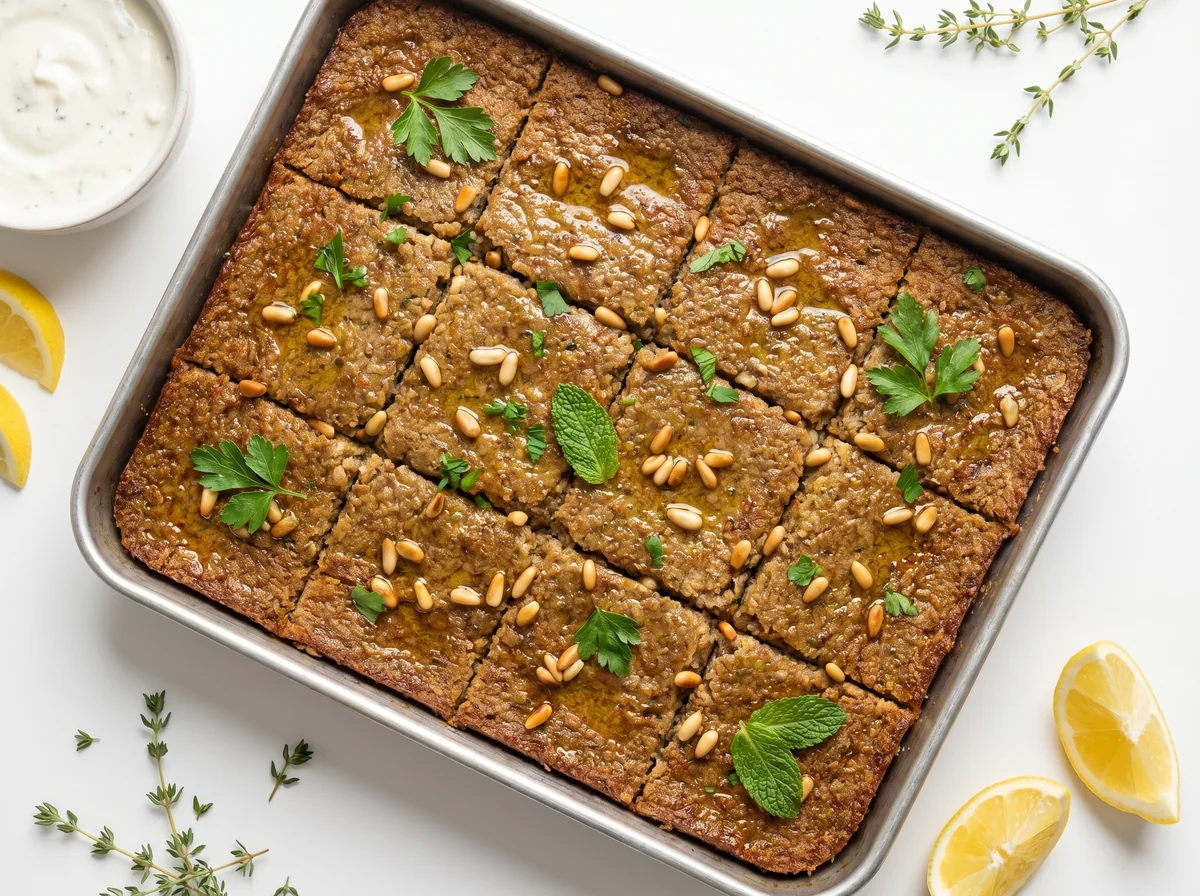
Levantine baked kibbeh — two layers of bulgur-and-minced-meat crust sandwiching a filling of ground meat, onion, and pine nuts, cut into diamonds and baked until golden. Lighter than fried kibbeh; bulgur is a whole grain with a low glycemic index. Contains gluten and pine nuts.
Baked kibbeh tray (kibbeh bil sinieh) is the oven-baked version of Levantine kibbeh — easier and faster than shaping individual fried kibbeh balls. The bulgur-and-meat crust is pressed into two layers enclosing a meat, onion, and pine-nut filling, scored into diamonds, and baked.
It is the family and entertaining dish of Syria, Lebanon, and Jordan, feeding a crowd with far less effort than the fried version. Its golden, slightly crunchy exterior, tender interior, and rich filling are the secrets to its enduring popularity.
Preparation Steps
Prepare the filling
Brown the chopped onion in ghee until softened. Add the ground meat, spices, and a pinch of salt, stirring until the colour changes and the liquid evaporates. Fold in the toasted pine nuts and set the filling aside to cool slightly. Driving off the meat's moisture prevents the layers from becoming soggy later.
Work the kibbeh crust
Process the finely minced meat with the small onion and spices in a food processor until smooth, then add the soaked and squeezed fine bulgur and salt and process until you have a smooth, cohesive dough. Wet your hands with cold water as you work to prevent sticking and improve the texture.
Press the bottom layer
Grease a baking tray with ghee. Press half the crust dough into the bottom with wet hands, forming an even, compact layer. Press it down firmly so it sticks to the base — it is the foundation that supports the filling.
Spread the filling
Spread the meat-and-pine-nut filling evenly over the bottom crust all the way to the edges with no bare spots. An even layer guarantees a balanced bite of crust and filling in every piece.
Form the top layer
Take the remaining crust dough and flatten it into patties with cold-water-wet hands, then tile them over the filling, pressing them together with your fingertips until they join into a solid top layer that covers the filling completely. Keeping your hands moist prevents sticking and makes spreading easier.
Score and garnish
Using a moistened knife, cut the kibbeh into diamonds or squares before baking — this makes serving much easier later. Press a pine nut into each piece, then brush the surface with ghee or olive oil so it browns and glistens in the oven.
Bake and serve
Bake in a 200 °C oven for about 45 minutes until the kibbeh is golden on top and bottom and the meat is cooked through. Serve hot with yoghurt or a salad. Baked kibbeh is easier and lighter than the fried kind, bringing together a golden bulgur crust and a rich meat-and-pine-nut filling in a family tray.
Blood Sugar Impact
The glycemic index (GI) measures how quickly a food raises blood sugar, while the glycemic load (GL) measures how much a full serving raises it. Together they give the complete picture.
Glycemic Index
GI
43Low
Low0–55Medium56–69High70+
A low value (≤55) means a gradual rise in blood sugar — the most suitable range for diabetes and insulin resistance.
Glycemic Load
GL
13Medium
Low0–10Medium11–19High20+
Glycemic load reflects the impact of the full serving. To lower it: take half a serving, or pair the recipe with a source of protein and fiber.
Nutritional Information
Per ServingMakes 6 servings · one serving is about 220 g of raw ingredients
Calories585 kcal29%of Daily Value*
Protein28 g56%of Daily Value*
Carbohydrates40 g15%of Daily Value*
Fat36 g46%of Daily Value*
Fiber10 g36%of Daily Value*
Sodium156 mg7%of Daily Value*
* Percent Daily Values are based on a 2,000-calorie diet per FDA food-label reference values — your daily needs may be higher or lower. Values are derived from the recipe's ingredients via the USDA database.
Troubleshooting
The most common problems when preparing Baked Kibbeh Tray, and how to fix them:
The kibbeh turned out dry and crumbly
Not enough fat, or the bulgur was over-soaked. Brush the top and bottom with enough ghee, squeeze the fine bulgur thoroughly, and don't over-bake. A layer of fat on the surface preserves moisture and promotes browning.
The crust is tough
The crust was over-processed or under-moistened. Process until smooth and keep your hands wet while pressing, without pressing harder than needed. Thoroughly squeezed fine bulgur gives a tender crust.
The layers separated
They were not pressed together firmly, or the filling was too wet. Press the bottom layer firmly, drain any liquid from the filling, and smooth the top layer so it adheres to the filling. Scoring before baking helps them hold together.
The top didn't brown
Not enough fat on the surface or the oven temperature was too low. Brush the top with ghee or olive oil before baking, bake at 200 °C, and turn on the top grill for the last few minutes to get a golden finish.
The meat in the filling is dry
The meat was too lean or overcooked. Add some sautéed onion and a knob of ghee to the filling, and cook it just until done — baking will finish it.
Storage and Make-Ahead
Refrigerator (4 °C)
Baked kibbeh keeps in a sealed container for 3 days. Reheat in the oven to restore some of its crispness. Pre-cut pieces reheat more easily.
Freezer (-18 °C)
Freeze baked or raw-assembled (pre-scored) for up to 3 months. Raw kibbeh can go straight from frozen into the oven — just add extra time. Ideal for preparing banquet dishes ahead of time.
Make-ahead
Prepare the filling and crust dough, assemble and score the tray, and refrigerate or freeze it. Bake fresh when needed.
Food safety
The meat is cooked in the filling and during baking until fully done. Do not leave kibbeh at room temperature for more than 2 hours.
Tested Ingredient Substitutions
Original Ingredient
Tested Substitute
Ratio
Flavor Difference
Baked kibbeh tray
Fried kibbeh balls
Same ingredients
Fried kibbeh is richer and crispier but heavier in fat and more time-consuming. The tray version is easier and lighter.
ghee
Olive oil
Same quantity
Healthier fats; ghee is closer to the traditional flavour.
Meat filling
Vegetarian filling (potato, spinach, or walnuts)
To match the quantity
For fasting or vegetarians; the bulgur-and-meat crust can also be made all-bulgur for a fully plant-based version.
How Much Does It Make? Scaling Guide
Number of servings
Bulgur
Kibbeh shell meat
Kibbeh filling meat
3 (half recipe)
1 cup
200 g
150 g
6 (base)
2 cups
400 g
300 g
12 (large family)
4 cups
800 g
600 g
EEINA Nutrition Tip
Baked kibbeh is lighter than fried kibbeh because it is baked, not submerged in oil, so it has less fat. Its crust is bulgur — a whole grain with a low glycemic index and high fibre — and the meat adds protein and iron, making its glycemic load low. To lighten it further: use lean meat, substitute olive oil for ghee, and serve alongside a large salad and yoghurt.
Add This Recipe to Your Plan
The EEINA app saves your favorite recipes, calculates them from their real ingredients, and shows your daily numbers toward your goal. Try it free now.
What is the difference between baked and fried kibbeh?
Baked kibbeh is pressed into two layers in a tray, baked, and cut into diamonds; fried kibbeh is shaped into stuffed balls and deep-fried. The tray version is easier, faster, and lower in fat (baked not fried); the fried version is richer and crispier.
Is baked kibbeh healthy?
Lighter than fried (baked not fried), and the crust is bulgur — a whole grain with a low glycemic index and high fibre — while the meat adds protein and iron. Glycemic load is low. Use lean meat and olive oil to lighten it further.
How do I get a tender crust, not a tough one?
Process the crust until smooth, squeeze the bulgur well, keep your hands wet with cold water while pressing, and avoid over-pressing or over-baking. Moisture and fine processing are the keys to tenderness.
Why score it before baking?
Scoring into diamonds before baking lets the pieces separate cleanly after baking (baked kibbeh crumbles if cut hot as a whole), allows heat to penetrate evenly, and gives it the traditional shape.