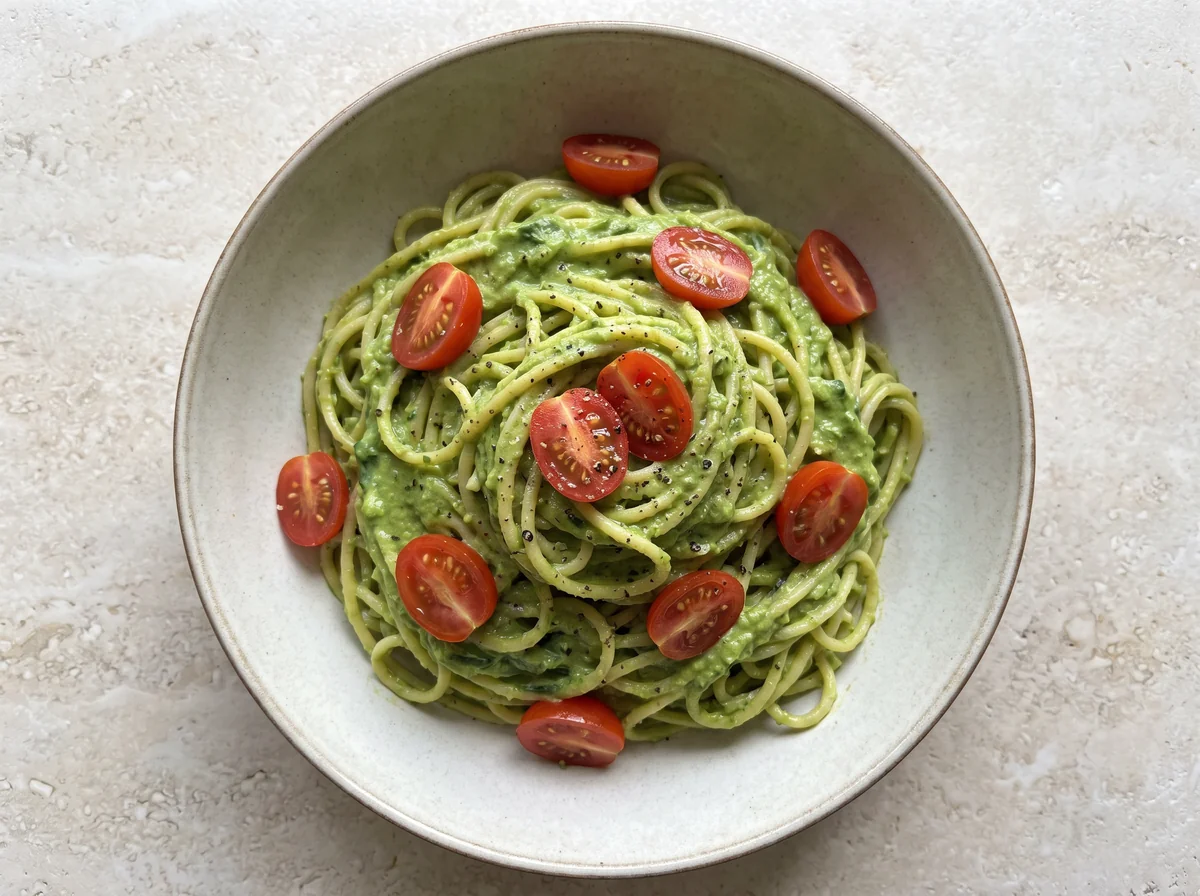
Pasta in a creamy green sauce of ripe avocado, basil, and spinach whipped in the blender in one minute — no cooking, no cream. The avocado provides the creamy body with its monounsaturated fats in place of butter and cream, and the lemon keeps the color vivid.
Avocado sauce for pasta is an idea that spread through healthy kitchens as a full replacement for cream sauces, and this version comes from Sayidaty Kitchen: avocado, basil, and spinach whipped raw in the blender.
We made two declared adjustments to the original: we lowered the salt from one teaspoon (about 6 g) to 2 g, and reduced the olive oil from three tablespoons to two, relying on the avocado's own fats — and we added the step of saving the cooking water to fine-tune the texture.
Preparation Steps
Boil the pasta
Bring a large pot of water to a boil over high heat and add the pasta, cooking it according to the package time until done but still firm to the bite. Before draining, save half a cup of the cooking water — it is what you will use to adjust the sauce's texture later.
Prepare the avocado
While the pasta cooks, halve the two avocados lengthwise, remove the pits, scoop out the flesh with a spoon, and cut it into large chunks. A ripe avocado yields to a light press of the finger without being mushy, and it is the foundation of the creamy texture here.
Blend the sauce
Put the avocado, basil, spinach, garlic, lemon juice, salt, and black pepper in the blender and blend for about a minute until completely smooth. Then pour in the olive oil gradually with the blender running until it comes together into a glossy, creamy green sauce.
Toss the pasta with the sauce
Drain the pasta, transfer it to a wide bowl, add the sauce immediately, and toss until every piece is coated. If the sauce is thick, loosen it with a tablespoon or two of the reserved cooking water until it flows over the pasta.
Serve immediately
Divide the pasta among plates, garnish with the cherry tomato halves and a grind of black pepper, and serve as soon as it is made — avocado sauce is eaten fresh on its day, and its bright green color is at its best in the first hour.
Blood Sugar Impact
The glycemic index (GI) measures how quickly a food raises blood sugar, while the glycemic load (GL) measures how much a full serving raises it. Together they give the complete picture.
Glycemic Index
GI
48Low
Low0–55Medium56–69High70+
A low value (≤55) means a gradual rise in blood sugar — the most suitable range for diabetes and insulin resistance.
Glycemic Load
GL
32High
Low0–10Medium11–19High20+
Glycemic load reflects the impact of the full serving. To lower it: take half a serving, or pair the recipe with a source of protein and fiber.
Nutritional Information
Per ServingMakes 4 servings · one serving is about 210 g of raw ingredients
Calories514 kcal26%of Daily Value*
Protein13 g26%of Daily Value*
Carbohydrates74 g27%of Daily Value*
Fat20 g26%of Daily Value*
Fiber8 g29%of Daily Value*
Sodium209 mg9%of Daily Value*
Potassium660 mg14%of Daily Value*
Phosphorus217 mg17%of Daily Value*
* Percent Daily Values are based on a 2,000-calorie diet per FDA food-label reference values — your daily needs may be higher or lower. Values are derived from the recipe's ingredients via the USDA database.
Troubleshooting
The most common problems when preparing Pasta with Avocado Basil Sauce, and how to fix them:
The sauce darkened quickly
The avocado oxidized. Make sure the lemon juice is blended with the avocado from the start, serve the dish as soon as it is tossed, and if you must wait, press plastic wrap directly onto the sauce's surface to keep the air out.
The sauce is too thick to coat the pasta
The avocados were large or the blender did not get enough liquid. Add the reserved cooking water spoon by spoon while tossing until it flows — its starch binds the sauce to the pasta better than plain water.
A slightly bitter taste
The avocado was underripe or the raw garlic was too much. Choose fruit that yields to a finger press, keep to two cloves, and if the bitterness got ahead, an extra spoon of lemon and a pinch of pepper balance it.
The sauce is grainy, not smooth
The blending was too short or the leaves were piled into an overfull blender. Blend a full minute at high speed, scrape down the sides halfway through, then continue until the sauce shines smooth.
The pasta clumped before tossing
It was drained early and left to dry. Make the sauce while the pasta boils, not after, and toss the pasta with the sauce the moment it is drained, while hot and moist.
Storage and Make-Ahead
Serving
A dish to eat fresh within the hour — the sauce is raw, and its color and taste are at their best at the start.
Refrigerator (4°C)
If any is left, keep it in an airtight container with wrap pressed onto the surface for one day, expecting a slight darkening of color that does not mean spoilage. Refresh with a squeeze of lemon when eating.
Freezing
Not suitable — raw avocado sauce separates and turns watery after thawing.
Make ahead
Halve the tomatoes and wash the leaves hours in advance, but blend the sauce right at mealtime — it takes one minute in the blender.
Tested Ingredient Substitutions
Original Ingredient
Tested Substitute
Ratio
Flavor Difference
White pasta
Whole-wheat pasta
Same weight, 350 g
Higher fiber and longer satiety; it needs one to two extra minutes of boiling.
White pasta
Red lentil or chickpea pasta
Same weight, 350 g
Higher plant protein and gluten-free, with a softer texture — watch the boiling closely.
Basil
Fresh coriander, or mint with parsley
Same amount
A different character of flavor, but the sauce stays green and aromatic; use mint at half quantity for its strength.
Spinach
Arugula (rocket)
Same amount
A light peppery note and a deeper color, with comparable leafy-green values.
Cherry tomatoes
Pomegranate seeds
1/2 cup
A sweet tang and crunch that cuts the sauce's creaminess, and a lovely local touch.
How Much Does It Make? Scaling Guide
Servings
Pasta
Avocado
Basil and spinach
Olive oil
2 servings
175 g
1 large piece
¼ cup of each
1 tablespoon
4 servings
350 g
2 large pieces
½ cup of each
2 tablespoons
8 servings
700 g
4 large pieces
1 cup of each
4 tablespoons
EEINA Nutrition Tip
The lemon juice here is not just for flavor — it is what slows the avocado's oxidation and the sauce's darkening. Blend it with the avocado from the first minute, not at the end, and serve the dish as soon as it is ready. To raise the meal's protein, choose whole-wheat or legume pasta, or add sliced grilled chicken breast.
Add This Recipe to Your Plan
The EEINA app saves your favorite recipes, calculates them from their real ingredients, and shows your daily numbers toward your goal. Try it free now.
No — it is blended raw and tossed with the hot pasta, warming only from its heat. Heating it on the stove breaks its color and taste and turns it bitter, and this is what makes it the fastest creamy sauce possible.
How does it differ nutritionally from cream-based pasta?
The creamy body here comes from the avocado's monounsaturated fats instead of the saturated fats in cream and butter, along with fiber and potassium from the fruit itself. The exact numbers appear with the per-serving nutrition calculation.
How do we pick a ripe avocado for the sauce?
Press the fruit lightly with your palm — if it yields slightly without feeling mushy, it is ready. Firm ones ripen at room temperature in two to three days, and placing them in a paper bag with a banana speeds it up.
Is the dish fully vegan?
Yes, in all its ingredients — no dairy and no eggs, and the creamy body is entirely plant-based from the avocado and olive oil.