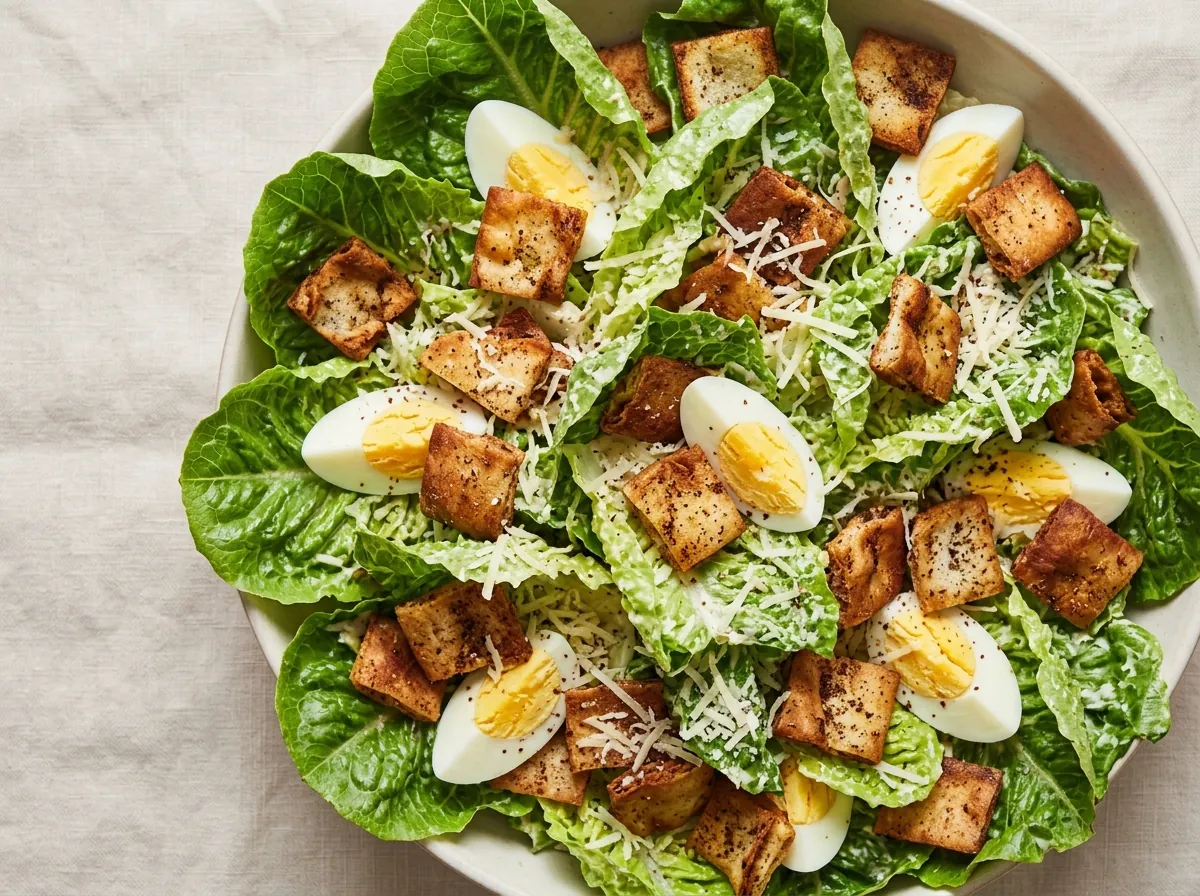
Caesar salad goes back to Mexico in the twenties, but cooks in the Levant made it their own by adding toasted Arabic bread and tart sumac.
The sumac stands in for the black pepper of the original recipe and gives the salad a distinctly Arab flavor. At suhoor it opens the appetite and is served as a light mezze before the main dishes.
Preparation Steps
Toast the bread
Cut the Arabic bread into squares and spread them out on an oven tray. Sprinkle over a spoonful of oil and toast them in a 180 degree oven for 10 minutes until they take on a golden color and turn crisp.
Prepare the dressing
In a small bowl, whisk the crushed garlic with the lemon, the mustard and half the olive oil. Add the sumac and the salt and keep whisking until it comes together.
Assemble the salad
Wash the lettuce, dry it and cut it into medium pieces. Put it in a large bowl and add the toasted bread and half the grated cheese.
Add the dressing
Pour the dressing over the salad and toss gently until every leaf is coated. Garnish with the rest of the cheese, the remaining olive oil and the parsley. Add the chopped boiled egg if you like.
Serve
Serve at once with lemon wedges. The salad loses its crunch 10 minutes after it is dressed, so put it together right before serving.
Blood Sugar Impact
The glycemic index (GI) measures how quickly a food raises blood sugar, while the glycemic load (GL) measures how much a full serving raises it. Together they give the complete picture.
Glycemic Index
GI
52Low
Low0–55Medium56–69High70+
A low value (≤55) means a gradual rise in blood sugar — the most suitable range for diabetes and insulin resistance.
Glycemic Load
GL
11Medium
Low0–10Medium11–19High20+
Glycemic load reflects the impact of the full serving. To lower it: take half a serving, or pair the recipe with a source of protein and fiber.
Nutritional Information
Per ServingMakes 4 servings · one serving is about 170 g of raw ingredients
Calories269 kcal13%of Daily Value*
Protein10 g20%of Daily Value*
Carbohydrates25 g9%of Daily Value*
Fat15 g19%of Daily Value*
Fiber3 g11%of Daily Value*
Sodium612 mg27%of Daily Value*
* Percent Daily Values are based on a 2,000-calorie diet per FDA food-label reference values — your daily needs may be higher or lower. Values are derived from the recipe's ingredients via the USDA database.
Troubleshooting
The most common problems when preparing Arabic Caesar Salad with Toasted Pita, and how to fix them:
The salad is watery
Drain the lettuce in a colander for ten minutes before dressing it. Excess water weakens the flavor of the dressing.
The dressing is bitter
Double the lemon and cut back the mustard. Anchovy adds a hidden saltiness, so swap it for ordinary salt.
The bread is soft
Toast it in a hot oven rather than in a pan. Older bread needs longer to turn crisp.
The lettuce is bitter
Remove the outer leaves and choose the pale inner ones. Older lettuce is more bitter.
Storage and Make-Ahead
In the refrigerator
One hour after it is made. Prepare the bread and the dressing ahead and combine them before serving.
Not suitable for freezing
The lettuce wilts and the bread loses its crunch.
Tested Ingredient Substitutions
Original Ingredient
Tested Substitute
Ratio
Flavor Difference
Arabic bread
toasted French bread
1:1
A different flavor but a similar texture.
parmesan
salted white cheese
1:1
A cheaper Levantine version.
mustard
tahini paste
1:1
A mustard-free alternative.
How Much Does It Make? Scaling Guide
Ingredient
4 people
8 people
12 people
Lettuce
300 g
600 g
900 g
Bread
150 g
300 g
450 g
Olive oil
40 ml
80 ml
120 ml
Lemon
30 ml
60 ml
90 ml
EEINA Nutrition Tip
Dry the lettuce completely after washing, because water thins the dressing. Toast the bread at the last moment, since it loses its crunch quickly.
Add This Recipe to Your Plan
The EEINA app saves your favorite recipes, calculates them from their real ingredients, and shows your daily numbers toward your goal. Try it free now.
Sumac is sharply tart, so it balances the richness of the dressing and carries the Levantine flavor. Black pepper is too strong and covers the taste of the cheese.
Does it only work as a mezze?
Yes, it is a mezze before the main dish. Cut back the bread and add grilled chicken breast and it becomes a complete meal.
Is it suitable for children?
Yes. Cut back the mustard and double the cheese. The flavor is mild and easy to like.
What is the difference between this version and the original?
The original is anchovy and garlic; this one is sumac and thyme. The flavors are close, but the seasoning here is Arab.