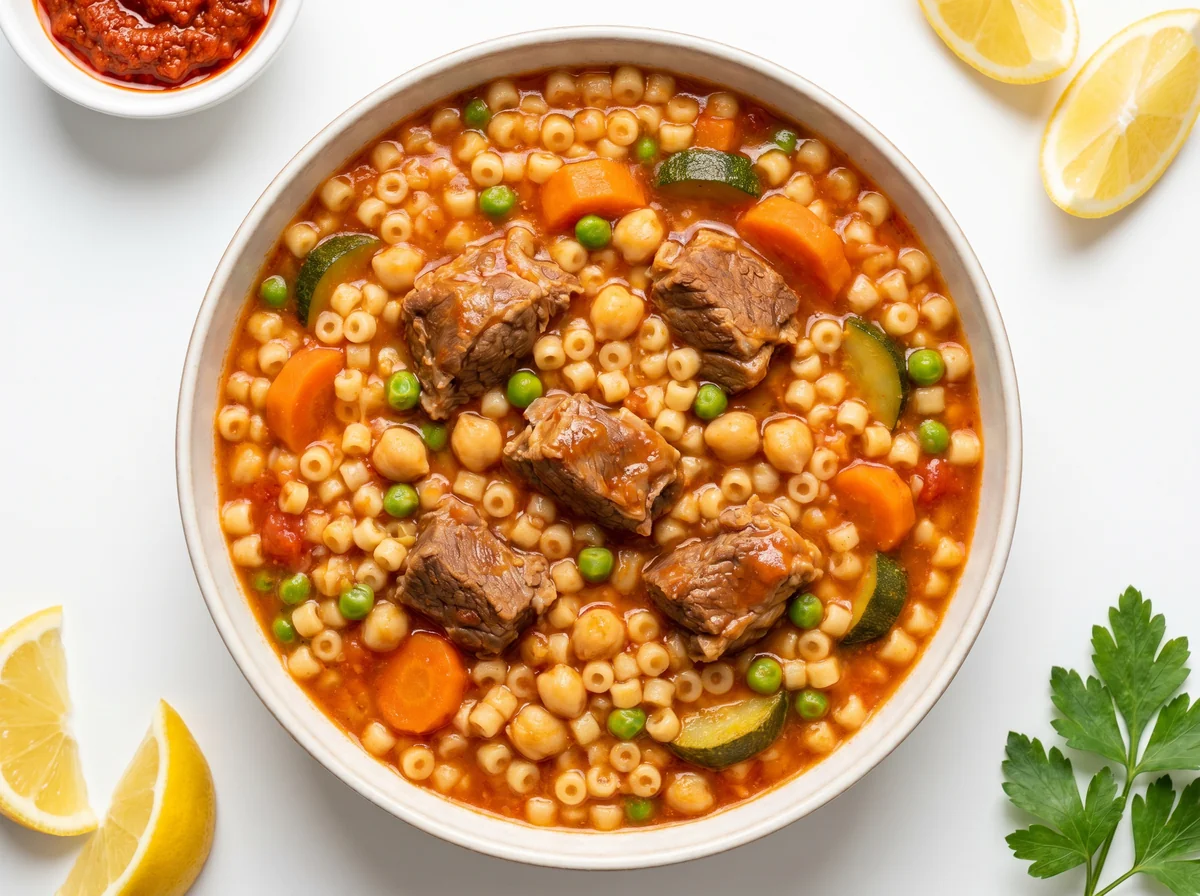
A traditional Algerian heritage dish — large couscous pearls cooked in a lamb, tomato, and vegetable broth with chickpeas, sitting somewhere between a soup and a main course. Rich in fibre with a medium glycemic load and contains gluten.
Berkoukes (also called mhammsa) is a beloved traditional Algerian dish. It is built around berkoukes — large couscous pearls, bigger than regular couscous, handmade from semolina — cooked in a lamb, tomato, vegetable, and chickpea broth.
Its consistency sits between a thick soup and a main course. It is prepared especially in winter (warming and filling) and during Ramadan and celebrations. The large nourishing pearls in the rich meat-and-vegetable broth make it a satisfying, warming dish that brings family around a shared bowl — a reflection of Algeria's agricultural and culinary heritage.
Preparation Steps
Build the broth
Brown the onion in ghee, add the lamb and stir, season with baharat, cinnamon, and salt, then add the tomato paste, grated tomatoes, soaked chickpeas, and water. Simmer until the lamb is tender. The spiced red broth is the foundation of berkoukes.
Add the vegetables
Add the cut vegetables (carrots and potato first, then zucchini) to the broth and let them cook until tender. The variety of vegetables enriches the berkoukes with vitamins and texture (much like couscous).
Cook the berkoukes
Add the berkoukes pearls (the large toasted couscous) to the boiling broth, stir, and let them cook until they swell up and absorb the broth, about 20 minutes. Berkoukes are large couscous pearls (bigger than regular couscous) and give a distinctive texture.
Adjust the consistency
Cook until the berkoukes are tender and the dish is somewhere between a thick soup and a main course — pearls in a rich broth. Add water if it dries out; berkoukes absorbs a lot. The consistency varies by family (more liquid or thicker).
Add the herbs
Add the mint and coriander at the end (an Algerian touch), then taste and adjust salt and spices. Fresh herbs refresh the berkoukes and round out its flavour.
Serve
Ladle the berkoukes into bowls, distribute the lamb and vegetables, and serve hot. This is a beloved traditional Algerian dish, especially in winter and Ramadan — the large couscous pearls in their meaty vegetable broth warm and satisfy, sitting between a soup and a main course.
Blood Sugar Impact
The glycemic index (GI) measures how quickly a food raises blood sugar, while the glycemic load (GL) measures how much a full serving raises it. Together they give the complete picture.
Glycemic Index
GI
59Medium
Low0–55Medium56–69High70+
A low value (≤55) means a gradual rise in blood sugar — the most suitable range for diabetes and insulin resistance.
Glycemic Load
GL
32High
Low0–10Medium11–19High20+
Glycemic load reflects the impact of the full serving. To lower it: take half a serving, or pair the recipe with a source of protein and fiber.
Nutritional Information
Per ServingMakes 5 servings · one serving is about 190 g of raw ingredients
Calories465 kcal23%of Daily Value*
Protein21 g42%of Daily Value*
Carbohydrates59 g21%of Daily Value*
Fat15 g19%of Daily Value*
Fiber4 g14%of Daily Value*
Sodium45 mg2%of Daily Value*
Potassium481 mg10%of Daily Value*
Phosphorus248 mg20%of Daily Value*
* Percent Daily Values are based on a 2,000-calorie diet per FDA food-label reference values — your daily needs may be higher or lower. Values are derived from the recipe's ingredients via the USDA database.
Troubleshooting
The most common problems when preparing Algerian Berkoukes, and how to fix them:
Berkoukes did not cook through
Added too late or not enough liquid. Add the berkoukes in plenty of broth with sufficient time, and cook until the pearls swell and are fully tender. Large berkoukes needs longer than regular couscous.
Too thick (paste-like)
Berkoukes absorbed all the broth. Add hot water or stock to reach the desired consistency — berkoukes absorbs a great deal (especially as it cools). The dish should sit between a soup and a main course.
Flat flavour
Not enough spices, tomato paste, or herbs. Season the broth well with baharat and cinnamon, use plenty of tomato paste, and add the mint and coriander at the end (the Algerian touch). A well-seasoned broth is the backbone of the flavour.
Lamb is tough
Not cooked long enough. Cook the lamb until fully tender before or alongside adding the berkoukes and vegetables — the pearls and vegetables cook faster. A pressure cooker speeds things up.
Pearls clumped and sticky
Not stirred or poor-quality berkoukes. Stir after adding the berkoukes (it can stick) and use good-quality pearls. Stirring during cooking separates them and prevents clumping.
Storage and Make-Ahead
Refrigerator (4°C)
Berkoukes keeps in an airtight container in the refrigerator for 3 days, and its flavour improves. It thickens considerably on chilling (absorbs the broth) — add water when reheating and stir. Reheat over low heat.
Freezer
Freeze for two to three months in an airtight container. Thaw and reheat with water and stirring. Practical for making a large batch for Ramadan or winter.
Meal prep
Cook the lamb, broth, and vegetables in advance, then add the berkoukes and cook them at serving time (they thicken over time). Or prepare the full dish and reheat with water. Ideal for winter and Ramadan.
Food safety
Cook the lamb until fully done, cool the berkoukes quickly, do not leave it out of the refrigerator for more than two hours, and reheat thoroughly before serving.
Tested Ingredient Substitutions
Original Ingredient
Tested Substitute
Ratio
Flavor Difference
Berkoukes
Regular couscous or small pasta
Same amount
Berkoukes (large couscous) is authentic and gives a distinctive texture; regular couscous or small pasta is a substitute when berkoukes is unavailable (shorter cooking time)
Lamb
Chicken or a vegetarian version (more chickpeas)
Same amount
Chicken is lighter; a vegetarian version (no meat, chickpeas and vegetables) makes it a fibre-rich fasting-friendly dish
ghee
Olive oil or reduced ghee
As preferred
Lowers saturated fat; ghee is the traditional Algerian flavour and olive oil is healthier
How Much Does It Make? Scaling Guide
Servings
Berkoukes
Meat
Vegetables
3 (half recipe)
1 cup
150 g
half
5 (base)
2 cups
300 g
full amount
10 (feast)
4 cups
600 g
double
EEINA Nutrition Tip
Berkoukes is a balanced, nourishing dish: the couscous pearls (semolina wheat) provide energy, the chickpeas offer plant protein and fibre, the lamb provides protein and iron, the vegetables supply vitamins and fibre, and the broth is hydrating. Its glycemic load is medium and it is a warming, complete meal. Its challenges are the white semolina (medium load), the fat in the lamb, and sodium. To lighten it: use whole-wheat berkoukes if available, increase the vegetables and chickpeas at the expense of the pearls, choose lean lamb, and control the salt.
Add This Recipe to Your Plan
The EEINA app saves your favorite recipes, calculates them from their real ingredients, and shows your daily numbers toward your goal. Try it free now.
An Algerian dish of large couscous pearls (berkoukes — bigger than regular couscous, made from semolina) cooked in a lamb, tomato, vegetable, and chickpea broth. Its consistency sits between a thick soup and a main course. Prepared especially in winter and Ramadan, it is a warming, filling traditional dish.
What is the difference between berkoukes and couscous?
Berkoukes uses large couscous pearls cooked directly in the broth (a wet dish like a thick soup), while couscous uses small pearls that are steamed and served light and fluffy with the sauce poured over (a dry dish). Berkoukes is larger in grain and cooked in liquid, giving it a different texture and flavour.
Is berkoukes healthy?
Yes, it is balanced and nourishing: the couscous pearls provide energy, the chickpeas add plant protein and fibre, the lamb adds protein, and the vegetables provide vitamins and fibre. Its glycemic load is medium. Its challenges are the white semolina and the lamb fat. Use whole-wheat berkoukes if available, increase the vegetables and chickpeas, and choose lean lamb.
When is berkoukes made?
Especially in winter (a warming, filling dish for cold weather) and during Ramadan (nourishing and satisfying) and celebrations. It is a quintessential Algerian winter home dish that brings family together around a warm bowl, reflecting Algeria's culinary heritage of couscous and semolina.