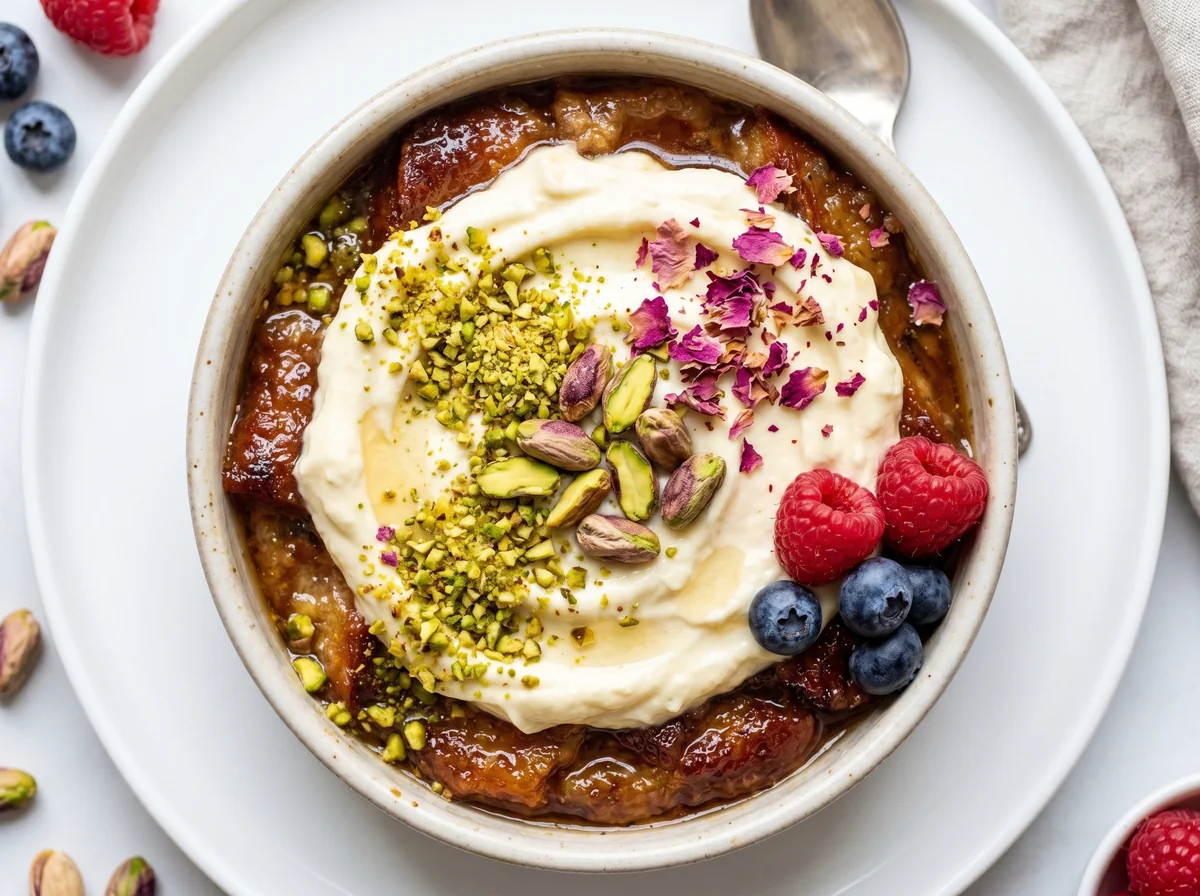
A chilled Levantine dessert — toasted bread crumbs soaked in sugar syrup, blanketed with a thick cream layer (ashta) and scattered with pistachios. A no-bake celebration sweet with a high glycemic load, containing gluten, dairy, and tree nuts.
Aish el-Saraya is a classic Levantine dessert whose name means 'palace bread' (al-saraya = the palace) — it was once served in the courts of rulers. The concept is brilliantly clever: stale bread is toasted, crumbled, and soaked in syrup to form a soft base, then blanketed with thick ashta cream and scattered with pistachios.
It is a cold, no-bake dessert beloved across Lebanon, Syria, Jordan, and Palestine. Its elegance and contrasting layers — a brown base and white ashta — have made it a refined dessert for celebrations and hospitality.
Preparation Steps
Dry and crumb the bread
Remove the crusts, cut the bread, and dry it in the oven until golden, crisp, and completely dry (without burning). Process in a food processor into fine crumbs. The toasted crumbs are the base of Aish el-Saraya — toasting gives them a deep, roasted flavour.
Make the syrup
Bring the sugar and water to a boil, add the lemon juice, and boil for 10 minutes until slightly thickened, then add the orange-blossom water and rose water. Keep it warm (not completely cold — the crumbs absorb it better while it is warm).
Soak the crumbs in syrup
Spread the toasted crumbs in a dish or mould and press them into a compact layer, then pour the warm syrup over gradually until fully saturated — soft and cohesive like dough, not dry and not waterlogged. Press firmly to form a solid base layer.
Cook the ashta cream
In a saucepan, whisk the milk with the cornstarch and sugar thoroughly before heating (to prevent lumps), then place over medium heat, stirring constantly until it thickens into a glossy, thick cream. Remove from the heat and stir in the rose water. This homemade ashta is the top layer of Aish el-Saraya.
Cool and assemble
Pour the hot ashta over the syrup-soaked crumb layer and spread evenly, then let the dish cool before refrigerating for at least two hours until both layers are set and chilled. Refrigeration is essential for the layers to hold and for clean slicing.
Garnish and serve
Scatter the crushed pistachios over the ashta layer and cut the Aish el-Saraya into squares. Serve cold. This is a refreshing Levantine dessert that needs no baking (no-bake), combining a syrup-drenched bread base with smooth ashta and crunchy pistachios — served at celebrations and for guests.
Blood Sugar Impact
The glycemic index (GI) measures how quickly a food raises blood sugar, while the glycemic load (GL) measures how much a full serving raises it. Together they give the complete picture.
Glycemic Index
GI
55Low
Low0–55Medium56–69High70+
A low value (≤55) means a gradual rise in blood sugar — the most suitable range for diabetes and insulin resistance.
Glycemic Load
GL
18Medium
Low0–10Medium11–19High20+
Glycemic load reflects the impact of the full serving. To lower it: take half a serving, or pair the recipe with a source of protein and fiber.
Nutritional Information
Per ServingMakes 8 servings · one serving is about 225 g of raw ingredients
Calories233 kcal12%of Daily Value*
Protein9 g18%of Daily Value*
Carbohydrates36 g13%of Daily Value*
Fat6 g8%of Daily Value*
Fiber4 g14%of Daily Value*
Sodium174 mg8%of Daily Value*
Potassium335 mg7%of Daily Value*
Phosphorus190 mg15%of Daily Value*
* Percent Daily Values are based on a 2,000-calorie diet per FDA food-label reference values — your daily needs may be higher or lower. Values are derived from the recipe's ingredients via the USDA database.
Troubleshooting
The most common problems when preparing Aish Saraya, and how to fix them:
Base is dry and crumbly, won't hold together
Not enough syrup, or crumbs not fully saturated. Pour the warm syrup gradually until the crumbs are soft and cohesive like dough — press firmly into the dish to set.
Base is waterlogged and runny
Too much syrup. Add gradually and stop when the bread is cohesive like soft dough, not swimming. If overdone, add more toasted crumbs to absorb the excess.
Ashta has lumps
The cornstarch was added to hot milk without whisking. Whisk the cold milk with the cornstarch and sugar before heating, and stir constantly over medium heat as it thickens. If lumps form, whisk vigorously or strain.
Layers didn't hold together
Not chilled enough. After pouring the ashta, refrigerate for at least two hours until both layers are set — slicing while warm will break them apart.
Bread flavour dominates
Not enough toasting or crusts not removed. Remove the crusts and toast thoroughly until golden (giving a roasted note, not a raw-bread taste), and process into fine crumbs.
Storage and Make-Ahead
Refrigerator (4°C)
Aish el-Saraya keeps covered in the refrigerator for three to four days (it contains a milk-based cream). Always serve cold — it firms up more with chilling.
Freezer
Not recommended for freezing — the ashta changes texture on thawing and becomes watery. Make and serve within a few days.
Make-ahead
An ideal make-ahead dessert: prepare the day before the occasion and refrigerate so the layers set and the flavours develop. Add the pistachios just before serving so they stay crunchy.
Note
As a cold no-bake dessert, it is very practical for entertaining: prepare ahead, take straight from the refrigerator, slice, and serve.
Tested Ingredient Substitutions
Original Ingredient
Tested Substitute
Ratio
Flavor Difference
Toast bread
Rusks, biscotti, or dried white bread
Same amount
Any bread toasted and crumbed works; toast is practical and gives fine, smooth crumbs
Homemade ashta cream (milk and cornstarch)
Ready-made ashta
Same amount
Ready-made is faster; homemade is more economical and gives you control over the sweetness
Whole milk
Low-fat milk
Same amount
Less fat; needs enough cornstarch to achieve a thick, set cream
How Much Does It Make? Scaling Guide
Number of servings
Bread
Sugar (syrup)
Milk (cream)
4 (half recipe)
3 flatbreads
1 cup
2 cups
8 (base)
6 flatbreads
2 cups
4 cups
16 (large tray)
12 flatbreads
4 cups
8 cups
EEINA Nutrition Tip
Aish el-Saraya is a celebration dessert with a high glycemic load — its base is bread soaked in sugar syrup. However, it is lower in fat than baklava or kunafa (no generous butter), and the ashta adds some calcium. Moderation is key: a small square is enough. To lighten it: reduce the sugar in both the syrup and the ashta, and use low-fat milk. For people with diabetes: a very small portion on a special occasion, with care.
Add This Recipe to Your Plan
The EEINA app saves your favorite recipes, calculates them from their real ingredients, and shows your daily numbers toward your goal. Try it free now.
It means 'palace bread' (al-saraya = palace), as it was once served in the courts of rulers and governors. It is a refined Levantine dessert that transforms stale bread into an elegant two-layered sweet.
Does it need an oven?
No — Aish el-Saraya is a cold no-bake dessert (apart from toasting the bread and cooking the ashta on the hob). This makes it very practical for entertaining and advance preparation.
How do I get a firm, cohesive base?
Toast the bread and crumb it finely. Pour the warm syrup gradually until the crumbs are soft and cohesive like dough (not dry, not waterlogged), then press firmly into the dish and refrigerate.
Is Aish el-Saraya suitable for people with diabetes?
It is a celebration dessert with a high glycemic load (bread and sugar syrup). It is not an everyday choice, but it is lower in fat than baklava. A very small portion with light syrup on a special occasion, with care.