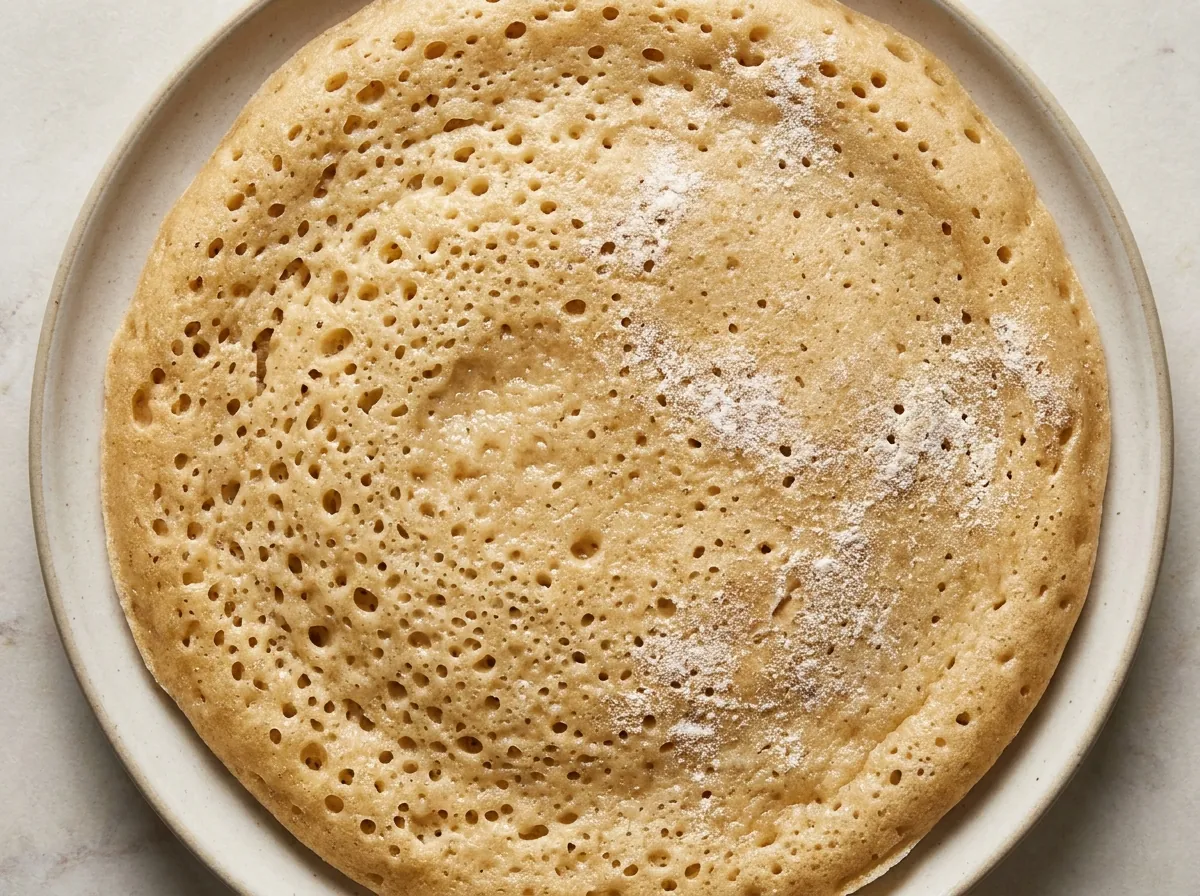
We bake lahoh as in Yemeni homes throughout the morning: a fermented batter poured onto a pan or griddle that forms a thin bread full of holes on one side and smooth on the other.
Its secret is the fermentation that gives it its sponginess and light sour taste. We make it a base to scoop up saltah and fahsah, or roll it with honey and ghee; it is the everyday companion of the Yemeni table.
Preparation Steps
Prepare the batter
Mix the white and whole wheat flours with the yeast and salt in a wide bowl, then add the warm water gradually and whisk until you get a smooth, lump-free batter, a little thinner than cake batter.
Fermentation
Cover the bowl and leave it in a warm place for about an hour until the batter ferments and bubbles and a faint sour smell appear on its surface, which is the secret to lahoh's sponginess.
Add the baking powder
Just before cooking, add the baking powder and stir gently, which gives the lahoh more holes.
Cook the lahoh
Heat a nonstick pan over medium heat without oil, pour in a ladle of the batter and let it spread into a thin circle, and cook it on one side without flipping until the top dries, the holes form, and the bottom turns golden.
Serving
Lift the lahoh and repeat with the rest of the batter, and serve it warm as a base for saltah, fahsah, or broth, or roll it with honey and ghee for breakfast.
Blood Sugar Impact
The glycemic index (GI) measures how quickly a food raises blood sugar, while the glycemic load (GL) measures how much a full serving raises it. Together they give the complete picture.
Glycemic Index
GI
75High
Low0–55Medium56–69High70+
A low value (≤55) means a gradual rise in blood sugar — the most suitable range for diabetes and insulin resistance.
Glycemic Load
GL
26High
Low0–10Medium11–19High20+
Glycemic load reflects the impact of the full serving. To lower it: take half a serving, or pair the recipe with a source of protein and fiber.
Nutritional Information
Per ServingMakes 8 servings · one serving is about 135 g of raw ingredients
Calories170 kcal8%of Daily Value*
Protein5 g10%of Daily Value*
Carbohydrates35 g13%of Daily Value*
Fat0 g0%of Daily Value*
Fiber1 g4%of Daily Value*
Sodium173 mg8%of Daily Value*
Potassium53 mg1%of Daily Value*
Phosphorus77 mg6%of Daily Value*
* Percent Daily Values are based on a 2,000-calorie diet per FDA food-label reference values — your daily needs may be higher or lower. Values are derived from the recipe's ingredients via the USDA database.
Troubleshooting
The most common problems when preparing Yemeni Lahoh (Spongy Fermented Flatbread), and how to fix them:
The lahoh is dense with no holes
Usually it did not ferment enough or the batter was too thick, so extend the fermentation and make the batter thinner by adding water, and baking powder before cooking helps.
The lahoh sticks to the pan
Use a good nonstick pan, set the heat to medium, and let it dry completely on top before lifting it.
The taste is too sour
Reduce the fermentation time or the amount of yeast, since long fermentation in hot weather increases the sourness.
Storage and Make-Ahead
Refrigerator
Keep the lahoh in a sealed bag for up to two days, and reheat it on a warm pan or with a short steam until it softens.
Freezing
Freeze it separated with parchment paper for up to a month, and reheat it straight from the freezer on a gentle pan.
Tested Ingredient Substitutions
Original Ingredient
Tested Substitute
Ratio
Flavor Difference
white flour
entirely whole wheat flour
same weight
The lahoh becomes richer in fiber, a little heavier, and darker in color
whole wheat
sorghum flour
up to a third of the amount
Sorghum is close to the traditional Tihama lahoh and gives a distinctive flavor
instant yeast
a sourdough starter or buttermilk
2 tablespoons of starter
The starter gives natural fermentation and a deeper flavor, as it was made in the old days
water
milk or water with a pinch of sugar
same amount
Milk gives a more golden color and a softer flavor, and the sugar activates the yeast
How Much Does It Make? Scaling Guide
Ingredient
Half amount
Amount (base)
Double
White flour
125 g
250 g
500 g
Brown flour
60 g
120 g
240 g
Warm water
350 ml
700 ml
1400 ml
Instant yeast
1.5 g
3 g
6 g
Salt
1.5 g
3 g
6 g
EEINA Nutrition Tip
Let the batter ferment for a full hour until the bubbles appear, and cook the lahoh on one side without flipping so the holes stay open and its sponginess becomes perfect.
Add This Recipe to Your Plan
The EEINA app saves your favorite recipes, calculates them from their real ingredients, and shows your daily numbers toward your goal. Try it free now.
What is the difference between lahoh and ordinary bread?
Lahoh is a thin fermented bread cooked on one side so sponge-like holes form in it, and it is usually eaten as a base for saltah and fahsah or with honey, not as a standalone loaf.
Why do we cook it on one side?
Cooking on one side keeps the holes open on top and gives the lahoh its spongy texture that absorbs broth and honey.
What do we eat lahoh with?
We eat it warm with saltah, fahsah, or Yemeni broth, or roll it with honey and ghee for breakfast.