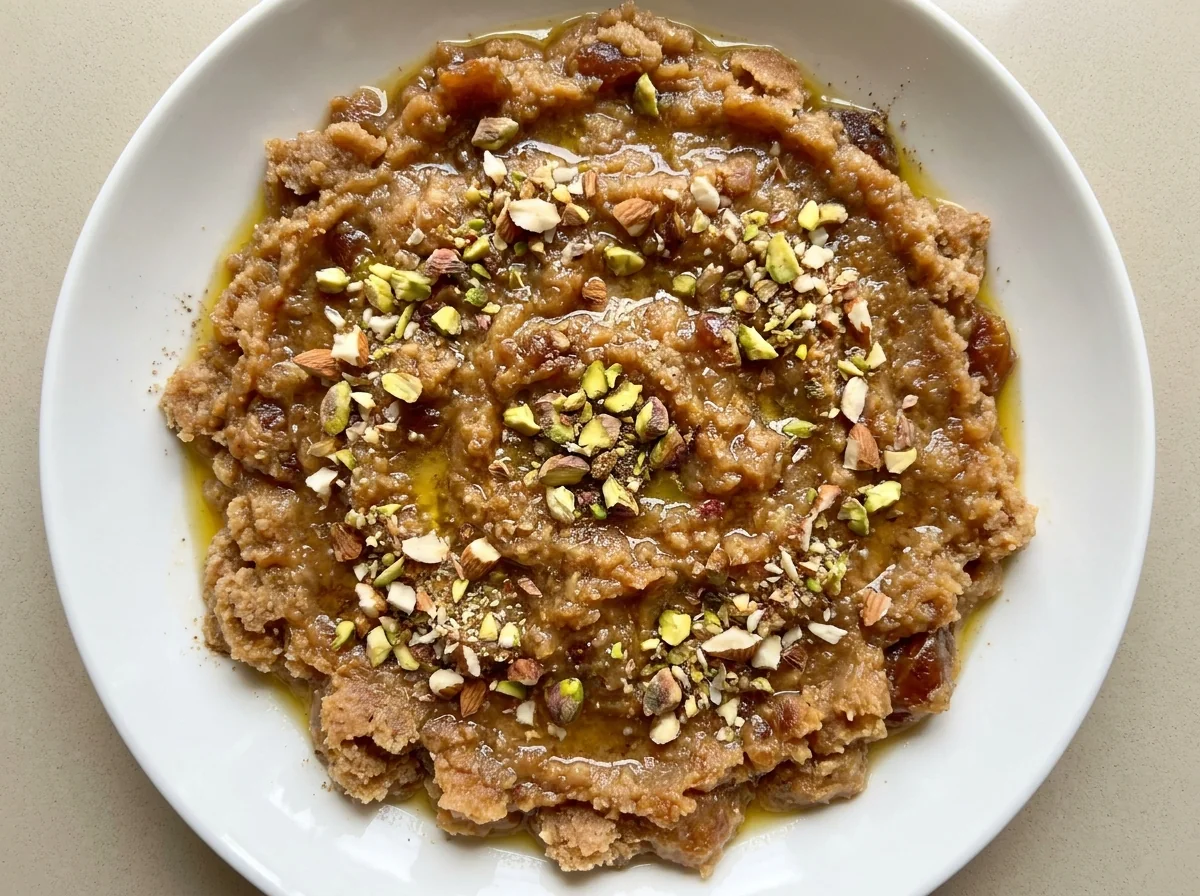
We make haneeni the way grandmothers make it in Yemen: whole-wheat bread toasted in ghee until its color deepens, then kneaded with mashed dates to become a warm, cohesive sweet.
Haneeni was a food for mornings and for hospitality, made from stale bread and dates so nothing was thrown away. We garnish it with nuts and serve it with coffee, a simple, creamy sweet carrying the memory of home.
Preparation Steps
Toasting the bread
Cut the whole-wheat bread into small squares, melt half the ghee in a pan over medium heat, and toast the bread while stirring until it turns golden and crisp.
Mashing the dates
Grind the pitted dates in a food processor until they form a smooth paste, and you can warm them slightly to soften them if they are dry.
Mixing
Lower the heat and add the date paste, cardamom, and the remaining ghee to the toasted bread, then stir gently for two minutes until the mixture comes together.
Light mashing
Mash the mixture lightly with the back of the spoon until it holds together while keeping the bread's texture, so do not make it completely smooth.
Serving
Arrange it on a plate, garnish it with the crushed nuts, and serve it warm or at room temperature with coffee or tea.
Blood Sugar Impact
The glycemic index (GI) measures how quickly a food raises blood sugar, while the glycemic load (GL) measures how much a full serving raises it. Together they give the complete picture.
Glycemic Index
GI
50Low
Low0–55Medium56–69High70+
A low value (≤55) means a gradual rise in blood sugar — the most suitable range for diabetes and insulin resistance.
Glycemic Load
GL
32High
Low0–10Medium11–19High20+
Glycemic load reflects the impact of the full serving. To lower it: take half a serving, or pair the recipe with a source of protein and fiber.
Nutritional Information
Per ServingMakes 4 servings · one serving is about 140 g of raw ingredients
Calories440 kcal22%of Daily Value*
Protein10 g20%of Daily Value*
Carbohydrates73 g27%of Daily Value*
Fat14 g18%of Daily Value*
Fiber9 g32%of Daily Value*
Sodium241 mg10%of Daily Value*
Potassium594 mg13%of Daily Value*
Phosphorus182 mg15%of Daily Value*
* Percent Daily Values are based on a 2,000-calorie diet per FDA food-label reference values — your daily needs may be higher or lower. Values are derived from the recipe's ingredients via the USDA database.
Troubleshooting
The most common problems when preparing Yemeni Date and Toasted Bread Sweet (Haneeni), and how to fix them:
The haneeni is dry and crumbly
Add a little warm ghee or a spoonful of warm water, since dry dates and stale bread need moisture to bind them together.
The haneeni is sticky and too heavy
Balance the amounts by adding a little more toasted bread, since too many dates make it sticky.
The bread tastes raw
Toast the bread well until it colors and crisps before adding the dates, since good toasting gives the flavor.
Storage and Make-Ahead
Refrigerator
Keep it in an airtight container for up to four days, and reheat it for a few minutes over low heat or let it return to room temperature before serving.
Freezer
Freeze it for up to a month in an airtight container, then thaw it in the refrigerator and warm it slightly so its texture returns.
Tested Ingredient Substitutions
Original Ingredient
Tested Substitute
Ratio
Flavor Difference
toasted whole-wheat bread
wheat bread or stale Yemeni kidam
same weight, 240 g
Stale bread is the original in haneeni, and wheat adds fiber
ghee
butter or coconut oil
same weight, 40 g
Ghee is closer to the traditional flavor, and butter is a little lighter
dates
Khalas, Sukkari, or Ajwa dates
same weight, 250 g
Any soft date works, and the sugar and color vary by type
nuts
toasted sesame or coconut
as desired
For garnish, and it can be omitted for those avoiding nuts
How Much Does It Make? Scaling Guide
Ingredient
Half the amount
The amount (base)
Double
pitted dates
125 g
250 g
500 g
whole-wheat bread
120 g
240 g
480 g
ghee or butter
20 g
40 g
80 g
nuts for garnish
10 g
20 g
40 g
EEINA Nutrition Tip
Choose soft dates such as Khalas or Sukkari so the paste comes together easily, and if the dates are dry, soak them in warm water for a few minutes, then drain them before grinding.
Add This Recipe to Your Plan
The EEINA app saves your favorite recipes, calculates them from their real ingredients, and shows your daily numbers toward your goal. Try it free now.
A homemade Yemeni and Gulf sweet of mashed dates and whole-wheat bread toasted in ghee, made quickly and served at breakfast or for hospitality with coffee.
Is haneeni healthy?
The dates and whole-wheat bread provide fiber and natural energy, but it is rich and calorie-dense because of the ghee and dates, so it is best eaten in moderation.
Should I use fresh bread?
The original uses stale or toasted bread, since soft bread makes the haneeni sticky, which is why we toast it well first.