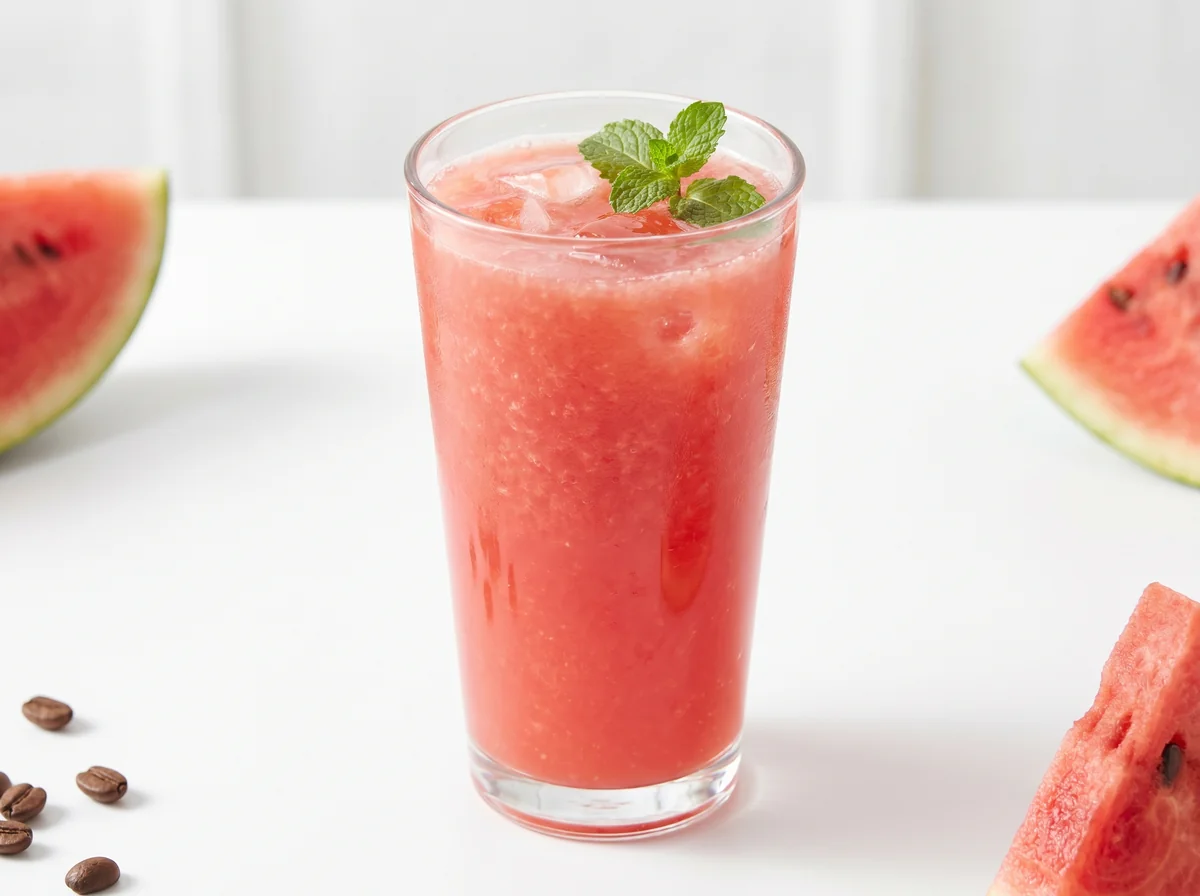
A refreshing summer juice: ripe red watermelon blended into a cooling low-calorie drink, the quintessential summer beverage. Low glycaemic load despite a high GI, free of common allergens.
Watermelon juice is a beloved refreshing summer drink throughout the Arab world, the drink of heat and summer. Watermelon is the great summer fruit of the Arab world, juicy, sweet, and refreshing, eaten and juiced to quench thirst and hydrate the body in the heat.
Ripe red watermelon is blended into a generous, naturally sweet juice (no sugar needed) and served very cold with lemon and mint. Its low calories (watermelon is 92% water), its refreshing quality, and its natural sweetness have made it one of the most beloved summer beverages in the Arab world, a symbol of hot summer evenings and cool refreshment.
Preparation Steps
Prepare the watermelon
Choose a ripe, sweet, deep-red watermelon and cut it into cubes, removing the seeds (or most of them). A ripe, sweet, red watermelon is the foundation of the juice (it is naturally sweet and needs no sugar). Watermelon is very high in water (92%) and yields a generous amount of juice.
Blend
Place the watermelon cubes in a blender and blend briefly until smooth. Watermelon is soft and watery and turns to juice quickly. Do not over-blend (there is no need, and it may incorporate air). Watermelon needs no added water as it is naturally liquid.
Strain (optional)
Strain the juice to remove any remaining seeds and pulp if you prefer a smoother texture, or leave it as is. Watermelon is already quite smooth. Straining gives a clearer juice; leaving it retains a little fibre.
Add lemon and mint
Add the lemon juice (it balances the sweetness and adds freshness and vitamin C) and mint if desired. Lemon and mint both amplify the refreshing quality of this summer watermelon juice. Taste and adjust.
Chill
Chill the juice well or add ice (or use pre-chilled watermelon). Watermelon juice is best served very cold as a summer hydration drink, and the cold temperature multiplies its refreshing power in the heat.
Serve
Pour the watermelon juice into glasses over ice with a mint leaf and serve cold immediately (drink fresh). This is a supreme summer refresher, beloved in the heat of the Arab summer. Watermelon (92% water) hydrates and cools, and its natural sweetness and low calories have made it one of the most beloved summer drinks, quenching thirst and cooling the body.
Blood Sugar Impact
The glycemic index (GI) measures how quickly a food raises blood sugar, while the glycemic load (GL) measures how much a full serving raises it. Together they give the complete picture.
Glycemic Index
GI
72High
Low0–55Medium56–69High70+
A low value (≤55) means a gradual rise in blood sugar — the most suitable range for diabetes and insulin resistance.
Glycemic Load
GL
11Medium
Low0–10Medium11–19High20+
Glycemic load reflects the impact of the full serving. To lower it: take half a serving, or pair the recipe with a source of protein and fiber.
Nutritional Information
Per ServingMakes 3 servings · one serving is about 220 g of raw ingredients
Calories64 kcal3%of Daily Value*
Protein1 g2%of Daily Value*
Carbohydrates16 g6%of Daily Value*
Fat0 g0%of Daily Value*
Fiber1 g4%of Daily Value*
Sodium2 mg0%of Daily Value*
Potassium242 mg5%of Daily Value*
Phosphorus23 mg2%of Daily Value*
* Percent Daily Values are based on a 2,000-calorie diet per FDA food-label reference values — your daily needs may be higher or lower. Values are derived from the recipe's ingredients via the USDA database.
Troubleshooting
The most common problems when preparing Watermelon Juice, and how to fix them:
The juice is pale and not sweet
The watermelon is not ripe. Use a ripe, sweet, deep-red watermelon (hollow sound when tapped, yellow patch on the skin). Under-ripe watermelon is pale and low in sweetness. Good watermelon is naturally sweet without sugar.
The juice is foamy
Over-blending. Blend the watermelon briefly only (it turns to juice quickly because it is watery); long blending incorporates air and creates foam. Let it settle for a moment or skim the foam off.
The juice has seeds in it
The seeds were not removed or the juice was not strained. Remove the seeds before blending (especially the hard black ones), or strain the juice afterward. Seedless watermelon is easiest, and the small white seeds are fine to leave.
The juice is not refreshing
Not cold enough. Watermelon juice is a summer hydration drink that should be served very cold, so chill it well or use pre-chilled watermelon and ice, and add lemon and mint for freshness. Cold temperature multiplies the enjoyment in the heat.
The taste changed quickly
Left sitting after blending. Drink it fresh immediately, as watermelon juice loses its flavour and freshness quickly (it is watery and delicate). A squeeze of lemon slows this slightly, but it is best drunk fresh.
Storage and Make-Ahead
Drink fresh
Watermelon juice is best drunk fresh immediately after blending (tastiest and most vibrant; watermelon is watery and delicate and loses its flavour quickly). Can be stored chilled in a sealed cup for 1 day (with a squeeze of lemon); stir before drinking as it separates.
Freezer
Watermelon juice can be frozen in ice-cube trays as refreshing cubes (added to drinks), or watermelon cubes can be frozen and blended as a slush. Fresh is better, but freezing is practical in summer.
Advance preparation
Best blended fresh (minutes). You can cube the watermelon, remove the seeds, and refrigerate it in advance, then blend it at serving time. Watermelon juice is very quick to prepare, so advance preparation is not necessary.
Food safety
Wash the watermelon rind before cutting (prevents transferring bacteria to the flesh), use clean utensils, drink the juice fresh, and refrigerate any leftover. Cut watermelon should be kept refrigerated.
Tested Ingredient Substitutions
Original Ingredient
Tested Substitute
Ratio
Flavor Difference
Watermelon alone
Blended with mint, lemon, strawberry, or cucumber
To taste
Mint and lemon boost freshness, strawberry adds flavour, and cucumber makes it lighter and more hydrating (summer cocktails).
Juiced watermelon
Eating the watermelon in pieces
-
Eating whole watermelon is slightly healthier (fibre and satiety, slows sugar absorption) than juicing it; an alternative for those monitoring blood sugar.
Plain (no additions)
A pinch of salt or mint (traditional)
A pinch
Some people sprinkle a little salt on watermelon (brings out the sweetness), and mint adds freshness; these are optional touches.
How Much Does It Make? Scaling Guide
Number of cups
Watermelon (cubed)
2 (half recipe)
2 1/2 cups
3 (base)
4 cups
6 (family)
8 cups
EEINA Nutrition Tip
Watermelon juice is an excellent hydrating drink with low calories: watermelon is 92% water (hydrates well in the heat), and is rich in lycopene (antioxidant for the heart), vitamin C, and citrulline (an amino acid beneficial for circulation). Important note: its glycaemic index is high (raises blood sugar quickly, 72) but its glycaemic load is low (few carbohydrates per serving because it is mainly water). So a moderate glass has a mild blood sugar effect despite the high GI, which illustrates the importance of glycaemic load, not GI alone. For people with diabetes: drink in moderation and with a meal, and it is better to eat whole watermelon (with fibre). Do not add sugar (it is sweet enough).
Add This Recipe to Your Plan
The EEINA app saves your favorite recipes, calculates them from their real ingredients, and shows your daily numbers toward your goal. Try it free now.
Yes, it is an excellent hydrating drink with low calories: watermelon is 92% water (hydrating), rich in lycopene (for the heart), vitamin C, and citrulline. Note: its glycaemic index is high but its glycaemic load is low (few carbohydrates per glass), so a moderate glass does not raise blood sugar much. Drink it in moderation without added sugar; eating it whole (with fibre) is slightly better.
Why is the GI high but the GL low?
The glycaemic index (GI) measures how quickly blood sugar is raised (watermelon is fast, 72), but the glycaemic load (GL) takes into account the actual carbohydrate content (watermelon is mainly water, so there are few carbohydrates per serving). Therefore a moderate glass has a low effect despite the high GI, which illustrates why glycaemic load matters, not GI alone.
Should I add sugar?
No, ripe watermelon is naturally sweet and sufficient, and adding sugar raises the glycaemic load and calories unnecessarily. Choose a ripe, sweet watermelon, and a squeeze of lemon balances and refreshes. Natural sweetness is always the best and healthiest option.
How do I choose a ripe, sweet watermelon?
Look for a watermelon that is heavy for its size (full of juice), has a yellow patch (where it rested on the ground as it ripened), and sounds hollow when tapped. These are signs of ripeness and sweetness, and a ripe watermelon gives sweeter, redder juice.
Sources: University of Sydney · Gulf GSO · Our methodology · Updated on