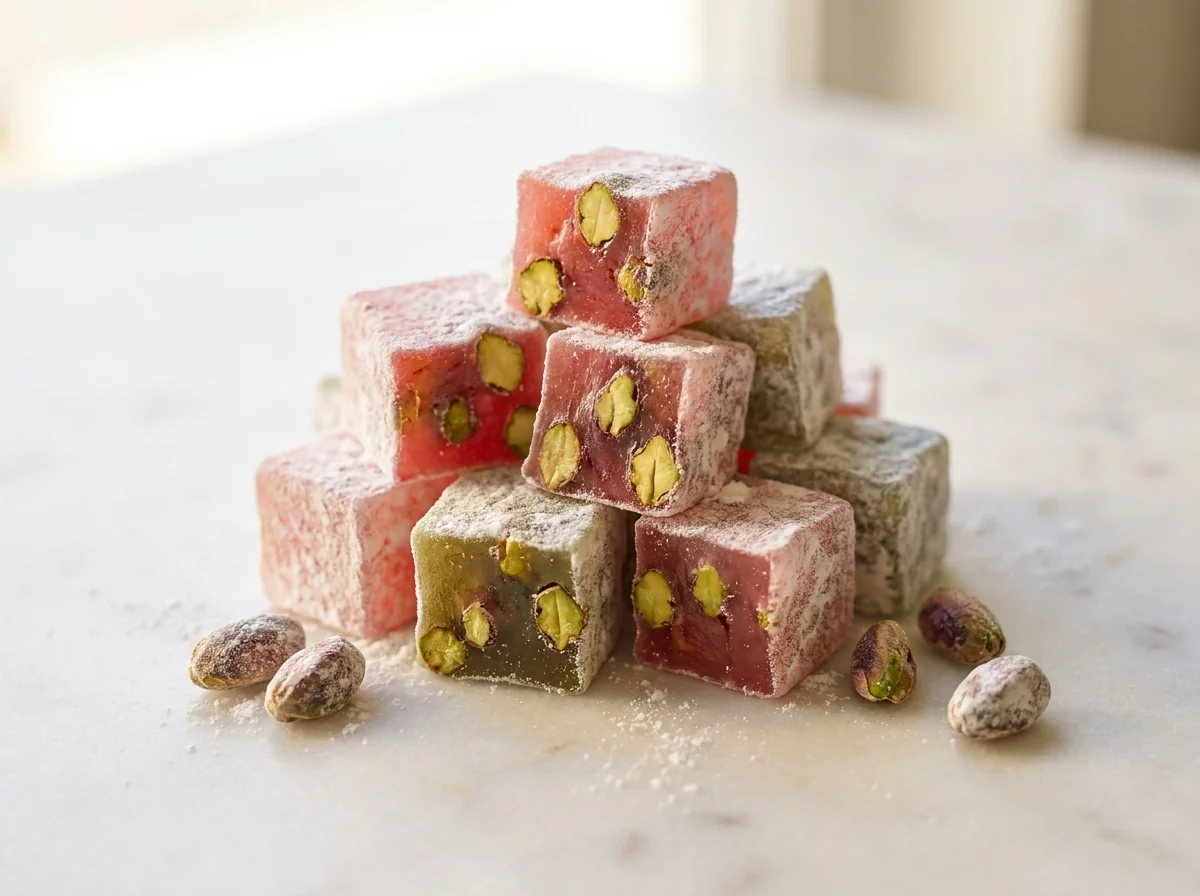
Turkish delight is among the most famous sweets of the Ottoman kitchen, known to Istanbul for centuries and spread across the world under the name Turkish delight.
It is cooked patiently over gentle heat until the sugar and starch turn into a translucent, gel-like consistency, then scented with rose water and studded with pistachios or hazelnuts. It is served in decorated boxes with Turkish coffee and given as a gift on holidays and occasions as a symbol of hospitality.
Preparation Steps
The sugar syrup
Boil the sugar with half the water and the lemon juice until the sugar dissolves and the syrup reaches about one hundred twenty-six degrees, for this temperature is the basis of the lokum's set.
The starch paste
In another pot, whisk the corn starch with the rest of the water over medium heat until you have a smooth, sticky paste.
Combining the two mixtures
Pour the hot sugar syrup gradually over the starch paste while whisking constantly until they are fully blended.
Slow cooking
Lower the heat to its lowest and cook the mixture for about fifty minutes, stirring from time to time, until it becomes golden, translucent, and thick.
Flavoring
Remove the pot from the heat and add the rose water and pistachios, stirring until the pistachios are distributed through the mixture.
Cooling and cutting
Pour the mixture into a lined mold and leave it at room temperature overnight until it sets, then cut it into cubes and coat them in the mixture of powdered sugar and starch.
Blood Sugar Impact
The glycemic index (GI) measures how quickly a food raises blood sugar, while the glycemic load (GL) measures how much a full serving raises it. Together they give the complete picture.
Glycemic Index
GI
68Medium
Low0–55Medium56–69High70+
A low value (≤55) means a gradual rise in blood sugar — the most suitable range for diabetes and insulin resistance.
Glycemic Load
GL
18Medium
Low0–10Medium11–19High20+
Glycemic load reflects the impact of the full serving. To lower it: take half a serving, or pair the recipe with a source of protein and fiber.
Nutritional Information
Per ServingMakes 25 servings · one serving is about 50 g of raw ingredients
Calories118 kcal6%of Daily Value*
Protein1 g2%of Daily Value*
Carbohydrates27 g10%of Daily Value*
Fat1 g1%of Daily Value*
Fiber0 g0%of Daily Value*
Sodium1 mg0%of Daily Value*
Potassium29 mg1%of Daily Value*
Phosphorus15 mg1%of Daily Value*
* Percent Daily Values are based on a 2,000-calorie diet per FDA food-label reference values — your daily needs may be higher or lower. Values are derived from the recipe's ingredients via the USDA database.
Troubleshooting
The most common problems when preparing Turkish Delight (Rose and Pistachio Lokum), and how to fix them:
The lokum does not set
It was not cooked enough or the syrup did not reach its temperature, so cook it again over gentle heat until it thickens and leave it to cool overnight.
The texture is grainy and crystallized
Lemon juice prevents the sugar from crystallizing, so make sure to add it and do not stir the syrup while it boils.
The lokum sticks to the hand
Coat it well in the mixture of powdered sugar and starch, and keep it in a dry place away from moisture.
Storage and Make-Ahead
Room temperature
Keep it in an airtight container between layers of powdered sugar and starch for up to three weeks in a dry place.
Refrigeration
It does not need refrigeration, and moisture dissolves its coating, so it is best kept dry at room temperature.
Tested Ingredient Substitutions
Original Ingredient
Tested Substitute
Ratio
Flavor Difference
pistachios
hazelnuts or walnuts
same weight, 70 g
All roasted nuts suit the filling
rose water
orange blossom water
same amount, 5 ml
Orange blossom water gives a different fragrance, and both are traditional
corn starch
wheat starch
same weight, 120 g
Wheat starch is a practical substitute, but it carries gluten, so its gluten-free status no longer holds
How Much Does It Make? Scaling Guide
Ingredient
Half amount
Amount (base)
Double
Sugar
225 g
450 g
900 g
Corn starch
60 g
120 g
240 g
Water
250 ml
500 ml
1000 ml
Pistachios
35 g
70 g
140 g
Rose water
2.5 ml
5 ml
10 ml
EEINA Nutrition Tip
Cook the mixture over the gentlest heat and be patient for fifty minutes, for slow cooking is what gives lokum its translucent, chewy texture, while haste leaves it sticky and unset.
Add This Recipe to Your Plan
The EEINA app saves your favorite recipes, calculates them from their real ingredients, and shows your daily numbers toward your goal. Try it free now.
Lemon prevents the sugar from crystallizing and preserves the lokum's translucent, gel-like texture, and it is an important step we do not skip.
Why is it left overnight?
The long cooling lets the starch set completely so cutting becomes easy and its texture stays firm, while haste leaves it sticky.
Is Turkish delight plant-based?
Yes in this recipe, as it is made of sugar, starch, water, and pistachios without any animal product, but it remains a sugary sweet to be enjoyed in moderation.