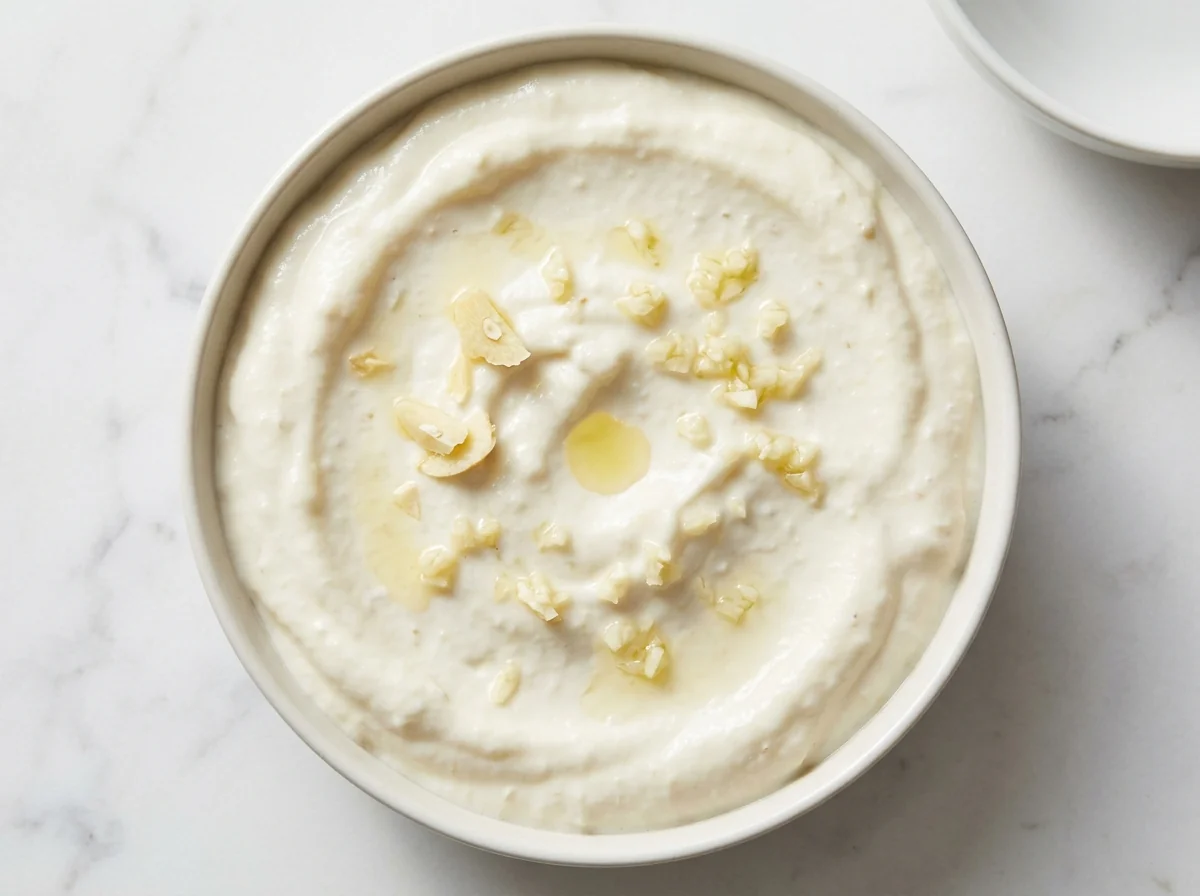
Crushed garlic blended with salt and lemon juice in a food processor, then vegetable oil and olive oil added gradually while blending until the sauce turns white and thick like mayonnaise.
The sauce of shawarma and grilled chicken in Levantine restaurants, and its texture is neither mayonnaise nor does it hold any egg: the garlic itself is the emulsifier, and its proteins grip the oil when it goes in drop by drop, so the sauce turns white and thick enough to stand on a spoon.
Adding the oil gradually is the whole recipe.
Preparation Steps
Blend the base
Blend the crushed garlic with the salt and the lemon juice in a food processor.
Add the oil gradually
Add the vegetable oil and the olive oil gradually and blend them in well.
Blend until it thickens
Keep working the ingredients until they come together and the sauce turns like mayonnaise.
Blood Sugar Impact
The glycemic index (GI) measures how quickly a food raises blood sugar, while the glycemic load (GL) measures how much a full serving raises it. Together they give the complete picture.
Glycemic Index
GI
7Low
Low0–55Medium56–69High70+
A low value (≤55) means a gradual rise in blood sugar — the most suitable range for diabetes and insulin resistance.
Glycemic Load
GL
0Low
Low0–10Medium11–19High20+
Glycemic load reflects the impact of the full serving. To lower it: take half a serving, or pair the recipe with a source of protein and fiber.
Nutritional Information
Per ServingMakes 20 servings · one serving is about 30 g of raw ingredients
Calories184 kcal9%of Daily Value*
Protein0 g0%of Daily Value*
Carbohydrates1 g0%of Daily Value*
Fat20 g26%of Daily Value*
Fiber0 g0%of Daily Value*
Sodium350 mg15%of Daily Value*
Potassium16 mg0%of Daily Value*
Phosphorus4 mg0%of Daily Value*
* Percent Daily Values are based on a 2,000-calorie diet per FDA food-label reference values — your daily needs may be higher or lower. Values are derived from the recipe's ingredients via the USDA database.
Troubleshooting
The most common problems when preparing Toumiya Garlic Sauce, and how to fix them:
The toumiya split and turned oily
The oil went in too fast. Start again with a crushed clove of garlic in the processor and add the split mixture to it gradually, and it comes back together.
It did not whiten or thicken
There is too little garlic for the oil, or the lemon all went in at the end. Follow the source's order: garlic, salt, and lemon first, then the oil.
The taste is too sharp
The garlic is very fresh or there is too much of it. Toumiya settles after an hour in the refrigerator, and the garlic can be cut back slightly next time.
It is saltier than it should be
The tablespoon of salt is the source's amount and it is generous. Start with half of it and taste once the sauce has thickened.
Storage and Make-Ahead
Refrigerator (4°C)
In a sealed glass jar for up to a week, and it thickens further as it chills.
Serving
At room temperature with grills, shawarma, and fried potatoes.
Not recommended
Freezing: the emulsion breaks completely on thawing and does not come back.
Sign of spoilage
A sharp smell that is not the smell of garlic, or a change in color: throw it out without tasting.
Tested Ingredient Substitutions
Original Ingredient
Tested Substitute
Ratio
Flavor Difference
Olive oil
All vegetable oil
440 ml
The toumiya comes out gentler in flavor and whiter in color, which is what restaurants usually do.
Lemon juice
Half of it white vinegar
60 ml lemon with 60 ml vinegar
A steadier acidity and a longer life in the refrigerator.
Salt
Half the amount
9 g
For anyone watching their sodium, and the acidity makes up for it in bringing out the taste.
Raw garlic
Half of it garlic boiled for two minutes
25 g each
It softens the bite considerably while keeping the flavor, for anyone who cannot take raw garlic.
How Much Does It Make? Scaling Guide
Servings
Garlic
Lemon juice
Vegetable oil
Olive oil
2 servings (half batch)
25 g
60 ml
110 ml
110 ml
4 servings (base recipe)
50 g
120 ml
220 ml
220 ml
8 servings (double)
100 g
240 ml
440 ml
440 ml
EEINA Nutrition Tip
Going slowly is not advice but a condition: pouring the oil in all at once breaks the emulsion and the toumiya separates into oil and garlic within seconds. Start with a very thin thread and do not increase it until the mixture whitens and thickens.
Add This Recipe to Your Plan
The EEINA app saves your favorite recipes, calculates them from their real ingredients, and shows your daily numbers toward your goal. Try it free now.
We put it at 50 grams, the weight of the average head in circulation, while the source says a head with no weight. Heads vary, so anyone using a large one should add a little more lemon to keep the balance.
Why does toumiya split for so many people?
Because the oil is added too quickly. Garlic is a weak emulsifier compared with egg yolk, so it needs a very thin thread of oil at the start before it grips.
Does it contain egg like mayonnaise?
No. The source's ingredients are garlic, salt, lemon, and oil only, and the resemblance is in the texture rather than in the ingredients, so it is free of egg and dairy.
How long does it keep?
A week in the refrigerator in a sealed container. The lemon's acidity and the salt preserve it, and the garlic flavor sharpens over the days.
How many spoons is a serving?
The source estimates the batch at four servings, and toumiya is a sauce eaten by the spoon rather than by the plate. We carried its estimate across as published and the values are calculated on it, and one tablespoon comes to about a tenth of a serving.
Sources: USDA · University of Sydney · Our methodology · Updated on