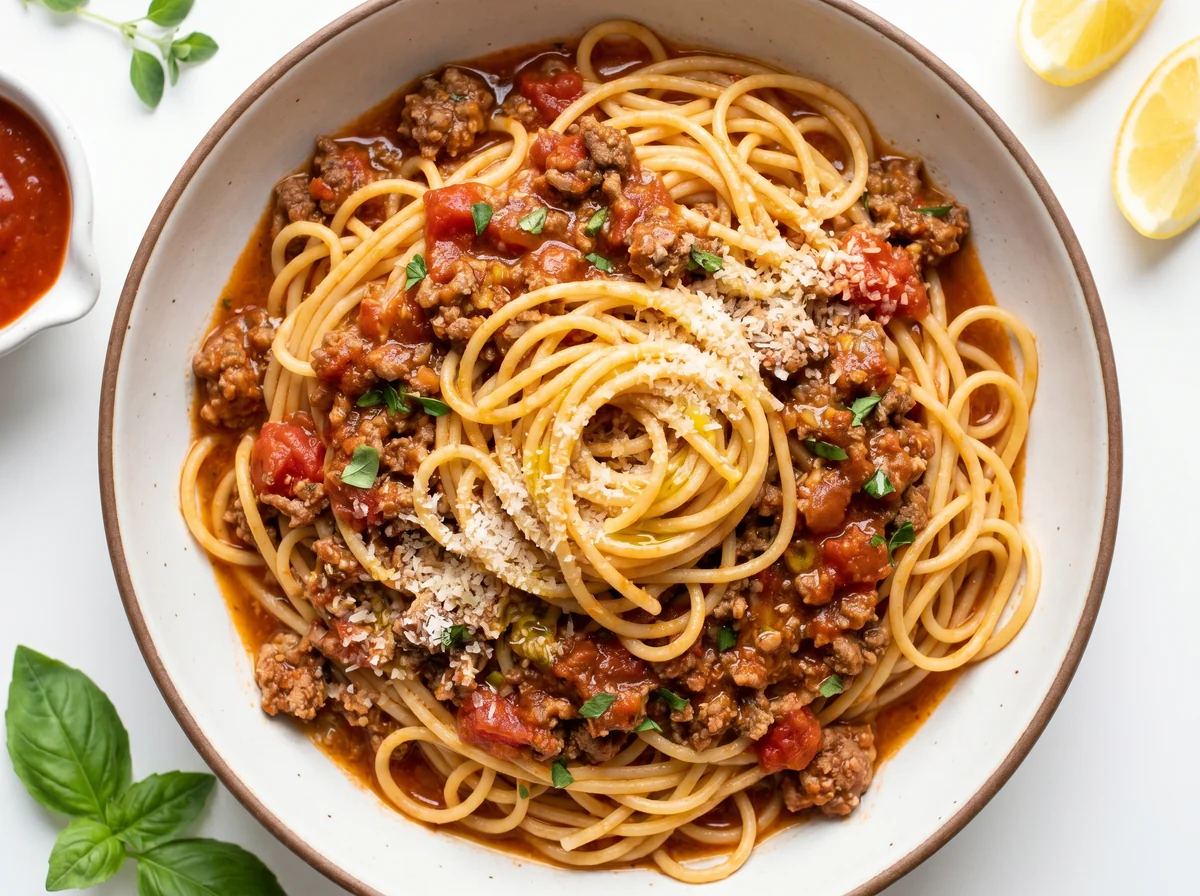
Whole-wheat spaghetti with Bolognese sauce — lean minced beef and tomatoes with vegetables slow-cooked together. Higher in fibre and lower GI than white spaghetti. A beloved Italian family dish.
Bolognese is the slow meat sauce from Bologna, Italy.
EEINA's version uses whole-wheat spaghetti — higher in fibre — with lean mince and plenty of vegetables in the sauce, producing a satisfying, balanced family dish that keeps all the depth of flavour of the original Bolognese.
Preparation Steps
Build the soffritto
Heat the oil in a pot over medium heat and sauté the onion, carrot, and celery for 5 minutes until softened — this Italian base, the soffritto, gives the sauce sweetness and depth. Add the garlic and cook for 1 minute.
Brown the beef
Add the minced beef and break it up with a spoon as it cooks for 6 minutes, until browned and no longer pink. Add the tomato paste and stir for 1 minute until its colour deepens.
Slow-cook the sauce
Add the crushed tomatoes, oregano, basil, salt, and pepper. Bring the sauce to a boil then reduce to the gentlest simmer for 20 to 25 minutes, stirring occasionally, until it thickens and the flavour deepens. The slow cooking is the secret of authentic Bolognese — do not rush it.
Cook the spaghetti
While the sauce cooks, boil the spaghetti in a large pot of well-salted water following the packet time minus 1 minute (al dente — tender with a slight bite). Reserve half a cup of the pasta water before draining.
Combine and serve
Toss the spaghetti with the sauce (or spoon the sauce on top). Add a splash of pasta water if it looks dry to bring everything together. Finish with Parmesan and fresh basil and serve warm with a green salad.
Blood Sugar Impact
The glycemic index (GI) measures how quickly a food raises blood sugar, while the glycemic load (GL) measures how much a full serving raises it. Together they give the complete picture.
Glycemic Index
GI
42Low
Low0–55Medium56–69High70+
A low value (≤55) means a gradual rise in blood sugar — the most suitable range for diabetes and insulin resistance.
Glycemic Load
GL
17Medium
Low0–10Medium11–19High20+
Glycemic load reflects the impact of the full serving. To lower it: take half a serving, or pair the recipe with a source of protein and fiber.
Nutritional Information
Per ServingMakes 4 servings · one serving is about 365 g of raw ingredients
Calories470 kcal24%of Daily Value*
Protein28 g56%of Daily Value*
Carbohydrates48 g17%of Daily Value*
Fat20 g26%of Daily Value*
Fiber7 g25%of Daily Value*
Sodium97 mg4%of Daily Value*
Potassium926 mg20%of Daily Value*
Phosphorus399 mg32%of Daily Value*
* Percent Daily Values are based on a 2,000-calorie diet per FDA food-label reference values — your daily needs may be higher or lower. Values are derived from the recipe's ingredients via the USDA database.
Troubleshooting
The most common problems when preparing Spaghetti Bolognese, and how to fix them:
The sauce is acidic or sharp.
It was not cooked slowly enough. Bolognese needs 20 to 25 minutes of slow simmering for the tomatoes to lose their acidity and deepen. The grated carrot in the soffritto adds natural sweetness to balance the acidity without any sugar.
The beef is in clumps, not crumbled.
It was not broken up during browning. Break it apart with the back of a spoon as it cooks over medium-high heat until you have separate fine grains before adding the tomatoes.
The sauce is dry or heavy.
Too much liquid has evaporated. Add a splash of water, stock, or the starchy pasta cooking water — it thins the sauce and helps it cling to the pasta.
The spaghetti is sticky and clumped.
Too little water, unsalted water, or overcooked. Use a generous amount of well-salted water, stir in the first 2 minutes, and cook al dente. Do not rinse after draining — the surface starch helps the sauce adhere.
The flavour is flat with no depth.
The soffritto was skipped or the sauce was not simmered slowly enough, or not enough salt. Never skip the onion, carrot, and celery at the start; cook the sauce low and slow; and season properly. Parmesan at the end deepens the flavour.
Storage and Make-Ahead
Fridge (4 °C)
Bolognese sauce: 4 days in a sealed container — the flavour deepens considerably the next day. Store it separately from the spaghetti for the best texture.
Freezer (-18 °C)
Bolognese sauce freezes excellently for 3 months in individual portions. Cook fresh spaghetti at serving time.
Prep ahead
Prepare the Bolognese sauce in a large batch in advance — it only improves with time and is ideal for batch cooking. Boiling the pasta takes 10 minutes at serving time.
Reheating
Reheat the sauce gently over low heat with a splash of water, then toss with fresh or reheated pasta. Do not leave it outside the fridge for more than 2 hours [2].
Tested Ingredient Substitutions
Original Ingredient
Tested Substitute
Ratio
Flavor Difference
Whole-wheat spaghetti
Courgette noodles or lentil spaghetti
Same amount
Courgette noodles cut the carbohydrates dramatically for people with diabetes; lentil spaghetti is higher in protein.
Minced beef
Minced chicken or turkey, or lentils
Same weight
Lentils are the vegetarian option; turkey is lower in fat.
Crushed tomatoes
Canned whole peeled tomatoes, crushed by hand
600 g
Faster and more consistent when fresh tomatoes are out of season.
Parmesan
Reduced-fat cheese or nutritional yeast
Same amount
To reduce fat or for the dairy-free version.
Beef (for the vegetarian version)
Lentils and finely chopped mushrooms
Same weight
Rich umami flavour and high fibre.
How Much Does It Make? Scaling Guide
Servings
Spaghetti
Meat
Tomato
Pot
2 (single × 2)
100 g
200 g
1 1/4 cups
medium pot
4 (base)
200 g
400 g
2 1/2 cups
large pot
6 (family)
300 g
600 g
3 1/2 cups
large pot
8 (guests)
400 g
800 g
5 cups
extra-large pot
EEINA Nutrition Tip
Whole-wheat spaghetti cooked al dente raises blood sugar more slowly than white pasta, and the vegetables and beef in the sauce slow absorption further. The carbohydrates from the pasta are the main consideration, so stick to a moderate portion (50 g dried per person) and load up on the sauce and vegetables in its place.
Add This Recipe to Your Plan
The EEINA app saves your favorite recipes, calculates them from their real ingredients, and shows your daily numbers toward your goal. Try it free now.
Is spaghetti Bolognese suitable for people with diabetes?
Whole-wheat spaghetti cooked al dente has a low glycaemic index (about 48), but the glycaemic load is moderate — so portion size matters. Stick to about 50 g dried and add extra meat sauce and vegetables. Courgette noodles are a better option for them.
What is the secret of authentic Bolognese?
The soffritto (onion, carrot, and celery) as the base, plus slow cooking for at least 20 to 25 minutes for the flavour to deepen. The longer the slow cooking, the better the flavour — which is why it tastes even better the next day.
How do I make it gluten-free?
Use lentil, rice, or courgette spaghetti. The Bolognese sauce itself is already gluten-free — just confirm the tomato paste is too.
Can I make it vegetarian?
Yes — replace the beef with a mix of lentils and finely chopped mushrooms. It gives a texture and depth close to meat, with high fibre and plant-based protein.
Is it suitable for batch cooking?
Excellent for it — in fact, it is recommended: Bolognese sauce improves with time and freezes for 3 months. Cook a large batch and portion it out; cook the spaghetti fresh at each serving.
Sources: USDA · University of Sydney · Gulf GSO · Our methodology · Updated on