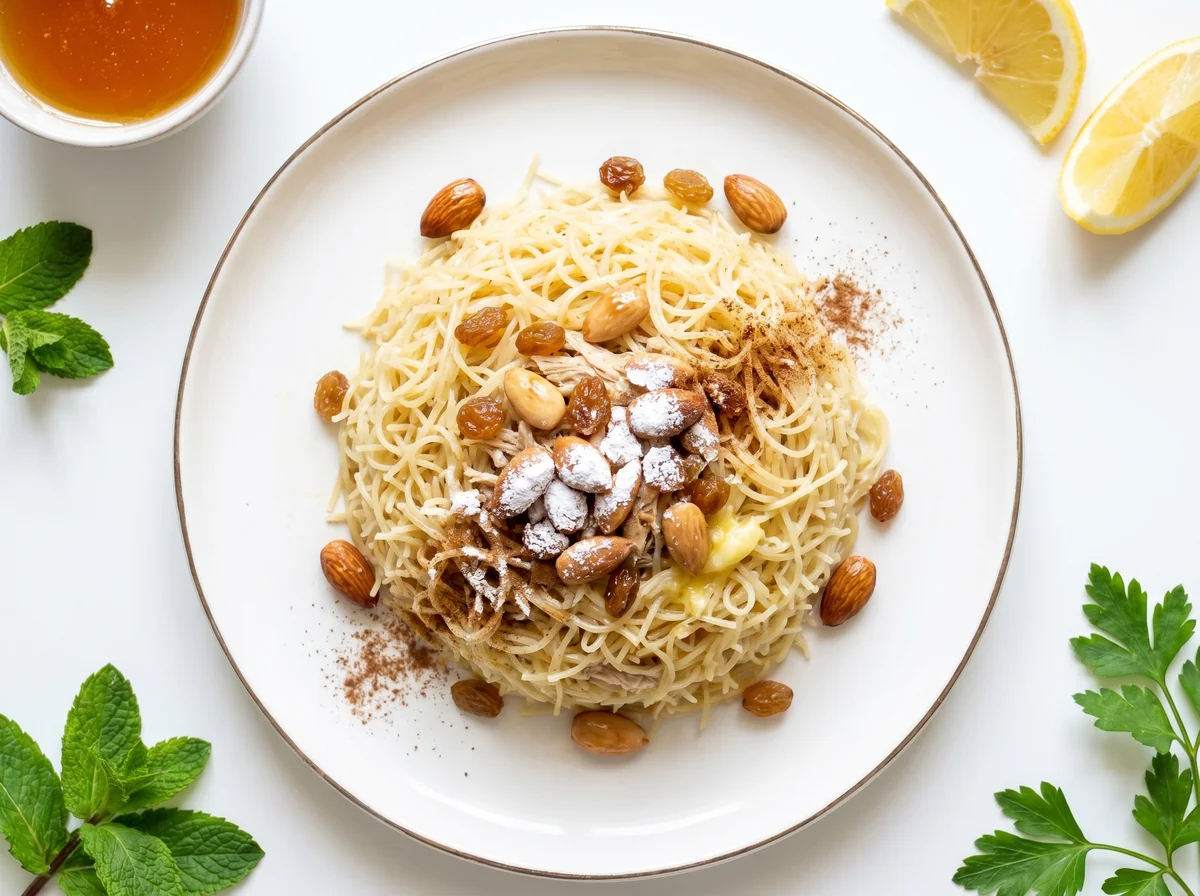
A timeless Moroccan sweet — steamed thin vermicelli garnished with cinnamon, icing sugar, almonds, and raisins. A warm celebratory dessert with a moderate glycaemic load, containing gluten, tree nuts, and dairy.
Seffa (or seffa medfouna) is a timeless Moroccan sweet made from thin steamed vermicelli (or couscous) garnished with cinnamon, icing sugar, almonds, and raisins. It has two versions: sweet (the well-known one) and savoury with chicken (close to seffa with chicken).
The name 'medfouna' sometimes refers to ingredients buried in the centre of the mound. It is served at occasions, weddings, and feasts, sometimes at the close of a meal, eaten warm with cold milk poured on top by those who like it. It reflects the Moroccan kitchen's mastery of combining sweet and savoury, and the technique of steaming, and its presence at the table is a sign of celebration, generosity, and genuine Moroccan hospitality.
Preparation Steps
First steam of the vermicelli
Sprinkle the vermicelli with a little water and oil, rub to separate the strands, then steam in a couscoussier (steaming pot) over boiling water until steam rises through the vermicelli. Repeated steaming is the secret to fluffy, soft seffa — not gluey. The method is steaming, not boiling.
Moisten and loosen
Transfer the vermicelli to a bowl, sprinkle with lightly salted water, loosen with a fork (take care with the heat), and leave to absorb for a few minutes. This moistening between steamings softens the strands and prevents clumping.
Repeat steaming
Repeat the steaming and moistening two or three times until the vermicelli is fully cooked, tender, and fluffy. Patience with repeated steaming gives the ideal soft, airy texture that distinguishes Moroccan seffa from simply boiled vermicelli.
Add the butter and raisins
After the final steaming, add the butter (or ghee) and orange blossom water and raisins to the hot vermicelli, and stir until the butter melts and the vermicelli is evenly coated. Butter gives rich flavour and the raisins add sweetness and texture.
Shape in a dish
Press the vermicelli into a mould or mound it in a serving dish in a pyramid shape. The name 'medfouna' (buried) sometimes comes from burying ingredients (almonds or meat in the savoury version) in the centre of the mound, to be discovered when eating. The sweet version is decorated on the outside.
Garnish and serve
Garnish the mound with crossing lines of cinnamon and icing sugar and the ground almonds and raisins (a distinctive Moroccan presentation). Serve warm with cold milk poured alongside for those who enjoy it. Seffa is a timeless Moroccan celebratory dessert, served at occasions, weddings, and feasts, and sometimes at the end of a meal. It brings together tender vermicelli with the sweetness of cinnamon, almonds, and raisins — a symbol of Moroccan hospitality.
Blood Sugar Impact
The glycemic index (GI) measures how quickly a food raises blood sugar, while the glycemic load (GL) measures how much a full serving raises it. Together they give the complete picture.
Glycemic Index
GI
54Low
Low0–55Medium56–69High70+
A low value (≤55) means a gradual rise in blood sugar — the most suitable range for diabetes and insulin resistance.
Glycemic Load
GL
31High
Low0–10Medium11–19High20+
Glycemic load reflects the impact of the full serving. To lower it: take half a serving, or pair the recipe with a source of protein and fiber.
Nutritional Information
Per ServingMakes 5 servings · one serving is about 85 g of raw ingredients
Calories318 kcal16%of Daily Value*
Protein8 g16%of Daily Value*
Carbohydrates60 g22%of Daily Value*
Fat6 g8%of Daily Value*
Fiber2 g7%of Daily Value*
Sodium6 mg0%of Daily Value*
Potassium271 mg6%of Daily Value*
Phosphorus132 mg11%of Daily Value*
* Percent Daily Values are based on a 2,000-calorie diet per FDA food-label reference values — your daily needs may be higher or lower. Values are derived from the recipe's ingredients via the USDA database.
Troubleshooting
The most common problems when preparing Seffa Medfouna (Moroccan Sweet Vermicelli), and how to fix them:
The vermicelli is sticky and clumped
It was boiled instead of steamed, or was not loosened between steamings. Steam the vermicelli (do not boil) and loosen between steamings with a sprinkle of water. Repeated steaming gives fluffy, separate strands. Boiling makes it gluey and clumped.
The vermicelli is hard and raw
Insufficient steaming. Repeat the steaming and moistening two or three times until fully tender and fluffy. One steaming may not be enough. Moistening between steamings helps the cooking.
Dry and parched
Not enough butter or moisture. Add enough butter and orange blossom water and raisins to the hot vermicelli (they moisten and perfume it). Good seffa is slightly moist and tender, not dry. Milk at serving also adds moisture.
Too sweet or not sweet enough
Imbalance of sugar. Seffa is sweetened with icing sugar and raisins; adjust the sugar to taste (raisins and almonds add sweetness themselves). Serve extra sugar on the side so each person can add their own.
The almonds lost their crunch
Added too early or were damp. Toast the almonds and leave to cool, then add at the decoration stage just before serving (not during cooking) so they stay crisp. Freshly toasted almonds are best.
Storage and Make-Ahead
Refrigerator (4°C)
Seffa keeps in an airtight container in the refrigerator for two to three days. It dries out slightly with chilling; reheat by steaming or in the microwave with a sprinkle of water to restore softness. Add the decoration (almonds and sugar) at serving time.
Advance preparation
The vermicelli can be steamed in advance and stored, then reheated and the butter and decoration added at serving. This shortens the lengthy repeated steaming process when preparing for occasions.
Freezer
Steamed vermicelli (without decoration) can be frozen for weeks. Thaw and reheat by steaming, then decorate fresh. Decoration (almonds and sugar) should always be added at serving to keep it fresh.
Food safety
Seffa is a steam-cooked sweet. Keep refrigerated (it contains butter), reheat well. Use fresh almonds and raisins and clean utensils, and serve warm for the best texture and taste.
Tested Ingredient Substitutions
Original Ingredient
Tested Substitute
Ratio
Flavor Difference
Thin vermicelli
Fine couscous
same quantity
Couscous is also a traditional substitute (seffa couscous), steamed the same way. Vermicelli is finer and cooks faster.
Icing sugar
Reduce it (raisins and almonds sweeten sufficiently)
to taste
Lowers sugar content. Seffa is delicious with the natural sweetness of raisins, almonds, and cinnamon and moderate sugar.
Almonds
Walnuts or peanuts, toasted
same quantity
Almonds are traditional. Walnuts are a substitute (still tree nuts). Avoid all nuts for anyone with a nut allergy.
How Much Does It Make? Scaling Guide
Servings
Vermicelli
Almonds
Raisins
3 (half recipe)
1.5 cups
1/4 cup
2 spoons
5 (base)
3 cups
1/2 cup
1/4 cup
10 (gathering)
6 cups
1 cup
1/2 cup
EEINA Nutrition Tip
Seffa is lighter than fried and syrup-soaked sweets. Almonds add protein, healthy fats, and fibre (which slows sugar absorption), and raisins provide natural sweetness with minerals. Its challenges are the vermicelli base (starch), icing sugar, and butter. To lighten it: reduce the icing sugar (raisins and almonds provide enough sweetness), use a moderate amount of butter, and increase the almonds for nutritional value. Its glycaemic load is moderate, so keep to a moderate portion as a special-occasion sweet or a light end to a meal.
Add This Recipe to Your Plan
The EEINA app saves your favorite recipes, calculates them from their real ingredients, and shows your daily numbers toward your goal. Try it free now.
A Moroccan sweet made from steamed thin vermicelli (or couscous) garnished with cinnamon, icing sugar, almonds, and raisins, eaten warm and sometimes with cold milk poured over. It has a sweet version (the well-known one) and a savoury version with chicken. Served at occasions, weddings, and feasts.
Why is the vermicelli steamed rather than boiled?
Repeated steaming (with moistening and loosening in between) gives tender, fluffy vermicelli with separate strands, whereas boiling makes it gluey and clumped. Steaming is the authentic Moroccan method for couscous and vermicelli, and patience with it is the secret to the perfect texture.
Is seffa healthy?
Lighter than fried sweets. Almonds add protein, healthy fats, and fibre; raisins add natural sweetness with minerals. The challenges are the vermicelli (starch), sugar, and butter with a moderate load. Reduce the sugar, increase the almonds, and keep to a moderate portion as a special-occasion sweet or a light ending.
Why is it called medfouna (buried)?
The name 'seffa medfouna' sometimes refers to burying ingredients in the centre of the vermicelli mound: in the savoury version the chicken is buried; in the sweet version almonds or raisins may be buried in the centre to be discovered when eating. Or it describes the rounded mound covered in decoration.