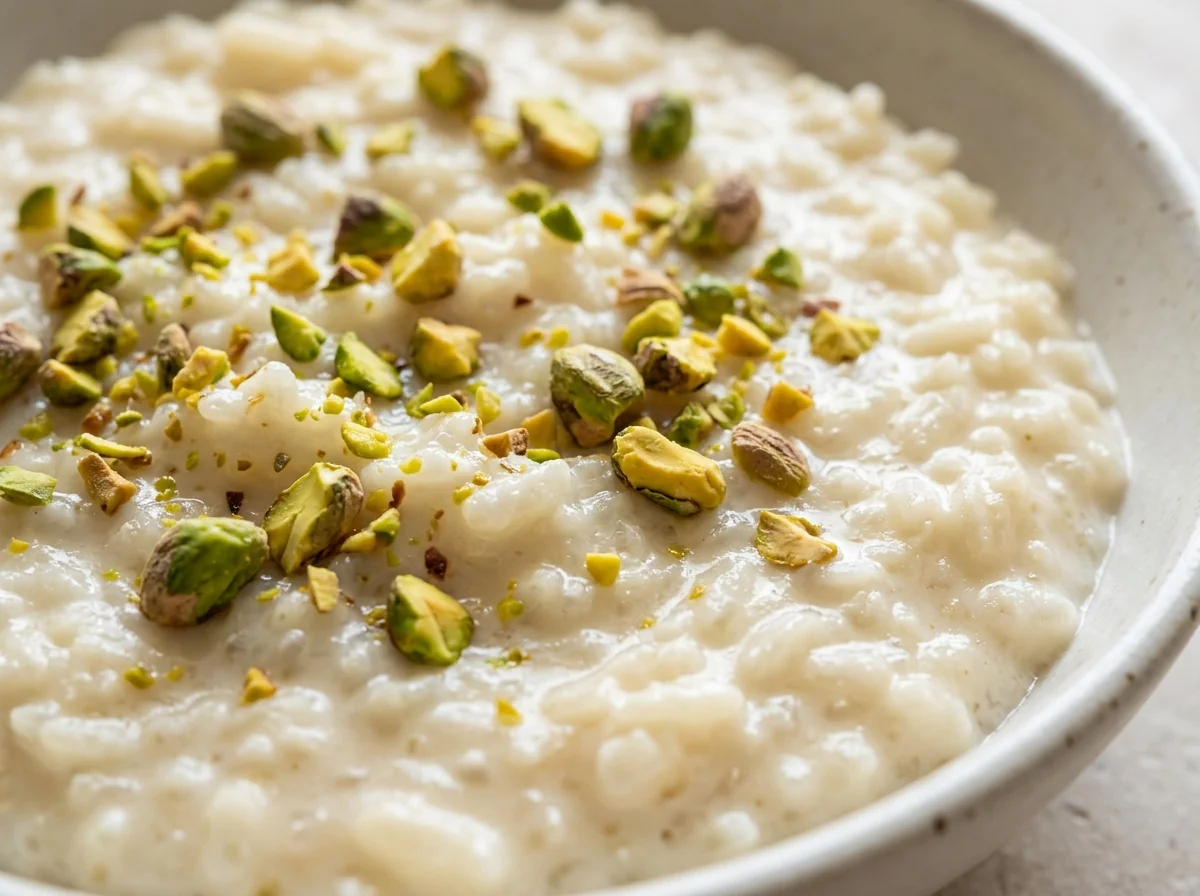
Egyptian rice soaked for an hour then cooked in milk dissolved with water until tender, sweetened with sugar and thickened with cornstarch and scented with orange blossom water and mastic, then poured into bowls and topped with pistachios.
Rice pudding the old-fashioned way: milk powder and water instead of liquid milk, and cornstarch to set the consistency instead of relying on the rice starch alone.
The mastic is what sets it apart from any other rice pudding, as its faint piney aroma lingers in the mouth after the last spoonful.
Preparation Steps
Soak the rice
Wash the rice until the water runs clear then soak it in hot water for one hour; this soaking opens the grains so they cook faster in the milk and release their starch, which thickens the mixture on its own.
Dissolve the milk and start cooking
Dissolve the milk powder in water and add the rice to it, then place the mixture in a pot on the stove while continuing to stir until it comes to a boil; continuous stirring here is essential so the rice doesn't stick to the bottom of the pot and burn.
Cook until the rice is done
Lower the heat and keep stirring the mixture from time to time until the rice grains are fully cooked and mash easily between the fingers, which takes about half an hour.
Sweeten with sugar
Add the sugar and stir well until it dissolves completely and you don't feel any granules at the bottom of the pot.
Thicken with cornstarch
Add the cornstarch amount and lower the heat, stirring from time to time until the mixture thickens and becomes a creamy consistency that coats the spoon. It is best to dissolve the cornstarch in a little cold water before adding it so it doesn't clump in the hot milk.
Add the flavoring and pour
Add the orange blossom water and mastic and let the mixture boil for three minutes so their aroma spreads, then pour the resulting mixture into bowls, garnish them with the pistachios and leave them to cool to room temperature.
Blood Sugar Impact
The glycemic index (GI) measures how quickly a food raises blood sugar, while the glycemic load (GL) measures how much a full serving raises it. Together they give the complete picture.
Glycemic Index
GI
65Medium
Low0–55Medium56–69High70+
A low value (≤55) means a gradual rise in blood sugar — the most suitable range for diabetes and insulin resistance.
Glycemic Load
GL
26High
Low0–10Medium11–19High20+
Glycemic load reflects the impact of the full serving. To lower it: take half a serving, or pair the recipe with a source of protein and fiber.
Nutritional Information
Per ServingMakes 5 servings · one serving is about 255 g of raw ingredients
Calories244 kcal12%of Daily Value*
Protein5 g10%of Daily Value*
Carbohydrates41 g15%of Daily Value*
Fat7 g9%of Daily Value*
Fiber1 g4%of Daily Value*
Sodium25 mg1%of Daily Value*
Potassium223 mg5%of Daily Value*
Phosphorus122 mg10%of Daily Value*
* Percent Daily Values are based on a 2,000-calorie diet per FDA food-label reference values — your daily needs may be higher or lower. Values are derived from the recipe's ingredients via the USDA database.
Troubleshooting
The most common problems when preparing Rice Pudding with Mastic, and how to fix them:
Rice stuck and burned at the bottom
Stirring was interrupted during the boiling stage or the heat was too high. Stir continuously until boiling then lower the heat, and use a thick-bottomed pot.
Cornstarch clumped in the mixture
Added dry to a hot liquid. Dissolve it in a little cold water first then pour it in a thin stream while stirring.
Consistency is runny after cooling
The cornstarch wasn't cooked enough after adding it. Cornstarch needs a brief boil to activate, and remember that the mixture thickens a lot as it cools so don't judge it while hot.
Mastic tastes bitter
The amount was increased or it was added early so it cooked too long. Add it in the last three minutes as the source does, and start with half a spoon.
Storage and Make-Ahead
Refrigerator (4°C)
Covered in its bowls for up to three days, and cover its surface with a cling film pressed on if you don't like the dry layer.
Serving
Cold or at room temperature as the source states, and garnish with the pistachios at serving time so they stay crunchy.
Not recommended
For freezing: the cornstarch separates upon thawing and the consistency becomes grainy.
Spoilage sign
Sour smell or sticky surface: discard it, because milk and cornstarch are quick to spoil.
Tested Ingredient Substitutions
Original Ingredient
Tested Substitute
Ratio
Flavor Difference
milk powder and water
full-fat liquid milk
960 ml
Closer to the modern method, and the consistency is slightly richer.
sugar
two-thirds of the amount
67 g
A milder sweetness that shows off the orange blossom and mastic aroma more.
mastic
a cinnamon stick and cardamom
a stick with 3 pods
For those who can't find mastic, and the aroma becomes closer to Gulf style.
Aleppo pistachios
chopped almonds
62 g
More affordable and milder in flavor, and the garnish role stays the same.
How Much Does It Make? Scaling Guide
Servings
Rice
Water
Cornstarch
Sugar
2.5 servings (half the amount)
23 g
480 ml
22 g
50 g
5 servings (the base)
46 g
960 ml
43 g
100 g
10 servings (double)
92 g
1920 ml
86 g
200 g
EEINA Nutrition Tip
Grind the mastic finely with a little sugar before adding it, because its pieces stick together when ground alone and remain as clumps in the bowl. A teaspoon is a generous amount, so anyone trying it for the first time should start with half a teaspoon because the flavor intensifies with cooling.
Add This Recipe to Your Plan
The EEINA app saves your favorite recipes, calculates them from their real ingredients, and shows your daily numbers toward your goal. Try it free now.
It's the resin of the mastic tree, small transparent grains sold at spice shops and ground before use. Its distinctive piney aroma is used in oriental sweets and ice cream.
Why specifically Egyptian rice?
Because it's short-grain and high in starch so it breaks down and thickens the mixture, whereas long-grain rice like basmati keeps its grains separate and doesn't give the desired creamy consistency.
Why cornstarch when rice thickens by itself?
Because a quarter cup of rice is only for four cups of liquid, a ratio where its starch isn't enough to thicken. So the cornstarch is the main thickener here and the rice grains are part of the texture.
How do I prevent the dry layer on the surface?
Cover the surface of the bowl with plastic wrap pressed against the dessert while it's still warm, which prevents surface evaporation and crust formation.
When is it eaten, cold or warm?
The source leaves it to cool to room temperature. Most people prefer it cold from the refrigerator, where it's firmer and its aroma is clearer.
Sources: USDA · University of Sydney · Our methodology · Updated on