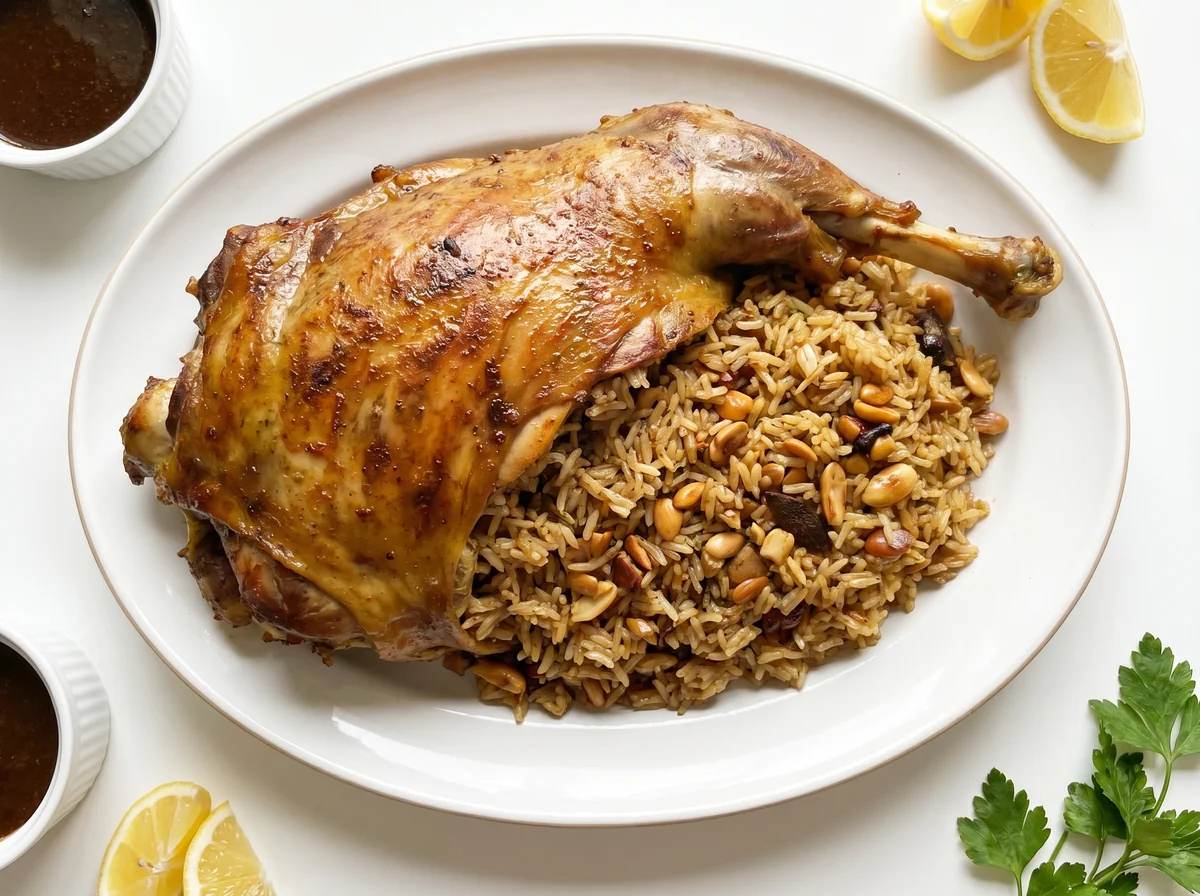
Iraq's prized national dish — lamb slow-cooked until fall-off-the-bone tender, served over yellow baharat (Gulf spice blend) and saffron rice, crowned with toasted almonds, pine nuts, and raisins. High glycemic load from the rice, very high in protein, and contains tree nuts.
Quzi (also spelled Ghouzi) is one of Iraq's most celebrated national dishes, traditionally served at weddings and grand feasts. A whole lamb or large cuts are slow-cooked until meltingly tender, then presented over saffron-and-baharat yellow rice, crowned with toasted almonds, pine nuts, and raisins.
It has spread across the Gulf as a banquet dish. The combination of fall-off-the-bone meat, fragrant rice, toasted nuts, and sweet raisins is what makes it so luxurious and beloved on tables of generous hospitality.
Preparation Steps
Simmer the lamb low and slow
Place the large lamb pieces in a pot and cover with water. Add the onion, bay leaves, cardamom, cinnamon, cloves, and a pinch of salt. Bring to a boil and skim off any foam, then reduce the heat, cover, and simmer for two hours or more over the lowest possible flame until the meat is completely tender and falls off the bone. Slow cooking is the secret to meltingly soft Quzi. Strain and reserve the broth.
Toast the nuts and plump the raisins
In a pan with a little ghee, toast the almonds and pine nuts until golden, then remove them. Stir the raisins in the same pan for a few seconds until they plump up. Toasted nuts and raisins are the signature crown of Quzi.
Season and sear the lamb
Rub the slow-cooked lamb pieces with the baharat (Gulf spice blend), turmeric, and dissolved saffron mixture, then sear them in ghee or roast under the grill until the surface turns golden brown. This gives Quzi its beautiful colour and roasted flavour on top of the tenderness from slow cooking.
Cook the yellow rice
In a pot, sauté an onion with spices, add the drained soaked rice and stir, then pour in five cups of hot lamb broth with turmeric, saffron, and a pinch of salt (the broth and turmeric give the rice its yellow colour and flavour). Stir once only.
Finish the rice
Bring the rice to a boil, then cover and cook over the very lowest heat for fifteen minutes until the broth is absorbed and steam holes appear. Remove from heat and leave covered for five minutes, then fluff gently to separate the grains.
Plate and serve
Spread the yellow rice on a wide platter and arrange the tender lamb pieces on top, then scatter the toasted almonds, pine nuts, and raisins generously over everything. Serve Quzi hot alongside labneh (strained yogurt) and salad. This is Iraq's grand national dish for weddings and celebrations — served across the Gulf as a symbol of generous hospitality.
Blood Sugar Impact
The glycemic index (GI) measures how quickly a food raises blood sugar, while the glycemic load (GL) measures how much a full serving raises it. Together they give the complete picture.
Glycemic Index
GI
70High
Low0–55Medium56–69High70+
A low value (≤55) means a gradual rise in blood sugar — the most suitable range for diabetes and insulin resistance.
Glycemic Load
GL
56High
Low0–10Medium11–19High20+
Glycemic load reflects the impact of the full serving. To lower it: take half a serving, or pair the recipe with a source of protein and fiber.
Nutritional Information
Per ServingMakes 6 servings · one serving is about 310 g of raw ingredients
Calories978 kcal49%of Daily Value*
Protein38 g76%of Daily Value*
Carbohydrates83 g30%of Daily Value*
Fat54 g69%of Daily Value*
Fiber3 g11%of Daily Value*
Sodium168 mg7%of Daily Value*
* Percent Daily Values are based on a 2,000-calorie diet per FDA food-label reference values — your daily needs may be higher or lower. Values are derived from the recipe's ingredients via the USDA database.
Troubleshooting
The most common problems when preparing Quzi — Slow-Cooked Lamb over Saffron Rice, and how to fix them:
The lamb is tough and has not softened
It was not cooked long enough. Quzi requires slow cooking for two hours or more over the very lowest heat until the meat is tender and falls off the bone. Do not rush — a long, gentle simmer is the key to tenderness.
The rice turned out clumpy and doughy
Too much water or excessive stirring. Use a ratio of one-and-a-half cups of broth per cup of rice, stir only once, and do not open the lid during cooking.
The rice has no colour or flavour
Insufficient broth, saffron, or turmeric. Cook the rice in lamb broth, not plain water, and add turmeric and dissolved saffron — these give the yellow colour and distinctive flavour.
The nuts burned
They were toasted over too high a heat. Toast the almonds and pine nuts over a low flame, stirring constantly, and remove them the moment they turn golden — pine nuts in particular burn very quickly.
The lamb has no browned flavour
It was not seared after simmering. Rub the cooked lamb with spices and sear or grill it until the surface browns — this adds flavour and colour on top of the tenderness from slow cooking.
Storage and Make-Ahead
Refrigerator (4°C)
Store Quzi in an airtight container for three days (meat and rice together or separately). Reheat with a splash of broth or water over low heat or by steaming. Add the nuts fresh at serving time.
Freezer (−18°C)
Cooked lamb freezes for three months; rice for one month. Thaw in the refrigerator and reheat by steaming. Slow-cooked lamb reheats beautifully.
Advance preparation
Slow-cook the lamb ahead and store it in its broth; toast the nuts; cook the rice fresh at serving time. Pre-cooked lamb actually deepens in flavour overnight.
Food safety
Cook the lamb until fully tender and do not leave cooked rice at room temperature for more than two hours.
Tested Ingredient Substitutions
Original Ingredient
Tested Substitute
Ratio
Flavor Difference
White basmati rice
Brown basmati rice
Same quantity with more water and longer cooking time
Higher fibre and lower glycemic load for the whole dish
Lamb
Bone-in beef or chicken
Same weight
Chicken cooks faster; lamb is more authentic and grand for Quzi
Almonds and pine nuts
Toasted cashews or pistachios
Same quantity
Any toasted nut works for the garnish alongside the raisins; all remain tree-nut allergens
How Much Does It Make? Scaling Guide
Number of servings
Lamb
Rice
Nuts
3 (half recipe)
500 g
1.5 cups
0.25 cup of each
6 (base)
1 kg
3 cups
0.5 cup of each
12 (banquet)
2 kg
6 cups
1 cup of each
EEINA Nutrition Tip
Quzi is a rice dish with a high glycemic load, but the slow-cooked lamb is easy to digest and the nuts add healthy fats and protein. For balance: keep the rice portion to a fist-sized serving, load up on the lamb, trim visible fat, and serve with a large salad. Replace a third of the white rice with brown rice to boost fibre. A special-occasion dish, not an everyday meal.
Add This Recipe to Your Plan
The EEINA app saves your favorite recipes, calculates them from their real ingredients, and shows your daily numbers toward your goal. Try it free now.
What is the difference between Quzi, Mandi (Yemeni-Saudi smoked meat and rice), and Kabsa (Saudi spiced rice dish)?
In Quzi the meat is slow-cooked until it melts and is served over yellow rice garnished with nuts and raisins — it is a grand banquet dish. Mandi (Yemeni-Saudi smoked meat and rice) smokes the meat in a pit, while Kabsa (Saudi spiced rice dish) cooks the rice in the meat broth. Quzi is distinguished by its long slow cook and lavish garnish.
Is Quzi traditionally made with a whole lamb?
At large feasts, yes — a whole lamb is slow-cooked. At home, large bone-in cuts (leg or shoulder) are used. They are cooked the same way and yield the same tenderness and flavour at a practical scale.
Is Quzi suitable for people with diabetes?
With caution, as it is a rice dish with a high glycemic load. With a small rice portion, plenty of meat, and a salad at a special occasion it can fit in. Replacing some rice with brown rice helps. Consult your doctor.
How do I get melt-in-the-mouth lamb?
The secret is a long, slow simmer — two hours or more over the very lowest heat until the meat falls off the bone. Searing with spices afterwards adds flavour and colour without losing the tenderness.