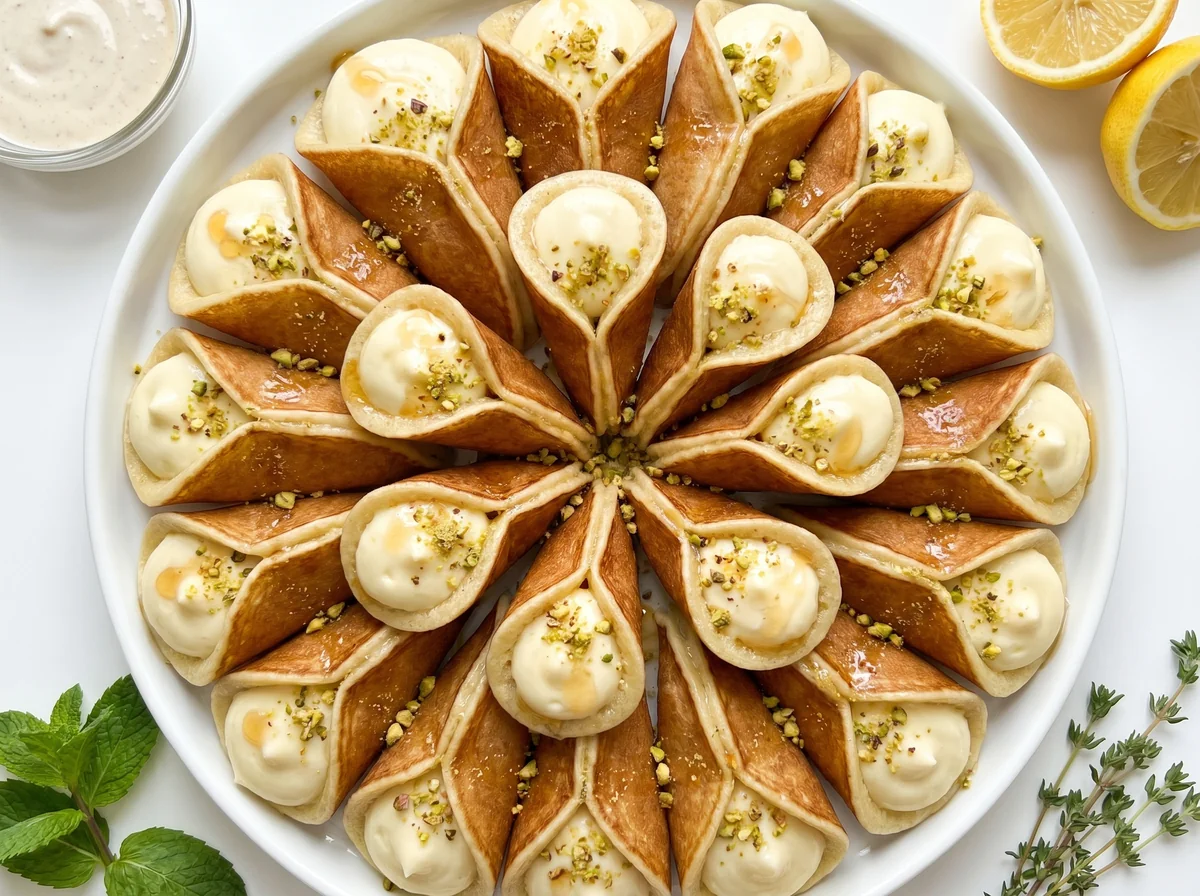
The most famous Ramadan sweet — batter discs baked on one side until pocked with holes, filled with clotted cream and folded into a half-moon, decorated with pistachios and dipped in simple syrup. A festive sweet with a high glycemic load, containing gluten, dairy, and pistachios.
Qatayef is unquestionably the most famous Ramadan sweet across the Levant and Egypt, so much so that it has become a symbol of the holy month. They are batter discs baked on one side until pocked, then filled and folded.
There are two versions: cream qatayef (asafiri) are filled with clotted cream, left open, and eaten unfried, while walnut qatayef are sealed and fried. Their origins are ancient, traceable to Abbasid-era cookbooks. Ready-made discs are sold during Ramadan and filled at home.
Preparation Steps
Prepare the cold syrup
Boil the sugar and water, add the lemon juice (prevents crystallization), and let it boil for ten minutes until slightly thickened, then add the orange-blossom water and turn off the heat. Leave it to cool completely. Cold syrup on hot fried qatayef (or vice versa) preserves the crunch.
Make the qatayef batter
Mix the flour, semolina, yeast, sugar, and baking powder, then gradually add the warm water and whisk until you have a smooth pourable batter (slightly thinner than pancake batter). Leave it to rest for half an hour in a warm place until bubbles appear on the surface — those bubbles are the secret to the pocked surface of qatayef.
Cook the discs on one side
Heat a griddle or non-stick pan over medium heat with no oil. Pour a small ladle of batter to form a disc, and leave it without flipping until the surface dries completely, holes form on top, and the bottom is cooked, about a minute and a half. Qatayef are cooked on one side only — the pocked surface is what holds the filling.
Cool the discs
Lift the discs onto a clean towel and cover with another towel to keep them soft (do not stack them while hot or they will stick). Let them cool slightly before filling. Discs with dry edges will not stick when folded.
Fill and fold
Place a spoonful of cream in the centre of each disc (on the pocked side), then fold the disc in half and press only half the edge closed, leaving the other half open so the filling shows (qatayef asafiri style), or press the entire edge shut for a fully closed half-moon. Press the edge firmly to seal.
Decorate and serve
Dip the filled qatayef in cold syrup (or drizzle it over them) and decorate the open part with ground pistachios. Serve immediately. Qatayef with cream are eaten unfried (raw and fresh), unlike walnut qatayef which are fried. They are the quintessential Ramadan sweet — soft and refreshing with cream and syrup.
Blood Sugar Impact
The glycemic index (GI) measures how quickly a food raises blood sugar, while the glycemic load (GL) measures how much a full serving raises it. Together they give the complete picture.
Glycemic Index
GI
64Medium
Low0–55Medium56–69High70+
A low value (≤55) means a gradual rise in blood sugar — the most suitable range for diabetes and insulin resistance.
Glycemic Load
GL
54High
Low0–10Medium11–19High20+
Glycemic load reflects the impact of the full serving. To lower it: take half a serving, or pair the recipe with a source of protein and fiber.
Nutritional Information
Per ServingMakes 8 servings · one serving is about 275 g of raw ingredients
Calories470 kcal24%of Daily Value*
Protein12 g24%of Daily Value*
Carbohydrates86 g31%of Daily Value*
Fat10 g13%of Daily Value*
Fiber2 g7%of Daily Value*
Sodium26 mg1%of Daily Value*
* Percent Daily Values are based on a 2,000-calorie diet per FDA food-label reference values — your daily needs may be higher or lower. Values are derived from the recipe's ingredients via the USDA database.
Troubleshooting
The most common problems when preparing Qatayef with Clotted Cream, and how to fix them:
The qatayef surface has no holes
The batter was not rested, or it is too thick, or the yeast is weak. Let the batter rest half an hour until bubbles appear, adjust the consistency to smooth and pourable, and make sure the yeast is active. The holes come from the bubbles.
Qatayef splits open when folded
Edges are wet or filling is too much. Let the discs cool slightly and dry at the edges before filling, use a moderate amount of filling, and press the edge firmly to seal.
The disc is dry and brittle
Overcooked or left uncovered. Cook only until the surface dries and the bottom is done, and cover the discs with a towel immediately after lifting to keep them soft and pliable without cracking.
The qatayef went soggy after the syrup
Hot syrup on hot qatayef, or too much syrup. Dip in cold syrup, quickly, and serve immediately. Leaving them in the syrup too long destroys their texture.
The cream drips out
The cream is too thin. Use thick clotted cream (ashta), or strain it — thin cream drips out of the qatayef and makes them soggy.
Storage and Make-Ahead
Refrigerator (4°C)
Qatayef with cream keep in the fridge for two days (cream is a dairy product that needs refrigeration). Eat cold, and add the syrup at serving time to keep them closer to soft rather than limp.
Unfilled discs
Baked qatayef discs keep in a sealed bag at room temperature for two days or in the freezer for a month (thaw and fill fresh). Fill with cream close to serving time.
Freezer
Empty discs freeze excellently for a month between sheets of baking paper. Cream-filled qatayef do not freeze well (the cream changes texture).
Advance prep
Bake the discs and make the syrup ahead of time; fill with cream and add the syrup close to serving. This preserves the texture and softness of the qatayef.
Tested Ingredient Substitutions
Original Ingredient
Tested Substitute
Ratio
Flavor Difference
Clotted cream (ashta)
Homemade cream (milk and starch) or cream cheese
Same quantity
Homemade is more economical — make sure it is thick so it does not drip out of the qatayef
Cream filling (unfried)
Walnut filling and fry (walnut qatayef)
As desired
A different version — sealed and fried, richer and heavier than cream, with walnut nuts
Full syrup dip
Drizzle syrup instead of dipping
To taste
Significantly reduces sugar while retaining sweetness — a lighter option
How Much Does It Make? Scaling Guide
Number of servings
Flour
Cream
Sugar (syrup)
4 (half recipe)
1 cup
1 cup
1 cup
8 (base)
2 cups
2 cups
2 cups
16 (Ramadan gathering)
4 cups
4 cups
4 cups
EEINA Nutrition Tip
Qatayef is a high-sugar Ramadan sweet from the syrup and batter — it is not an everyday food. Cream qatayef, unfried, are lighter than fried walnut qatayef, so prefer them. Moderation is key: one or two pieces after iftar is enough. To lighten: dip in light syrup or drizzle instead of dipping, and use low-fat cream. For diabetics: only a very small number with great caution.
Add This Recipe to Your Plan
The EEINA app saves your favorite recipes, calculates them from their real ingredients, and shows your daily numbers toward your goal. Try it free now.
So the top surface becomes pocked with holes from the yeast bubbles — those holes are what grips the filling. The bottom cooks through while the top stays pocked and unbaked from above, so it sticks together when folded.
What is the difference between cream qatayef and walnut qatayef?
Cream qatayef (asafiri) are filled with clotted cream, left open, and eaten unfried — soft and refreshing. Walnut qatayef are filled with walnuts, completely sealed, and fried until crispy. Cream is lighter; walnut is richer.
How do they stay crispy... or soft?
Cream qatayef are served soft, not crispy — the secret is cold syrup on fresh qatayef and serving immediately. Fried walnut qatayef stay crispy with cold syrup on the hot-fried pieces.
Are qatayef suitable for diabetics?
They are a high-sugar Ramadan sweet, so they are not a good choice for diabetics except in very small quantities with light syrup on a special occasion with great caution. Unfried cream qatayef are relatively lighter than the fried version.