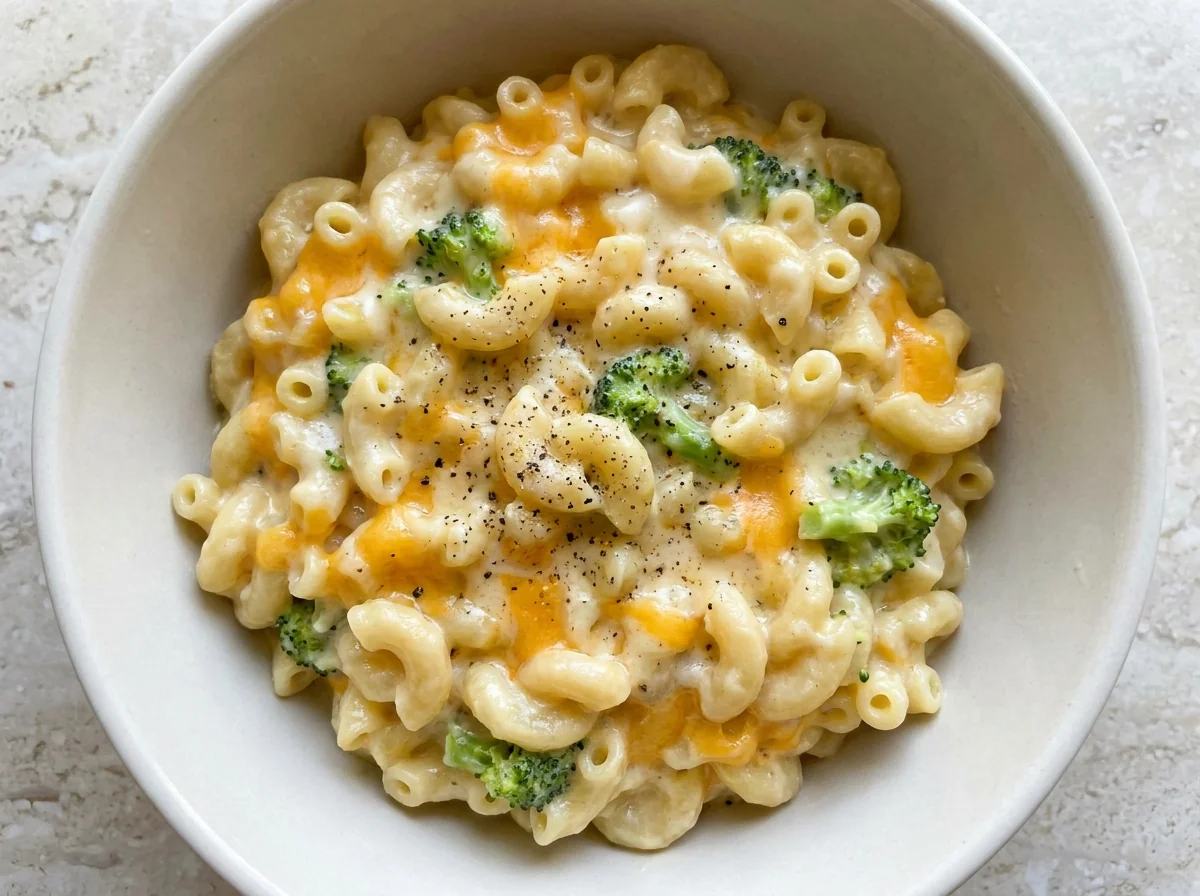
Mac and cheese is the king of American children's dishes that crossed over to the world's restaurant menus and the instant grocery boxes, and the homemade one-pot version cooks the pasta in its milk so it gives birth to its own sauce: faster than the ready-made box and with a cleaner notebook.
Preparation Steps
Cook the pasta in its milk. The one-pot trick
In a wide pot, gather the pasta, milk, water and salt and boil, then lower the heat and cook for ten minutes with frequent stirring to guard the bottom. The pasta cooks as it releases its starch into the milk, which thickens into a ready sauce: no boiling, no draining and no separate bechamel pot.
Add the broccoli in the last minutes
The small broccoli florets for the last four minutes. They cook to a green crispness and slip the vegetables into children's most beloved dish with a clever sneak.
Melt the cheese off the heat. The rule of smoothness
Turn off the heat and wait half a minute, then stir in the butter, cheddar, mozzarella, mustard and garlic powder. Cheese over a live flame curdles into broken strands, and off it melts into an orange silk that coats every elbow.
Serve it with its flowing texture
It is poured a little looser than you crave, it thickens in the bowls within minutes, with a pinch of black pepper: the most famous American children's dish from a single pot in a third of an hour and with a lighter notebook than the restaurants'.
Blood Sugar Impact
The glycemic index (GI) measures how quickly a food raises blood sugar, while the glycemic load (GL) measures how much a full serving raises it. Together they give the complete picture.
Glycemic Index
GI
47Low
Low0–55Medium56–69High70+
A low value (≤55) means a gradual rise in blood sugar — the most suitable range for diabetes and insulin resistance.
Glycemic Load
GL
30High
Low0–10Medium11–19High20+
Glycemic load reflects the impact of the full serving. To lower it: take half a serving, or pair the recipe with a source of protein and fiber.
Nutritional Information
Per ServingMakes 4 servings · one serving is about 380 g of raw ingredients
Calories592 kcal30%of Daily Value*
Protein26 g52%of Daily Value*
Carbohydrates67 g24%of Daily Value*
Fat25 g32%of Daily Value*
Fiber3 g11%of Daily Value*
Sodium870 mg38%of Daily Value*
* Percent Daily Values are based on a 2,000-calorie diet per FDA food-label reference values — your daily needs may be higher or lower. Values are derived from the recipe's ingredients via the USDA database.
Troubleshooting
The most common problems when preparing Lighter One-Pot Mac and Cheese, and how to fix them:
The sauce curdled and its oil separated
Cheese melted over a live flame. Turning off and the half minute is law, and the broken one is partly rescued with a spoonful of cold milk and a whisk.
The pasta drank all the liquid before it was done
A strong heat that evaporated, not cooked. The low one after boiling and a sip of hot milk for the thirsty.
The bottom stuck
Inattentive stirring. Pasta in milk demands a spoon present every two minutes.
The little one discovered the broccoli and objected
Large florets exposed themselves. Very small florets dissolve into the orange, or they are chopped finely so they vanish completely.
Storage and Make-Ahead
Right away
With its hot, flowing texture.
In the fridge
Two days in containers. Loosened with a sip of milk on gentle reheating and it returns.
Not suitable for freezing
The cheese sauce separates on thawing.
Tested Ingredient Substitutions
Original Ingredient
Tested Substitute
Ratio
Flavor Difference
White pasta
Whole-wheat elbows
1:1
Higher fiber with two extra minutes and a sip of milk
Full-fat cheddar
Low-fat cheddar with the mozzarella
~
Lighter, with a melt that needs more patience
Broccoli
Peas or grated carrot
1:1
The smuggling vegetable changes
Adding protein
Shredded chicken or tuna
150 g
A complete meal from the same pot
How Much Does It Make? Scaling Guide
Ingredient
4 servings
2 servings
8 servings
Pasta
300 g
150 g
600 g
Milk
500 ml
250 ml
1 L
Cheese
200 g
100 g
400 g
EEINA Nutrition Tip
Melt the cheese with the heat off. The golden rule for all cheese sauces: cheese proteins over a live flame curdle into broken, oily granules; in the pot's residual heat they melt into a silky flow that clings to the elbows. Half a minute of patience equals the whole texture.
Add This Recipe to Your Plan
The EEINA app saves your favorite recipes, calculates them from their real ingredients, and shows your daily numbers toward your goal. Try it free now.
How does it beat the instant mac and cheese boxes?
The boxes are artificial cheese powder, colorings and double the sodium, and your pot is real cheese and milk: the same minutes and a notebook beyond comparison.
How does it differ from our pasta with bechamel?
Bechamel is an oven tray with meat layers that is baked; this is a single creamy instant pot with no oven. The gathering's place there and the tired Tuesday's place here.
How does it become a balanced meal?
Its broccoli at the core, shredded chicken in it and a side salad. The beloved orange carries the vegetables and protein in secret.
Which cheese does not work for it?
Ready-made processed melting cheeses (slices) come out a plastic sauce. Real freshly grated cheddar is the difference.