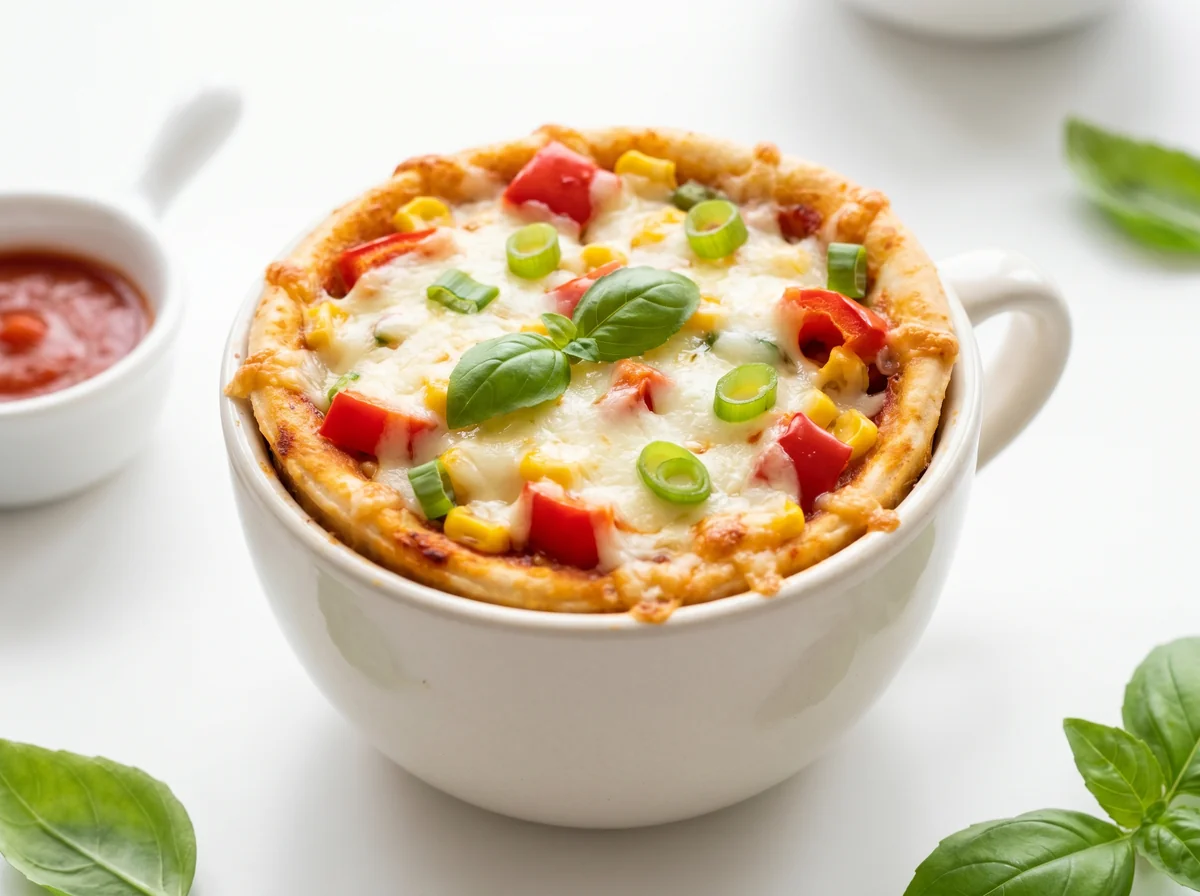
When hunger strikes in the evening and you have no desire to fire up the oven or wait for dough to rise, a single mug and a microwave are all you need.
This recipe compresses pizza into a single-serve cup: a quick dough from oats and flour lifted by baking powder instead of yeast, cooked in ninety seconds, then crowned with sauce, cheese, and vegetables. It is not a miniature traditional pizza nor a baked cauliflower crust — it is a standalone mug format born from the beloved mug cake idea, giving you one controlled portion with no leftovers and few dishes to wash.
Preparation Steps
Prepare the mug
Grease the inside of a wide microwave-safe mug (at least 250 ml capacity) with olive oil until the bottom and sides glisten. Light greasing prevents the dough from sticking and makes it easy to remove. Choose a wide-bottomed mug rather than a narrow one so the dough cooks evenly.
Mix the dry ingredients
In the same mug, mix the oat flour, white flour, baking powder, and a pinch of salt with a fork for about 15 seconds until evenly distributed. Even distribution of the baking powder ensures a uniform rise and prevents a metallic taste in any one spot.
Add wet ingredients and form the dough
Add the yogurt and water, then stir with a fork for about 30 seconds until no dry flour remains and the mixture forms a thick batter resembling cake batter. Look for a smooth mixture with no white lumps — remaining dry flour gives a raw taste after cooking. Do not over-mix or the dough will become stretchy.
Microwave the crust
Smooth the surface of the dough with a fork, then microwave on full power for about 90 seconds until the dough rises and the surface dries out, coming out clean when a toothpick is inserted in the center. A non-shiny, firm surface means it is done; a shiny wet surface means it needs ten more seconds. Microwaves vary in power, so start at 90 seconds and increase gradually.
Add the sauce and toppings
Spread the tomato sauce over the surface of the hot crust, then scatter the mozzarella on top and add the bell pepper and mushrooms. Placing the sauce under the cheese keeps the crust from drying out and anchors the toppings.
Melt the cheese and serve
Return the mug to the microwave on full power for about 30 seconds until the cheese melts completely and the surface shines. Stretchy cheese strings when you lift a spoon mean it is ready — unmelted cheese stays grainy. Garnish with basil leaves and serve the mug warm with a spoon.
Blood Sugar Impact
The glycemic index (GI) measures how quickly a food raises blood sugar, while the glycemic load (GL) measures how much a full serving raises it. Together they give the complete picture.
Glycemic Index
GI
65Medium
Low0–55Medium56–69High70+
A low value (≤55) means a gradual rise in blood sugar — the most suitable range for diabetes and insulin resistance.
Glycemic Load
GL
23High
Low0–10Medium11–19High20+
Glycemic load reflects the impact of the full serving. To lower it: take half a serving, or pair the recipe with a source of protein and fiber.
Nutritional Information
Per ServingMakes 1 servings · one serving is about 205 g of raw ingredients
Calories308 kcal15%of Daily Value*
Protein14 g28%of Daily Value*
Carbohydrates38 g14%of Daily Value*
Fat11 g14%of Daily Value*
Fiber2 g7%of Daily Value*
Sodium592 mg26%of Daily Value*
* Percent Daily Values are based on a 2,000-calorie diet per FDA food-label reference values — your daily needs may be higher or lower. Values are derived from the recipe's ingredients via the USDA database.
Troubleshooting
The most common problems when preparing Single-Serve Microwave Mug Pizza, and how to fix them:
The dough is rubbery or dense after cooking
Reduce microwave time by ten seconds and avoid over-mixing the dough. Over-cooking or over-mixing dries it out and makes it tough.
The center is still raw while the edges are cooked
Use a wider, shorter mug and cook in short ten-second bursts, testing with a toothpick. A narrow, deep mug cooks the edges before the center.
The dough bubbled up and overflowed the mug
Use a mug with at least 250 ml capacity and do not fill it more than two-thirds. Reduce the baking powder slightly — the dough rises powerfully during cooking.
The cheese did not melt well
Return the mug for an extra ten seconds and layer the mozzarella before adding cold vegetables. Very cold toppings delay melting.
A faint metallic taste
Reduce the baking powder to 2 g and mix it thoroughly with the dry flour. Too much baking powder, or uneven distribution, leaves an alkaline aftertaste.
Storage and Make-Ahead
Serve immediately
This recipe is best served hot right away. The crust loses its softness and stiffens quickly as it cools.
Refrigerator
If any remains, store in an airtight container in the refrigerator for a maximum of one day, and reheat in the microwave for about twenty seconds. Texture is affected after refrigeration.
Advance dry-mix prep
Combine the dry ingredients (both flours, baking powder, and salt) in a mug or small bag in advance and store in a dry place. At mealtime, just add the yogurt, water, toppings, and cook. This cuts prep time in half for the time-pressed individual.
Tested Ingredient Substitutions
Original Ingredient
Tested Substitute
Ratio
Flavor Difference
Oat flour
Whole wheat flour
1:1 by weight
Raises fiber with a slightly denser texture; you may need an extra 5 ml of water.
White flour
Additional oat flour
1:1 by weight
Makes the recipe all-oat, raising soluble fiber with a slightly softer texture.
Low-fat yogurt
Buttermilk or milk
about the same amount
Adjust the liquid gradually until you reach a thick cake-batter consistency.
Low-fat mozzarella
Another low-fat melting cheese
1:1 by weight
Choose a good-melting variety — very dry cheeses will not stretch into strings.
Bell pepper and mushrooms
Any quick-cooking vegetables such as zucchini or tomatoes
about the same weight
Slice them thin so they cook through in thirty seconds with the cheese.
How Much Does It Make? Scaling Guide
Ingredient
1 serving
2 servings
4 servings
Oat flour
30 g
60 g
120 g
White flour
10 g
20 g
40 g
Baking powder
3 g
6 g
12 g
Low-fat yogurt
45 g
90 g
180 g
Low-fat mozzarella
30 g
60 g
120 g
Tomato sauce
30 g
60 g
120 g
EEINA Nutrition Tip
Replace a third of the white flour with extra oat flour to boost soluble fiber. Choose low-fat mozzarella and sugar-free tomato sauce to reduce sodium and saturated fat. Add a handful of colorful vegetables like bell pepper and mushrooms to increase fiber and satiety without significant extra calories.
Add This Recipe to Your Plan
The EEINA app saves your favorite recipes, calculates them from their real ingredients, and shows your daily numbers toward your goal. Try it free now.
Yes. Pour the batter into a greased small pan and bake in a preheated oven at 180°C for about twelve to fifteen minutes until cooked through, then add the sauce and cheese and return for two minutes until the cheese melts. The result is closer to a baked crust and takes longer.
Why baking powder instead of yeast?
Baking powder lifts the dough chemically as soon as it heats, with no fermentation time needed — that is what makes this recipe fast. Yeast requires resting and fermentation, which does not suit the quick mug concept.
Is it suitable for children?
Yes, as a light snack. Be careful of the hot mug and the melted cheese, which stays very hot after cooking. Let it cool for a minute before serving to a child and offer it with a spoon.
Can it be made gluten-free?
Replace the white flour and oat flour with a gluten-free flour blend and gluten-free certified oat flour, and check the labels on the tomato sauce and cheese. Texture may vary slightly.
How do I increase the protein?
Use low-fat Greek yogurt instead of regular, or add a spoonful of low-salt cottage cheese on top of the sauce before the mozzarella. This raises protein and satiety without a large increase in calories.