Sorbet is the venerable European fruit-ice dessert that predated ice cream itself, and the blended frozen-mango version pared it down to three ingredients with no machine and no refined sugar.
The golden fruit of summer in its coldest form.
Preparation Steps
Freeze the ripe mango ahead of time
Cubes of sweet ripe mango spread on a tray and frozen for four hours or more. Spread out, not in a clumped bag: free pieces blend smoothly, and the surplus of mango season is frozen for sorbet all year round.
Blend with the patience of stages
The frozen cubes, lemon juice, and honey in a powerful blender. Intermittent pulses first to break them up, then continuous blending while scraping the sides every half minute.
Add water drop by drop when it resists
If the blender stalls helplessly, one spoon of cold water and back to it, and thrift is a creed: every extra spoon takes it from sorbet toward juice.
Stop at the moment of creaminess
When the mixture winds into a silky, glossy mass turning on itself, stop at once. Over-blending melts it.
Serve at once or freeze for an hour
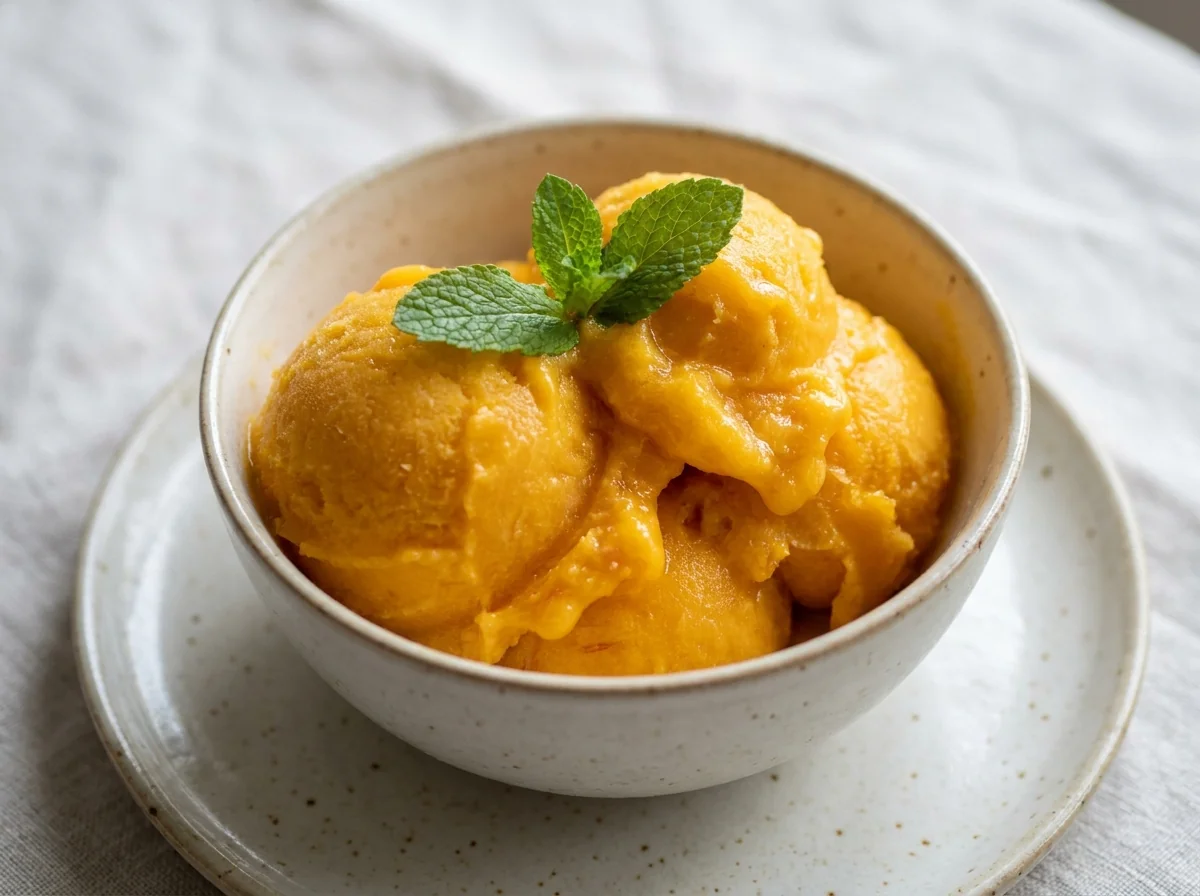
With a soft-serve texture, serve it at once with mint leaves, or an hour in the freezer for scoopable balls: the sorbet of fine restaurants from a fruit, a lemon, and a spoon of honey.
Blood Sugar Impact
The glycemic index (GI) measures how quickly a food raises blood sugar, while the glycemic load (GL) measures how much a full serving raises it. Together they give the complete picture.
Glycemic Index
GI
53Low
Low0–55Medium56–69High70+
A low value (≤55) means a gradual rise in blood sugar — the most suitable range for diabetes and insulin resistance.
Glycemic Load
GL
12Medium
Low0–10Medium11–19High20+
Glycemic load reflects the impact of the full serving. To lower it: take half a serving, or pair the recipe with a source of protein and fiber.
Nutritional Information
Per ServingMakes 4 servings · one serving is about 145 g of raw ingredients
Calories99 kcal5%of Daily Value*
Protein1 g2%of Daily Value*
Carbohydrates25 g9%of Daily Value*
Fat0 g0%of Daily Value*
Fiber2 g7%of Daily Value*
Sodium2 mg0%of Daily Value*
* Percent Daily Values are based on a 2,000-calorie diet per FDA food-label reference values — your daily needs may be higher or lower. Values are derived from the recipe's ingredients via the USDA database.
Troubleshooting
The most common problems when preparing Three-Ingredient Mango Sorbet, and how to fix them:
The blender stalled helplessly
Fused masses. Pulses first and scraping, and the single spoon of water is the key to the stubbornness, not its open door.
It came out as juice, not sorbet
Water poured in or blending went long past creaminess. Thrift and stopping at the moment of winding, or an hour in the freezer rescues the liquid.
Acidity with a pale sweetness
Unripe mango was frozen. The ripe, fragrant one is the first condition, and honey cannot fix an unripe one.
It froze rock-hard in the freezer later
The nature of homemade sorbet without stabilizers. Ten minutes at room temperature before scooping restores its softness.
Storage and Make-Ahead
Immediately
With its soft, silky texture. Its absolute peak.
In the freezer
Two weeks in an airtight tub with parchment paper touching its surface, softened for ten minutes before serving.
A frozen base
The mango cubes alone for six months. Fresh sorbet each time is better than stored sorbet.
Tested Ingredient Substitutions
Original Ingredient
Tested Substitute
Ratio
Flavor Difference
The mango
Frozen strawberries, peaches, or pineapple
1:1
A base for every summer fruit
The honey
Date paste from our jar
1:1
A deeper sweetening
A creamy touch
Half a frozen banana with it
~
Between a sorbet and a nice cream
A grown-up touch
Grated ginger or cardamom with the blending
~
The signature restaurant sorbet
How Much Does It Make? Scaling Guide
Ingredient
4 scoops
2 scoops
8 scoops
Frozen mango
500 g
250 g
1 kg
Honey
30 g
15 g
60 g
Lemon
15 ml
8 ml
30 ml
EEINA Nutrition Tip
Freeze the mango spread out, not piled. A clumped bag comes out as a rock that breaks the blender blades and melts before it breaks up; the spread-out, separate pieces blend one by one into a cold silk within two minutes: a quarter hour of arranging on the tray is the difference between a sorbet and an icy juice.
Add This Recipe to Your Plan
The EEINA app saves your favorite recipes, calculates them from their real ingredients, and shows your daily numbers toward your goal. Try it free now.
What is the difference between sorbet, ice cream, and nice cream?
Ice cream is cream and milk; nice cream is creamy blended banana; and sorbet is pure fruit and ice with no dairy. The purest and lightest of the three.
Why lemon in a sweet dessert?
Its acid sharpens the mango flavor and keeps it from fading with freezing. The balancing drop that a respectable sorbet cannot do without.
Is it suitable for those avoiding dairy and gluten?
It is free of both and of all the big eight by nature. Everyone's safe dessert at any gathering.
Ready-made frozen store mango?
It works perfectly. Choose the unsweetened kind and check the label: mango only.