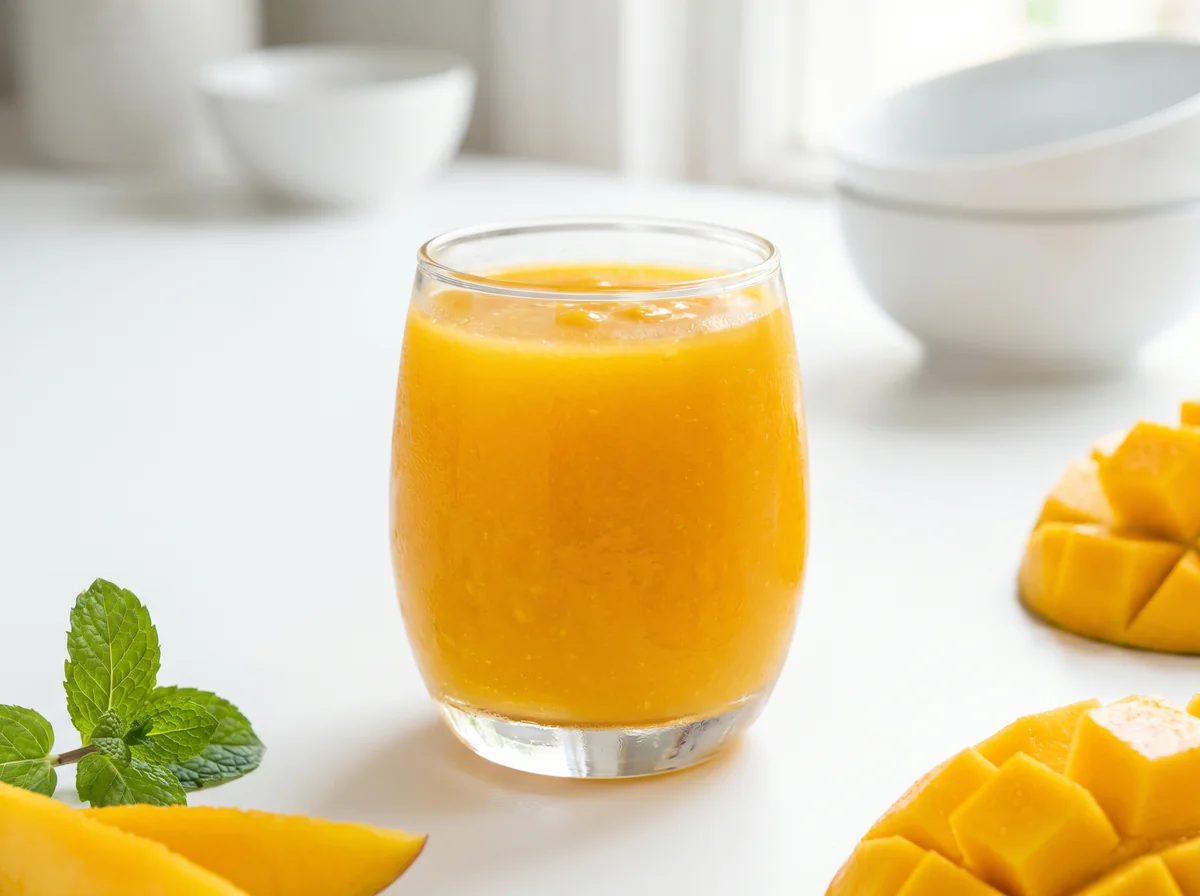
A refreshing summer juice — ripe mangoes blended with water (or milk) into a thick, fragrant drink rich in vitamins A and C. Low glycemic load and free from common allergens (contains dairy if made with milk).
Mango juice is a beloved refreshing summer drink throughout the Arab world. Mango is a treasured fruit in many Arab countries (Egyptian mangoes with their famous varieties, Yemeni mangoes, and imported Indian and Pakistani ones), and its summer season brings joy.
The juice is made by blending ripe mangoes with water or milk and served cold at juice bars and in homes. Its beautiful golden color and sweet, fragrant tropical flavor have made it one of the most beloved summer juices, and its richness in vitamins A and C adds value to the pleasure — a drink that combines the joy of the royal fruit with the cool of summer.
Preparation Steps
Choose the mango
Select a ripe, fragrant mango (one that gives slightly under gentle pressure and smells at the stem end). Mango ripeness is the foundation of the juice and its sweetness — an unripe mango is hard, sour, and bland. Sweet varieties (such as Ouwais and Zebda) are excellent for juicing.
Prepare the flesh
Peel the mango and cut the flesh away from the stone into pieces. Mango is slightly fibrous around the stone, so extract all the flesh. Ripe, soft flesh gives a thick, fragrant juice.
Blend
Place the mango flesh and cold water (or milk) in a blender and blend on high speed until the juice is smooth and uniform with no rough fibers. Good blending breaks down the flesh and gives a thick, silky juice.
Adjust texture and sweetness
Adjust the thickness by adding more water (or milk) to thin it (mango juice is naturally thick). Taste — ripe mango is usually sweet enough with no need for sugar. Add honey only if necessary, and a squeeze of lemon balances the sweetness and brightens the flavor.
Strain (optional)
For those who like a smoother juice, strain through a sieve to remove any fibers. However, keeping the full flesh is healthier (more fiber and nutrients) — well-blended mango is naturally smooth without straining.
Serve
Pour the mango juice into glasses over ice and serve cold immediately. It is a beloved refreshing summer juice throughout the Arab world (mango is a cherished fruit, especially Egyptian, Yemeni, and Indian varieties), rich in vitamins A and C. Its golden color and sweet tropical flavor have made it one of the most loved summer juices — a refreshing, nourishing pleasure.
Blood Sugar Impact
The glycemic index (GI) measures how quickly a food raises blood sugar, while the glycemic load (GL) measures how much a full serving raises it. Together they give the complete picture.
Glycemic Index
GI
51Low
Low0–55Medium56–69High70+
A low value (≤55) means a gradual rise in blood sugar — the most suitable range for diabetes and insulin resistance.
Glycemic Load
GL
12Medium
Low0–10Medium11–19High20+
Glycemic load reflects the impact of the full serving. To lower it: take half a serving, or pair the recipe with a source of protein and fiber.
Nutritional Information
Per ServingMakes 3 servings · one serving is about 315 g of raw ingredients
Calories105 kcal5%of Daily Value*
Protein1 g2%of Daily Value*
Carbohydrates27 g10%of Daily Value*
Fat0 g0%of Daily Value*
Fiber3 g11%of Daily Value*
Sodium2 mg0%of Daily Value*
* Percent Daily Values are based on a 2,000-calorie diet per FDA food-label reference values — your daily needs may be higher or lower. Values are derived from the recipe's ingredients via the USDA database.
Troubleshooting
The most common problems when preparing Mango Juice, and how to fix them:
The juice is sour and bland
The mango was not ripe. Use a ripe, fragrant mango (one that gives under pressure and smells at the stem). An unripe mango is sour and hard. To ripen a firm mango, leave it at room temperature for a few days until it softens and becomes fragrant.
The juice is too thick
Insufficient liquid. Add more water or milk and blend until the desired consistency — mango juice is naturally thick (dense flesh). Adjust the liquid to the preferred thickness.
The juice is fibrous and rough
The mango variety is fibrous or it was not blended well enough. Blend thoroughly on high speed, or strain to remove the fibers. Some mango varieties are more fibrous — choose soft, low-fiber varieties for juicing.
Too sweet or too rich
Sugar or too much milk was added. Do not add sugar (mango is sweet), thin with water, and a squeeze of lemon balances the sweetness. The water version is lighter than the full-fat milk version.
The color or taste changed
It was left out after blending. Drink the juice fresh immediately after blending (tastiest and freshest) — fresh juices oxidize and lose their flavor over time. A squeeze of lemon slows this slightly.
Storage and Make-Ahead
Fresh (best)
Mango juice is best drunk fresh immediately after blending (tastiest and richest in vitamin C). Chilled in a sealed glass, it keeps for one day — stir before drinking as it may separate. The milk version should be drunk more quickly (dairy).
Freezer
Mango flesh (especially in season, to use out of season) or the juice can be frozen in ice cube trays. Thaw the flesh and blend it fresh. Freezing mango in season makes the juice available all year.
Advance preparation
Mango flesh can be cut and frozen in advance, then blended with cold water at serving time (gives an iced juice without ice cubes). This is practical and preserves the mango season.
Food safety
Wash the mango before peeling, use clean water or milk, and drink the juice fresh. The milk version should be kept chilled and not left unrefrigerated. Clean the blender well after use.
Tested Ingredient Substitutions
Original Ingredient
Tested Substitute
Ratio
Flavor Difference
Water
Milk or yogurt (laban)
Same quantity
Milk makes it a creamy juice (mango with milk is common and delicious) and yogurt adds acidity and probiotics (both add dairy).
Mango only
Blend with orange, pineapple, or banana
To taste
Orange adds acidity and vitamin C, pineapple adds a tropical note, and banana adds creaminess and potassium — all make delicious combinations.
Adding sugar
Without (mango is sweet) or a little honey
To taste
Ripe mango is sweet enough without sugar (the healthier choice). Honey is a natural alternative if needed for a less sweet mango.
How Much Does It Make? Scaling Guide
Cups
Mango
Water
2 (half recipe)
1 mango
1 cup
3 (base)
2 mangoes
2 cups
6 (family)
4 mangoes
4 cups
EEINA Nutrition Tip
Mango juice is a good choice: mango is rich in vitamin A (for eye health and immunity), vitamin C, antioxidants, potassium, and some fiber, and its glycemic index is low to medium. To maximize the benefit: keep the full flesh (do not strain) for the fiber, add no sugar (ripe mango is sweet enough), and use water rather than sweetened milk to reduce calories. Its challenge is the natural sugar — drink in moderation, especially for people managing blood sugar.
Add This Recipe to Your Plan
The EEINA app saves your favorite recipes, calculates them from their real ingredients, and shows your daily numbers toward your goal. Try it free now.
Choose a fruit that gives slightly under gentle pressure and releases its fragrant aroma at the stem end (not hard and not overripe). Sweet, soft, low-fiber varieties are excellent for juicing. To ripen a firm mango, leave it at room temperature for a few days.
Water or milk?
Both are delicious: the water version is lighter and brings out the mango's tropical flavor, while the milk version (mango with milk) is creamier and richer and adds protein and calcium. Choose to taste — water gives the purest mango flavor and fewer calories.
Is mango juice healthy?
Yes, a good choice: mango is rich in vitamins A and C, antioxidants, potassium, and some fiber, and its glycemic index is low to medium. Keep the full flesh (do not strain) for the fiber, add no sugar, and use water. Its challenge is the natural sugar — drink in moderation, especially for people managing blood sugar.
How do I get a smooth, fiber-free juice?
Choose soft, low-fiber mango varieties and blend thoroughly on high speed. For a completely smooth juice, strain through a sieve. However, keeping the full flesh is healthier (fiber), and good mango blended well is smooth without straining.
Sources: University of Sydney · Gulf GSO · Our methodology · Updated on