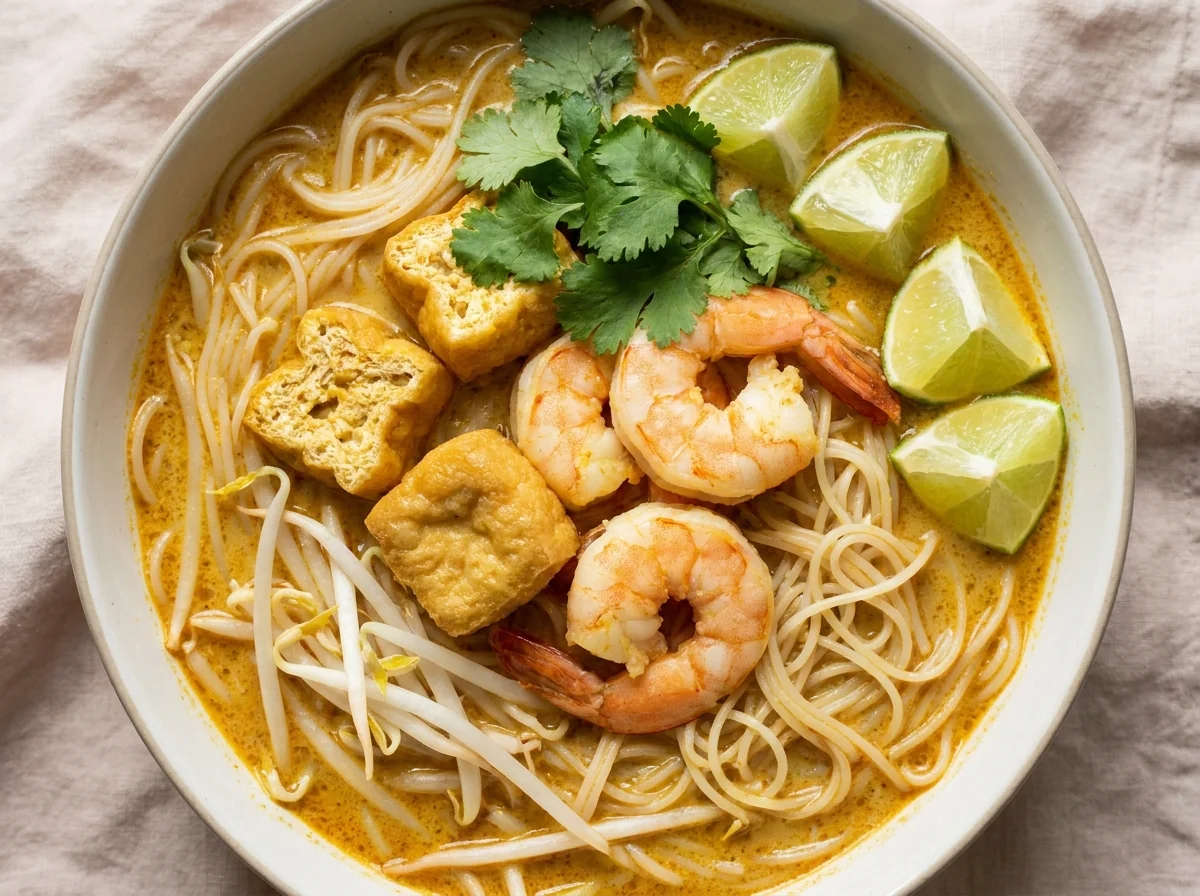
Laksa is one of the most famous dishes of Malaysian and Peranakan cuisine: a noodle soup with coconut milk and curry paste, whose rich version is known as laksa lemak.
This is a lighter version that uses light coconut milk and plenty of vegetables, while keeping the shrimp, tofu puffs, and bean sprouts that define the dish.
Preparation Steps
Prepare the rice noodles
Soak the thin rice noodles in hot water for five minutes until they soften, then drain them and set them aside. This is faster than boiling and keeps their texture.
Fry the curry paste
In a wide pot, heat the oil and stir the curry paste over medium heat for two minutes until it is fragrant and its color turns slightly darker. Frying the paste before adding the liquid is what releases the laksa flavor.
Add the stock and coconut milk
Pour in the stock and the light coconut milk and stir well until the curry dissolves, and let the soup simmer gently for ten minutes over low heat. Do not let it boil hard so the coconut milk does not split.
Add the tofu then the shrimp
Add the fried tofu puffs and the fish sauce and leave them for four minutes to absorb the soup, then add the shrimp and cook it for three minutes until it turns pink and opaque. Shrimp cooks quickly, so do not cook it long or it will toughen.
Adjust the acidity
Turn off the heat and add the lime juice, taste, and adjust the salt with fish sauce as desired. The acidity at the end balances the richness of the coconut milk.
Serve
Divide the rice noodles and bean sprouts among the serving bowls, pour the hot soup with the shrimp and tofu over them, and garnish with cilantro and lime quarters. Serve hot immediately.
Blood Sugar Impact
The glycemic index (GI) measures how quickly a food raises blood sugar, while the glycemic load (GL) measures how much a full serving raises it. Together they give the complete picture.
Glycemic Index
GI
39Low
Low0–55Medium56–69High70+
A low value (≤55) means a gradual rise in blood sugar — the most suitable range for diabetes and insulin resistance.
Glycemic Load
GL
19Medium
Low0–10Medium11–19High20+
Glycemic load reflects the impact of the full serving. To lower it: take half a serving, or pair the recipe with a source of protein and fiber.
Nutritional Information
Per ServingMakes 4 servings · one serving is about 530 g of raw ingredients
Calories500 kcal25%of Daily Value*
Protein36 g72%of Daily Value*
Carbohydrates52 g19%of Daily Value*
Fat17 g22%of Daily Value*
Fiber3 g11%of Daily Value*
Sodium926 mg40%of Daily Value*
* Percent Daily Values are based on a 2,000-calorie diet per FDA food-label reference values — your daily needs may be higher or lower. Values are derived from the recipe's ingredients via the USDA database.
Troubleshooting
The most common problems when preparing Lighter Malaysian Laksa with Coconut Milk, and how to fix them:
The coconut milk split and an oily layer appeared
The boil was too hard. Cook the soup over low heat at a gentle simmer only after adding the coconut milk.
The shrimp is tough and rubbery
It was overcooked. Add it in the last three minutes only and take the pot off the heat as soon as it turns pink.
The soup is flat in flavor
The curry paste was not fried enough. Fry it for two minutes in the oil until fragrant before adding the liquid, and add more fish sauce and lime juice at the end.
The rice noodles clumped
They were soaked too long or drained late. Soak them for five minutes only and drain them at once, and divide them into the bowls right before pouring the soup.
Storage and Make-Ahead
Immediately
Serve hot right after preparing, as the noodles absorb the soup over time.
In the fridge
Keep the soup and noodles separate for two days, and combine them when reheating.
Freezing
Not suitable for freezing, as the coconut milk and rice noodles change texture.
Tested Ingredient Substitutions
Original Ingredient
Tested Substitute
Ratio
Flavor Difference
The shrimp
Diced chicken breast
1:1
For anyone who does not eat shellfish, and it is cooked through completely
The light coconut milk
Full-fat coconut milk diluted with water
half and half
An alternative when light is not available
The rice noodles
Egg noodles
1:1
A common Malaysian flavor but it adds gluten and eggs
The fish sauce
Low-salt soy sauce
1:1
A vegetarian alternative that adds soy and gluten
How Much Does It Make? Scaling Guide
Ingredient
4 servings
2 servings
8 servings
Shrimp
400 g
200 g
800 g
Light coconut milk
400 ml
200 ml
800 ml
Rice noodles
200 g
100 g
400 g
EEINA Nutrition Tip
Choosing light coconut milk instead of full-fat reduces the saturated fat in the dish while keeping the flavor. And the shrimp must be cooked until it turns pink and opaque to make sure it is done per food-safety guidelines (internal temperature 63 degrees Celsius).
Add This Recipe to Your Plan
The EEINA app saves your favorite recipes, calculates them from their real ingredients, and shows your daily numbers toward your goal. Try it free now.
What is the difference between curry laksa and asam laksa?
Curry laksa (lemak) is based on coconut milk and curry paste and is the well-known creamy version, while asam laksa is based on fish stock and tamarind without coconut milk. This recipe is a lighter version of curry laksa.
How did it become lighter than traditional laksa?
By swapping full-fat coconut milk for light, relying on low-fat shrimp, adding plenty of bean sprouts, and controlling the amount of rice noodles.
Can I make it vegetarian?
Yes, by replacing the shrimp with more tofu and the fish sauce with soy sauce, while making sure the curry paste is free of dried shrimp.
How does it make a complete meal?
The dish is complete on its own (protein, noodles, and vegetables), and you can add a boiled egg or a side vegetable dish.