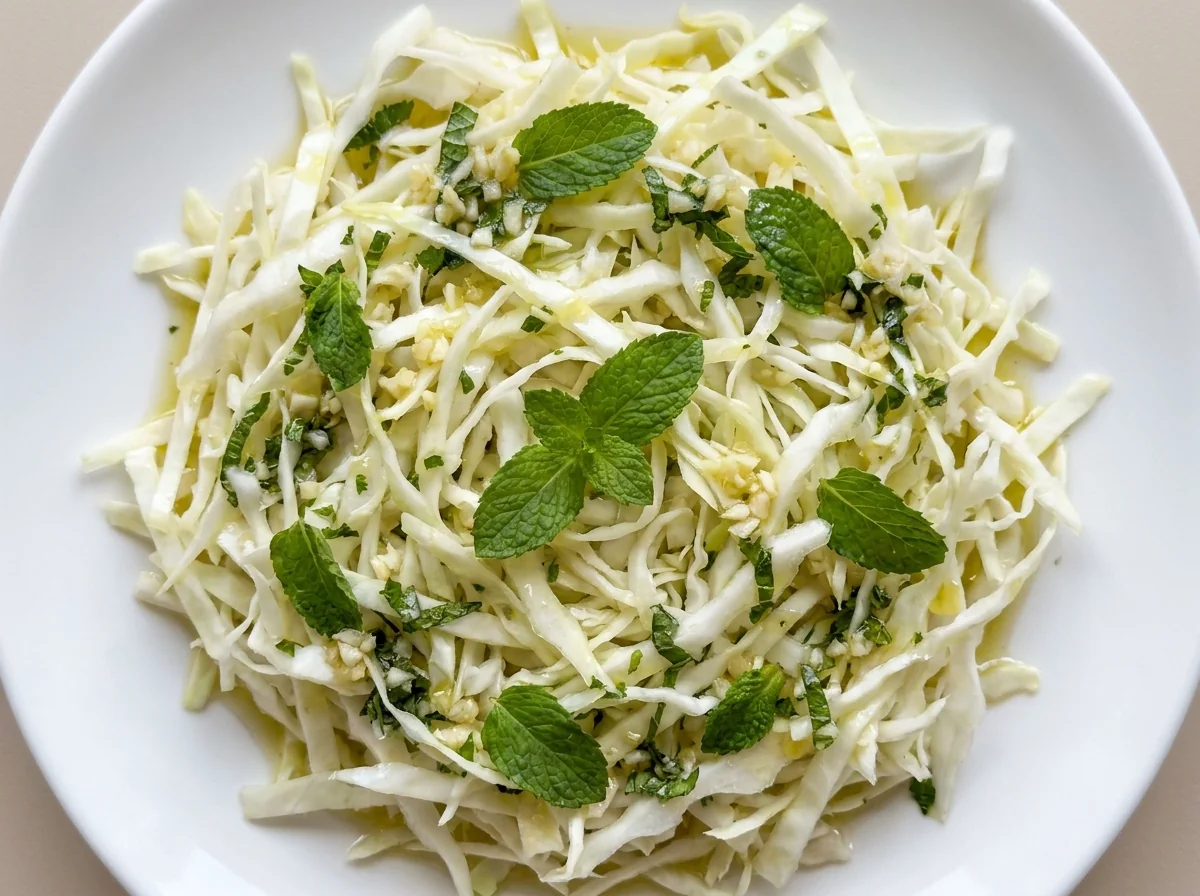
We make Levantine cabbage salad the way it is served on the tables of the Levant, white cabbage shredded with only lemon, garlic, and mint.
We distinguish it from Western coleslaw that is drowned in mayonnaise and carrot, because this is a sour, refreshing salad relying on olive oil and acidity, accompanying grills and fried dishes with lightness rather than weighing them down.
Preparation Steps
Shredding
Shred the white cabbage into very thin slices as in coleslaw, because the thinness is what makes the cabbage absorb the dressing and soften a little.
The garlic
Mash the garlic with the salt until it becomes a smooth paste, because this distributes its flavor throughout the whole salad instead of scattered sharp pieces.
The mint
Wash the mint leaves, gather them, and cut them into thin ribbons, then add them to the cabbage.
Dressing
Mix the cabbage with the mashed garlic, lemon juice, and olive oil, and stir well until the slices are coated, and serve it immediately because cabbage wilts quickly.
Blood Sugar Impact
The glycemic index (GI) measures how quickly a food raises blood sugar, while the glycemic load (GL) measures how much a full serving raises it. Together they give the complete picture.
Glycemic Index
GI
11Low
Low0–55Medium56–69High70+
A low value (≤55) means a gradual rise in blood sugar — the most suitable range for diabetes and insulin resistance.
Glycemic Load
GL
1Low
Low0–10Medium11–19High20+
Glycemic load reflects the impact of the full serving. To lower it: take half a serving, or pair the recipe with a source of protein and fiber.
Nutritional Information
Per ServingMakes 4 servings · one serving is about 130 g of raw ingredients
Calories158 kcal8%of Daily Value*
Protein1 g2%of Daily Value*
Carbohydrates8 g3%of Daily Value*
Fat14 g18%of Daily Value*
Fiber2 g7%of Daily Value*
Sodium513 mg22%of Daily Value*
Potassium188 mg4%of Daily Value*
Phosphorus29 mg2%of Daily Value*
* Percent Daily Values are based on a 2,000-calorie diet per FDA food-label reference values — your daily needs may be higher or lower. Values are derived from the recipe's ingredients via the USDA database.
Troubleshooting
The most common problems when preparing Levantine Cabbage Salad with Lemon and Mint (Salatet Malfouf), and how to fix them:
The cabbage is tough and dry
Shred it thinner and rub it with the dressing between your fingertips for a minute, so it softens a little without losing its crunch.
The garlic is too sharp
Reduce its amount or mash it finer with the salt, because mashing breaks its sharpness and distributes it.
The salad wilted and turned watery
Dress it at the moment of serving, not before, because salt and lemon draw out the cabbage's water quickly.
Storage and Make-Ahead
Serving
Serve it the same day, because cabbage wilts quickly after dressing and loses its crunch.
Refrigerator
Keep the shredded, undressed cabbage in the refrigerator for up to two days, and dress it when needed.
Tested Ingredient Substitutions
Original Ingredient
Tested Substitute
Ratio
Flavor Difference
fresh mint
dried mint
one tablespoon instead of 10 g fresh
Dried is more concentrated, so a smaller amount is enough.
lemon juice
apple cider vinegar
same volume, 45 ml
The acidity becomes more penetrating and less tender.
white cabbage
red cabbage
same weight, 400 g
The color is prettier and the crunch a little stronger.
garlic
garlic powder
1 g instead of 6 g fresh
The flavor is lighter, so adjust by tasting.
How Much Does It Make? Scaling Guide
Ingredient
Half amount
Base amount (base)
Double
White cabbage
200 g
400 g
800 g
Lemon juice
22 ml
45 ml
90 ml
Olive oil
30 ml
60 ml
120 ml
Garlic
3 g
6 g
12 g
Fresh mint
5 g
10 g
20 g
Salt
2.5 g
5 g
10 g
EEINA Nutrition Tip
Shred the cabbage very thin and mash the garlic with the salt before mixing, because mashed garlic dissolves into the dressing while large pieces give an unbalanced sharp bite.
Add This Recipe to Your Plan
The EEINA app saves your favorite recipes, calculates them from their real ingredients, and shows your daily numbers toward your goal. Try it free now.
Coleslaw relies on mayonnaise, carrot, and sugar, while the Levantine version relies only on lemon, olive oil, garlic, and mint, so it is lighter and more sour.
Does it have carrot or mayonnaise?
No, this Levantine version has no carrot and no mayonnaise, and this is what distinguishes it from the other cabbage salads in the library.
Why do we serve it immediately?
The cabbage releases its water and wilts quickly after dressing, so we dress it at the moment of serving to keep it crisp and refreshing.