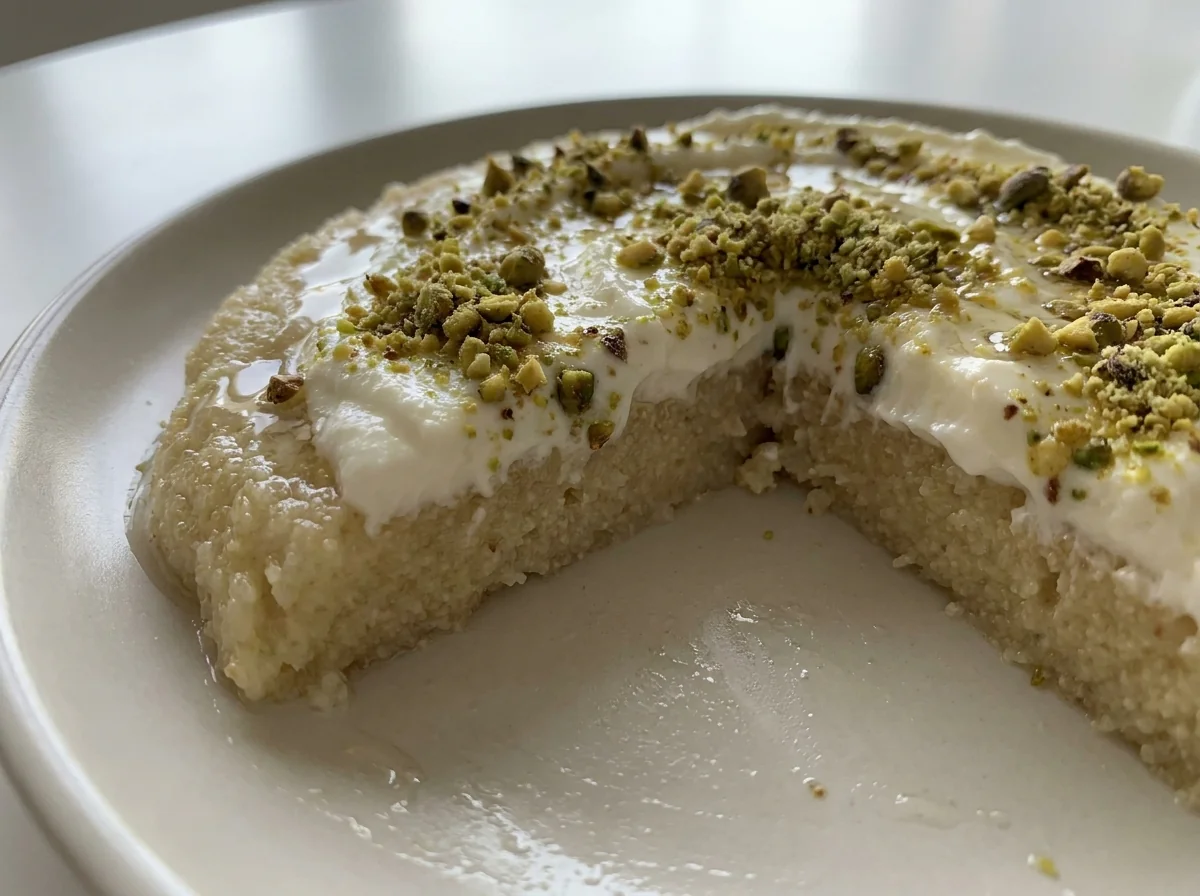
Levantine Madlouka · a sweet of cooked semolina spread and layered with clotted cream (ashta), soaked in syrup and topped with pistachios. A time-honored Levantine sweet, with values from the Lebanese University lab analysis.
Madlouka is a time-honored Levantine sweet whose name comes from the verb 'dalaqa' (to pour and spread), as the semolina is spread with clotted cream in layers and soaked in syrup. It is popular in the Levant and Lebanon at occasions and feasts.
Its secret is cooking the semolina until it sets glossy and soaking it with cold syrup while hot. EEINA's version keeps the method, and its values are from the Lebanese University lab analysis.
Preparation Steps
Cook the semolina
Stir the semolina with the sugar and the water or milk over medium heat with constant stirring until it thickens into a glossy, cohesive dough; constant stirring prevents clumping.
Spread the first layer
Pour half the semolina dough into a tray and spread it with the back of a water-moistened spoon until level; the moisture prevents sticking.
Add the cream
Spread a layer of clotted cream over the semolina, then pour the rest of the semolina over it and spread to cover.
Soak with syrup
Soak the Madlouka with cold syrup as soon as it comes out hot; cold syrup on hot sweet gives it its moist texture.
Garnish and serve
Scatter ground pistachios, let it absorb the syrup a little, then cut and serve. Eaten in moderate portions.
Blood Sugar Impact
The glycemic index (GI) measures how quickly a food raises blood sugar, while the glycemic load (GL) measures how much a full serving raises it. Together they give the complete picture.
Glycemic Index
GI
65Medium
Low0–55Medium56–69High70+
A low value (≤55) means a gradual rise in blood sugar — the most suitable range for diabetes and insulin resistance.
Glycemic Load
GL
27High
Low0–10Medium11–19High20+
Glycemic load reflects the impact of the full serving. To lower it: take half a serving, or pair the recipe with a source of protein and fiber.
Nutritional Information
Per ServingMakes 8 servings · one serving is about 70 g of raw ingredients
Calories262 kcal13%of Daily Value*
Protein6 g12%of Daily Value*
Carbohydrates41 g15%of Daily Value*
Fat10 g13%of Daily Value*
* Percent Daily Values are based on a 2,000-calorie diet per FDA food-label reference values — your daily needs may be higher or lower. Values are derived from the recipe's ingredients via the USDA database.
Troubleshooting
The most common problems when preparing Levantine Madlouka, and how to fix them:
The semolina is clumpy
It was not stirred constantly. Stir it without stopping over medium heat from the start until it sets.
The Madlouka is dry
Too little syrup. Soak it with enough syrup while hot so it absorbs.
The syrup is not absorbed
The syrup was hot or the sweet was cold. The rule: cold syrup on a hot sweet.
The layers mix
The semolina did not set before the cream. Cook it into a cohesive dough before spreading.
Storage and Make-Ahead
Refrigerator (4°)
Three days in an airtight container.
Make ahead
Prepared the same day, as the cream is eaten fresh, and the syrup is added before serving.
Freezer
Not recommended, as the cream changes after thawing.
Tested Ingredient Substitutions
Original Ingredient
Tested Substitute
Ratio
Flavor Difference
Full-fat cream
Low-fat cream
same weight
Lowers saturated fat
Syrup
A smaller amount
half
Lowers added sugar
Semolina
Partly whole-wheat semolina
one-third
Adds fiber
Pistachios
Pine nuts or almonds
same amount
An alternative garnish
How Much Does It Make? Scaling Guide
Number of servings
Semolina
Cream
Sugar
4 (half recipe)
100 g
125 g
50 g
8 (base)
200 g
250 g
100 g
16 (gathering)
400 g
500 g
200 g
EEINA Nutrition Tip
The clotted cream adds saturated fat, and the semolina and syrup raise sugar and carbohydrates. It is an occasion sweet eaten in small portions; lighten it by reducing the syrup and using low-fat cream.
Add This Recipe to Your Plan
The EEINA app saves your favorite recipes, calculates them from their real ingredients, and shows your daily numbers toward your goal. Try it free now.