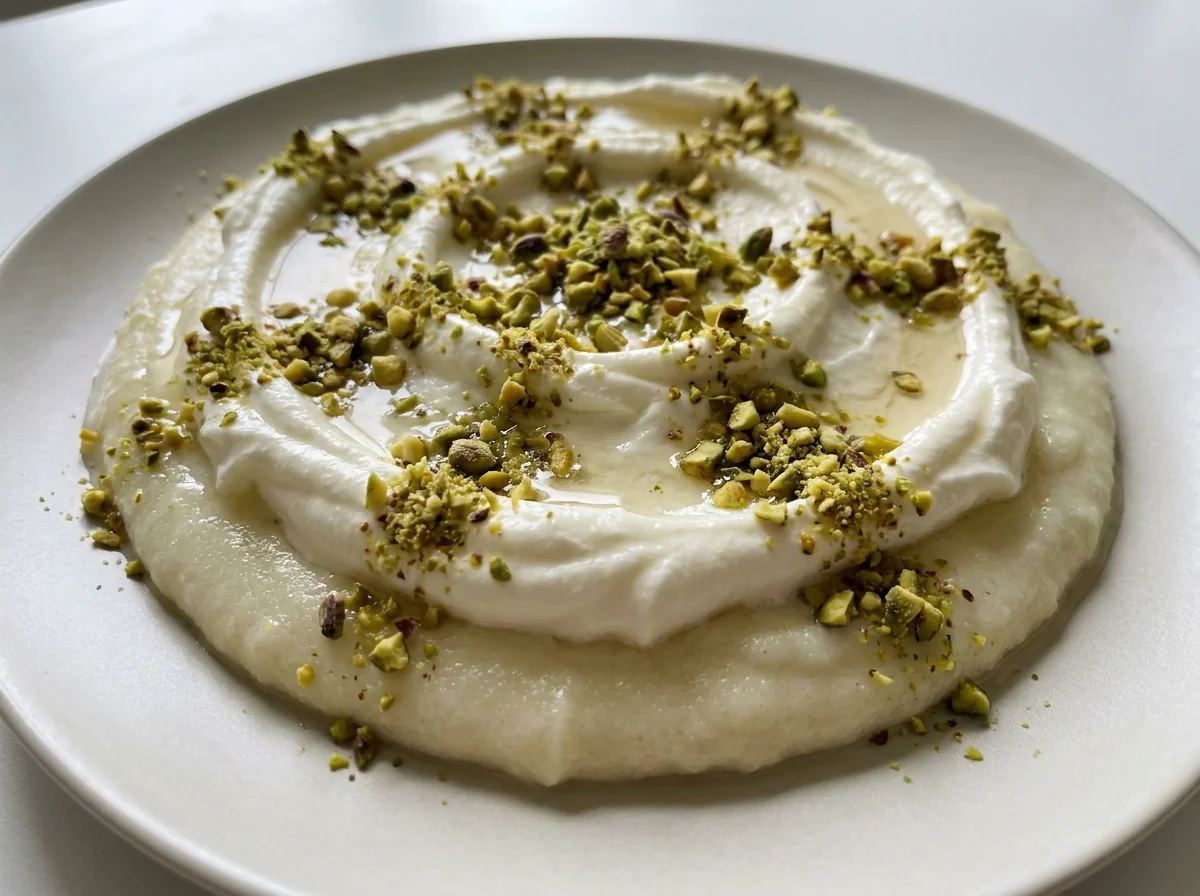
Layali Lubnan is a refined cold Lebanese dessert, and its poetic name borrows the beauty of clear Lebanese nights.
It is built on a pudding layer of semolina cooked with milk and sugar, topped with a thick white layer of ashta, scattered with green pistachios, and then drizzled with syrup. The contrast of its white and green layers gives it an elegant look that has made it one of the desserts of hospitality and celebrations, and it is close to Aish el Saraya but with a base of semolina rather than bread, so it comes out smoother in texture and lighter in flavor.
Preparation Steps
Cooking the semolina layer
Put the milk, semolina, and sugar in a pot over medium heat, and stir constantly for about twenty minutes until the semolina dissolves and the mixture thickens and turns creamy, avoiding letting the milk boil so it does not bubble over.
Scenting and spreading
Turn off the heat, add the orange blossom water, and stir, then pour the mixture into a flat dish and spread it into an even layer with the back of the spoon.
The first chilling
Cover the surface of the semolina with cling film pressed against it to prevent a skin from forming, and leave it to cool to room temperature for about fifteen minutes until it sets.
The ashta and pistachio layer
Lift off the film and spread the ashta layer evenly over the semolina, then scatter the crushed pistachios across the whole surface.
The final chilling
Cover the dish and refrigerate it for at least two hours until both layers set and cool completely, for chilling is essential for easy cutting.
Syrup and serving
Boil the syrup sugar with the water for a few minutes until it thickens slightly and let it cool, then cut the dessert into squares and drizzle each piece with a little syrup at serving.
Blood Sugar Impact
The glycemic index (GI) measures how quickly a food raises blood sugar, while the glycemic load (GL) measures how much a full serving raises it. Together they give the complete picture.
Glycemic Index
GI
57Medium
Low0–55Medium56–69High70+
A low value (≤55) means a gradual rise in blood sugar — the most suitable range for diabetes and insulin resistance.
Glycemic Load
GL
34High
Low0–10Medium11–19High20+
Glycemic load reflects the impact of the full serving. To lower it: take half a serving, or pair the recipe with a source of protein and fiber.
Nutritional Information
Per ServingMakes 6 servings · one serving is about 265 g of raw ingredients
Calories416 kcal21%of Daily Value*
Protein13 g26%of Daily Value*
Carbohydrates61 g22%of Daily Value*
Fat14 g18%of Daily Value*
Fiber2 g7%of Daily Value*
Sodium82 mg4%of Daily Value*
* Percent Daily Values are based on a 2,000-calorie diet per FDA food-label reference values — your daily needs may be higher or lower. Values are derived from the recipe's ingredients via the USDA database.
Troubleshooting
The most common problems when preparing Layali Lubnan (Lebanese Semolina Pudding with Ashta), and how to fix them:
The semolina layer turned lumpy
Stirring stopped or the heat rose. Stir constantly over medium heat, and if it lumps, whisk it with a hand whisk until smooth before pouring.
The two layers blended together
The ashta was added onto hot semolina. Chill the semolina layer until it sets, then spread the ashta gently over it.
The dessert will not hold when cut
It was not chilled enough. Refrigerate it for at least two hours, for cutting it while warm breaks apart the layers.
Storage and Make-Ahead
Refrigerator
Keep it covered in the refrigerator for three days; it is served cold, and add the syrup at serving so the pieces do not turn soggy.
Freezing
We do not recommend freezing it because the pudding and ashta turn watery after thawing; it is best made a day before the occasion.
Tested Ingredient Substitutions
Original Ingredient
Tested Substitute
Ratio
Flavor Difference
fine semolina
cornstarch
about 70 g instead of 130 g semolina
It gives a smoother pudding with no grains, and the flavor is lighter than semolina
ready-made ashta
homemade ashta (milk, cornstarch, and cream)
about 200 g
Homemade is more economical and lets you adjust the sweetness, while the ready-made is faster
whole milk
low-fat milk
same volume, 950 ml
Less fat, and the texture stays creamy thanks to the semolina
pistachios
crushed almonds or walnuts
same weight, 60 g
The color differs while the flavor stays nutty
How Much Does It Make? Scaling Guide
Ingredient
Half amount
Base amount (base)
Double
Fine semolina
65 g
130 g
260 g
Full-fat milk
475 ml
950 ml
1900 ml
Sugar
50 g
100 g
200 g
Ashta (clotted cream)
100 g
200 g
400 g
Sugar (for the syrup)
40 g
80 g
160 g
Pistachios
30 g
60 g
120 g
EEINA Nutrition Tip
Stir the semolina constantly over medium heat and do not let it boil, for stirring prevents lumps and sticking to the bottom, while boiling makes the milk bubble over. And chill the first layer before adding the ashta so the two layers do not blend and the contrast stays clear.
Add This Recipe to Your Plan
The EEINA app saves your favorite recipes, calculates them from their real ingredients, and shows your daily numbers toward your goal. Try it free now.
What is the difference between Layali Lubnan and Aish el Saraya?
Both have layers with ashta and pistachios, but the base of Layali Lubnan is a smooth semolina pudding, while the base of Aish el Saraya is ground toasted bread saturated with syrup.
Why should I not let the milk boil?
Boiling makes the milk bubble over and can split it; what is needed is to heat it over medium heat while stirring until the semolina thickens and turns creamy.
Can it be made ahead?
Yes, it is ideal for making ahead a day before the occasion, as its layers set with chilling, and we add the syrup at serving.