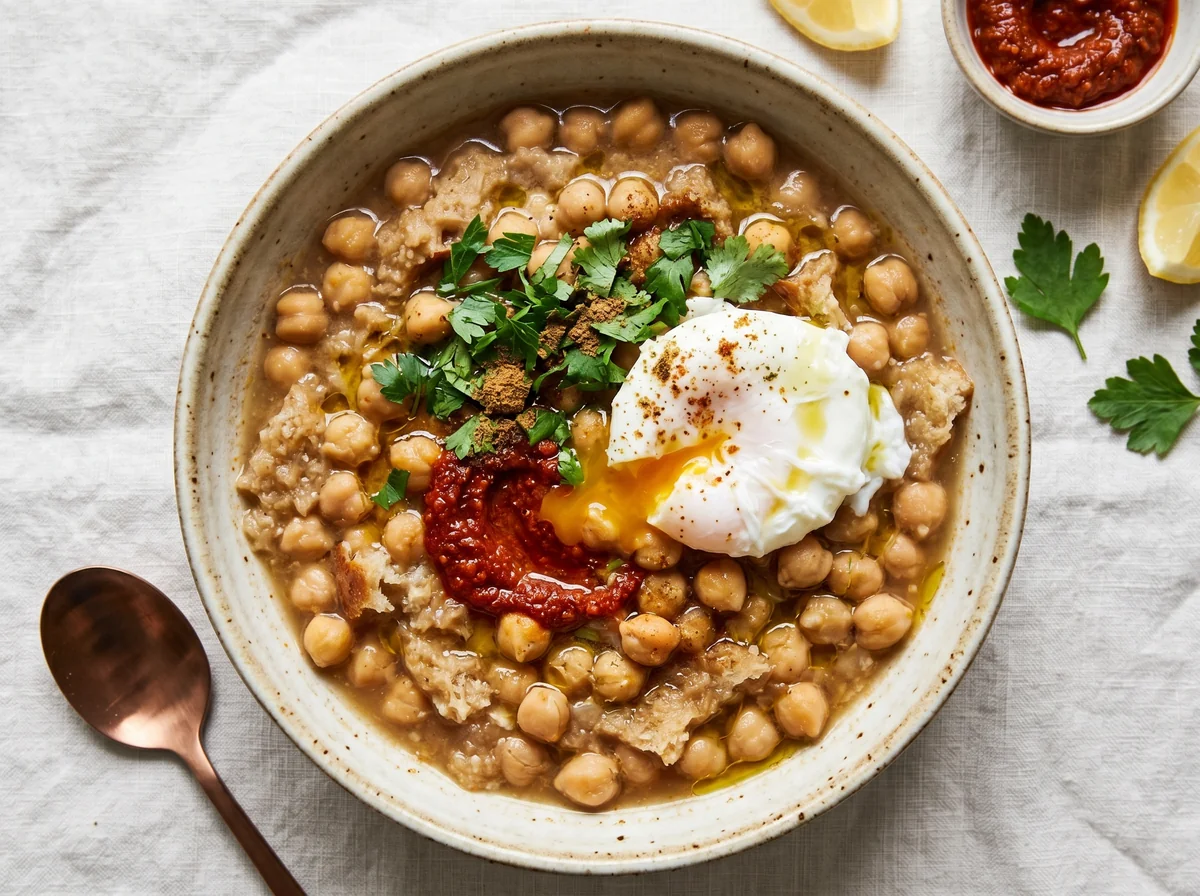
A beloved Tunisian street soup — chickpeas simmered in a garlic, cumin, and harissa broth poured over crumbled bread and crowned with egg, olive oil, and capers. Rich in fiber and plant protein, low glycemic load, contains gluten and eggs.
Lablabi is a beloved Tunisian winter street soup, quintessential street food sold at specialist lablabi shops and made at home. Its base is chickpeas cooked in a garlic, cumin, and harissa broth, poured over crumbled stale bread and topped with boiled egg, olive oil, capers, and tuna.
It is a filling, warming, inexpensive breakfast or lunch that warms you in winter, reflecting the genius of Tunisian street food in making a nourishing, satisfying meal from chickpeas and stale bread — zero waste. Its spicy, aromatic warmth and richness have made it a beloved icon across generations.
Preparation Steps
Cook the chickpeas
Boil the soaked chickpeas in plenty of water until completely tender (easily mashed), about one hour (or less in a pressure cooker). Reserve the cooking liquid (chickpea broth). Tender chickpeas in their broth are the foundation of lablabi.
Prepare and season the broth
Add crushed garlic, cumin, harissa, tomato paste, and salt to the broth. Bring to a boil until the flavors meld. Garlic, cumin, and harissa are the soul of Tunisian lablabi, giving it its warm, spicy aroma.
Boil the eggs
Boil the eggs to your preference — hard or soft. The boiled egg is mashed into the bowl with the lablabi or placed on top, an essential component that adds protein and richness.
Prepare the bread
Crumble stale (or toasted) bread into pieces in the bottom of a serving bowl. The crumbled bread is the base of lablabi (sometimes called chickpea fatteh). It absorbs the broth and provides the characteristic satisfying texture. This is a clever way to use up stale bread.
Assemble
Pour the hot, seasoned chickpeas and broth over the crumbled bread to let it soften and absorb, then add the boiled egg (mashed or sliced), lemon juice, capers, olives, and tuna (if using). Each bowl is assembled to taste.
Serve
Drizzle generously with olive oil, add a pinch of cumin and harissa for those who like it, and serve hot immediately (before the bread turns mushy). It is a famous Tunisian street soup for winter (breakfast or lunch), sold at specialist shops — a hearty, warming, affordable dish that brings together chickpeas, bread, egg, garlic, and harissa, an icon of beloved Tunisian street food across generations.
Blood Sugar Impact
The glycemic index (GI) measures how quickly a food raises blood sugar, while the glycemic load (GL) measures how much a full serving raises it. Together they give the complete picture.
Glycemic Index
GI
33Low
Low0–55Medium56–69High70+
A low value (≤55) means a gradual rise in blood sugar — the most suitable range for diabetes and insulin resistance.
Glycemic Load
GL
18Medium
Low0–10Medium11–19High20+
Glycemic load reflects the impact of the full serving. To lower it: take half a serving, or pair the recipe with a source of protein and fiber.
Nutritional Information
Per ServingMakes 4 servings · one serving is about 180 g of raw ingredients
Calories493 kcal25%of Daily Value*
Protein28 g56%of Daily Value*
Carbohydrates73 g27%of Daily Value*
Fat12 g15%of Daily Value*
Fiber18 g64%of Daily Value*
Sodium229 mg10%of Daily Value*
* Percent Daily Values are based on a 2,000-calorie diet per FDA food-label reference values — your daily needs may be higher or lower. Values are derived from the recipe's ingredients via the USDA database.
Troubleshooting
The most common problems when preparing Lablabi (Tunisian Chickpea Stew), and how to fix them:
The chickpeas are hard
Not soaked or cooked enough. Soak the chickpeas overnight, then boil until completely tender (easily crushed between fingers). You can add a pinch of baking soda to the soaking water to speed up softening.
The bread turned mushy (soggy)
Moistened too early or with too much broth. Pour the broth over the bread right at serving time and serve immediately — the bread turns mushy if left in the broth too long. Use stale bread (holds up better than fresh).
The lablabi tastes bland
Too little garlic, cumin, or harissa. These three are the flavor of lablabi — do not skimp on them. A squeeze of lemon at serving refreshes it. Bold seasoning is the secret of authentic lablabi.
Too thin (watery soup)
Too much water. Lablabi should have a thick consistency from the chickpeas and bread. Adjust the amount of broth (just enough to cover the chickpeas and bread), and the crumbled bread will thicken it. You can also mash some chickpeas to thicken it.
Too spicy
Too much harissa. Reduce the harissa to your tolerance — lablabi is naturally spicy but can be adjusted. Serve the harissa on the side so everyone can add it to their own bowl rather than putting it all in the pot.
Storage and Make-Ahead
Refrigerator (4°C)
The chickpeas and broth keep for 3 days in the fridge (without the bread and egg). Assemble lablabi with fresh crumbled bread and a freshly boiled egg at serving time — stored bread in broth turns mushy. Reheat the chickpeas and broth.
Cooked chickpeas
Cook a large batch of chickpeas and store refrigerated or frozen with their broth, ready to make lablabi in minutes. This shortcut eliminates most of the prep time (boiling chickpeas is the longest step).
Freezer
Freeze the chickpeas in their seasoned broth for two to three months. Thaw and reheat, then assemble lablabi fresh with bread and egg. Bread and egg are not frozen as part of the dish.
Food safety
Cook chickpeas thoroughly and eggs fully. Cool the broth quickly and do not leave the assembled dish unrefrigerated for more than two hours. Assemble fresh at serving time.
Tested Ingredient Substitutions
Original Ingredient
Tested Substitute
Ratio
Flavor Difference
Home-soaked chickpeas
Canned chickpeas, drained
2 cans
Much faster (skips the long boiling). Rinse and heat in seasoned broth. Choose low-sodium. Home-cooked tastes better and is cheaper.
Stale white bread
Stale whole-grain bread
same amount
Raises fiber and lowers glycemic load. Stale bread (white or whole-grain) holds up better than fresh.
Egg
Tuna or omit
as desired
Tuna is a common protein addition/substitute in lablabi (adds fish allergen), or omit entirely for a vegan version.
How Much Does It Make? Scaling Guide
Servings
Chickpeas
Eggs
Bread
2 (half recipe)
1 cup
2 eggs
2 pieces
4 (base)
2 cups
4 eggs
4 pieces
8 (feast)
4 cups
8 eggs
8 pieces
EEINA Nutrition Tip
Lablabi is a filling, nourishing meal: chickpeas are a legume rich in plant protein and high fiber (keeps you full and regulates blood sugar), egg adds protein, garlic and cumin and harissa have their benefits, and the glycemic load is low. It is a good choice for weight watchers (fiber fills you up). Its challenges are sodium (harissa, capers, salt) and the quantity of olive oil and bread. Control the salt and oil and use whole-grain bread, and it becomes a satisfying, wholesome street dish.
Add This Recipe to Your Plan
The EEINA app saves your favorite recipes, calculates them from their real ingredients, and shows your daily numbers toward your goal. Try it free now.
A beloved Tunisian street soup made from chickpeas cooked in a garlic, cumin, and harissa broth, poured over crumbled stale bread and topped with boiled egg, olive oil, capers, and tuna. A hearty, warming winter breakfast or lunch — a famous Tunisian street food sold at specialist shops.
Why is stale bread used?
Crumbled stale bread is the base of lablabi (a type of chickpea fatteh). It absorbs the broth, softening to give the characteristic satisfying texture — a clever way to use up stale bread (zero waste). Pour the broth over it at serving time so it softens without turning mushy.
Is lablabi healthy?
A filling, nourishing meal: chickpeas provide plant protein and high fiber (satisfying and blood-sugar-regulating), egg adds protein, and the glycemic load is low — a good choice for weight watchers. Its challenges are sodium (harissa and salt) and oil and bread quantity. Control salt and oil and use whole-grain bread.
Is lablabi spicy?
Yes — harissa gives it heat (a Tunisian identity), but it can be adjusted. Reduce harissa in the pot and serve extra on the side so everyone adds their own. Cumin and garlic provide the flavor, and the heat is optional to taste.
Sources: University of Sydney · Gulf GSO · Our methodology · Updated on