Karabij Halab (Aleppo Semolina Cookies with Pistachio and Natef Cream)
Aleppo's famous semolina cookies — filled with crushed pistachios and dipped in natef (sweet meringue cream flavored with soapwort root), a legendary Levantine sweet. Contains gluten, tree nuts, dairy and eggs.
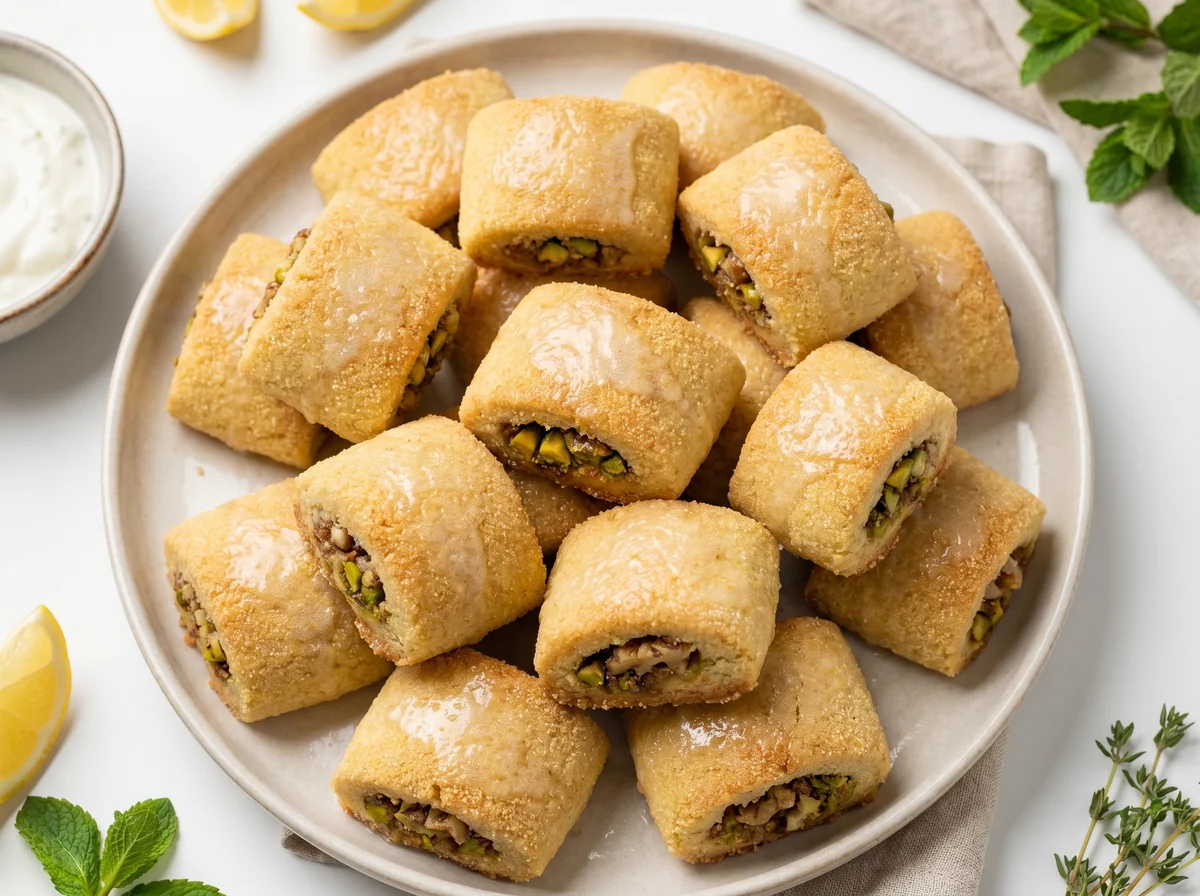
Karabij Halab is one of the most legendary sweets in Levantine heritage — a Levantine icon and a hallmark of Aleppo's famous sweet tradition. It is small semolina and pistachio cookies baked pale and served alongside natef (a unique soapwort meringue cream). Its name refers to small cups (karabij = cups in Arabic, reflecting the hollow cup shape filled with pistachios).
What makes it unique worldwide is the natef: a white, foam-like cream made from soapwort root extract (erq el sous, which contains natural saponins that foam egg whites) beaten into a light, sweet meringue. The cookie + natef is a magical pairing with no equal. Karabij is a symbol of Aleppo and Levantine confectionery and is considered among the most sophisticated traditional sweets in the world.
Preparation Steps
Make the semolina dough
Rub the semolina and flour with the ghee and sugar until the fat is absorbed (resembles damp sand). Add orange blossom water and a little water. Let it rest for one hour. The resting is essential for the dough to hold together and become easy to shape. Karabij Halab are small semolina cups, and the pistachio filling is their heart.
Prepare the pistachio filling
Mix crushed unsalted pistachios with a little sugar and orange blossom water. Use high-quality unsalted pistachios (Aleppo is famous for its pistachios, and Karabij are their most famous expression), well-crushed but not ground to a paste — a coarse texture is ideal.
Shape the Karabij
Take a small ball of dough, form it into a hollow cup (like a small bowl), place a little pistachio filling inside, and close it tightly into a cylindrical or semi-cylindrical shape (characteristic of Karabij). The shape should be small and compact (about the size of a date), with a smooth, thin shell around the filling.
Bake
Arrange the Karabij on a tray and bake in a moderate oven (170°C) for about fifteen to twenty minutes until set and just lightly golden (the semolina must be cooked but they should not brown much). Karabij should stay pale (similar to Kahk) — light browning is fine but no dark coloring.
Make the natef
The natef is Karabij's legendary companion: boil soapwort root extract (erq el sous) then strain it and use it to beat egg whites into a soft meringue, gradually adding the hot sugar syrup. The natef (white soapwort meringue) is Karabij's inseparable partner — a light, sweet, fragrant cream that you dip the cookies into. Making real natef requires soapwort root (erq el sous, which contains saponins that foam the whites).
Serve with natef
Arrange the Karabij in a serving dish and present the natef in a separate bowl for dipping. Dip each piece in natef before eating — the pistachio semolina biscuit with the sweet soapwort meringue cream is the magic of this legendary Aleppan sweet. A Levantine heritage icon and one of the most famous confections of Aleppo's sweet tradition.
Blood Sugar Impact
The glycemic index (GI) measures how quickly a food raises blood sugar, while the glycemic load (GL) measures how much a full serving raises it. Together they give the complete picture.
Glycemic Index
GI
60Medium
Low0–55Medium56–69High70+
A low value (≤55) means a gradual rise in blood sugar — the most suitable range for diabetes and insulin resistance.
Glycemic Load
GL
30High
Low0–10Medium11–19High20+
Glycemic load reflects the impact of the full serving. To lower it: take half a serving, or pair the recipe with a source of protein and fiber.
Nutritional Information
Per ServingMakes 10 servings · one serving is about 105 g of raw ingredients
Calories475 kcal24%of Daily Value*
Protein12 g24%of Daily Value*
Carbohydrates54 g20%of Daily Value*
Fat24 g31%of Daily Value*
Fiber4 g14%of Daily Value*
Sodium8 mg0%of Daily Value*
Potassium355 mg8%of Daily Value*
Phosphorus200 mg16%of Daily Value*
* Percent Daily Values are based on a 2,000-calorie diet per FDA food-label reference values — your daily needs may be higher or lower. Values are derived from the recipe's ingredients via the USDA database.
Troubleshooting
The most common problems when preparing Karabij Halab (Aleppo Semolina Cookies with Pistachio and Natef Cream), and how to fix them:
The dough crumbles and won't hold together
Not enough fat or resting time. Ensure the ratio of ghee to semolina is correct and rest the dough after rubbing (an hour or more) so the semolina absorbs the fat. A small amount of water can help but don't overdo it.
The Karabij broke open during baking
Too much filling or a weak seal. Fill modestly and close each piece well with no cracks. Small, tightly sealed pieces don't break.
The Karabij browned and dried out
Oven too hot or left too long. Bake at a moderate temperature and remove when set (the semolina is cooked but without strong browning). Check regularly — they bake quickly.
The natef won't foam (stays liquid)
Not enough soapwort or egg whites not clean. Simmer the soapwort extract well and use very clean, fat-free egg whites (even a drop of yolk prevents foaming). Beat at high speed and add the syrup gradually.
The natef deflates quickly
Hot syrup not added at the right moment or syrup was cold. The hot syrup (at soft-ball stage) stabilizes the foam — add it in a thin stream while beating. Prepare the natef close to serving time.
Storage and Make-Ahead
Karabij cookies
The baked Karabij cookies (without natef) keep at room temperature in an airtight container for one to two weeks — they are a dry cookie. Store away from moisture. They can also be frozen for three months and thawed at room temperature.
Natef
Natef is best prepared fresh just before serving (it deflates over time). It can be refrigerated for a few hours but is at its best freshly made. Karabij cookies store well; prepare the natef at serving time.
Freezer
Freeze the baked cookies (before natef) for three months in an airtight container. Thaw at room temperature. Prepare the natef fresh at serving time. A practical way to make a batch and serve it over days or weeks.
Food safety
Karabij cookies keep well (dry semolina and fat). The natef contains raw egg whites — serve and refrigerate promptly, do not leave out for more than two hours. Use fresh eggs and prepare the natef just before serving.
Tested Ingredient Substitutions
Original Ingredient
Tested Substitute
Ratio
Flavor Difference
Pistachios (filling)
Ground walnuts or almonds
Same amount
Pistachios are authentic to Karabij Halab (Aleppo is renowned for them); walnuts and almonds are alternatives (still tree nuts, avoid for those with nut allergies)
Soapwort natef (erq el sous)
Italian meringue (no soapwort)
Same amount
Traditional natef requires soapwort root; Italian meringue (egg whites with hot syrup only) is a widely accepted substitute — the foam is similar but the unique soapwort flavor is lost
Ghee
Butter
Same amount
Both give a crumbly texture; ghee has a more traditional Levantine flavor, butter is common; both contain dairy
How Much Does It Make? Scaling Guide
Number of servings
Semolina
Pistachios or Walnuts
5 (half recipe)
1.5 cups
1 cup
10 (base)
3 cups
2 cups
20 (celebration)
6 cups
4 cups
EEINA Nutrition Tip
Karabij Halab is an exceptional sweet: the pistachios add protein, healthy fats, fiber, vitamin B6 and antioxidants, while semolina is slower to digest than white flour. The natef is lighter than cream (mainly egg whites and syrup). The glycemic load per piece is moderate (not too sweet, not too large). Enjoy two to three pieces — it is one of the more nutritionally dignified traditional sweets. For those with nut allergies (pistachios are tree nuts): choose alternatives. For those sensitive to eggs: the natef contains egg whites.
Add This Recipe to Your Plan
The EEINA app saves your favorite recipes, calculates them from their real ingredients, and shows your daily numbers toward your goal. Try it free now.
Aleppo's famous small semolina and pistachio cookies, baked pale and served alongside natef (a unique soapwort meringue cream). The cookie is dipped in the natef before eating — a pairing with no equal. A Levantine heritage icon and a hallmark of Aleppo's renowned sweet tradition.
What is natef and what makes it unique?
Natef is a uniquely Aleppan sweet cream: egg whites beaten with soapwort root extract (erq el sous) and hot sugar syrup into a light, white, foam-like meringue. Its uniqueness comes from soapwort (erq el sous) which contains natural saponins that help foam and stabilize the egg whites uniquely. The natef + Karabij pairing is world-famous and has no substitute.
Can I make natef without soapwort?
You can substitute Italian meringue (egg whites beaten with hot sugar syrup only, without soapwort), and it is widely accepted as a substitute when soapwort is unavailable. The result is similar but the unique soapwort flavor and the special texture it gives the natef are irreplaceable. If you can find soapwort root (erq el sous, sold in spice shops), use it for an authentic natef.
Are Karabij Halab nutritious?
Among the more nutritionally dignified traditional sweets: pistachios add protein, healthy fats and antioxidants; semolina is slower than white flour; natef is lighter than cream (mainly egg whites). Moderate glycemic load per piece. Two to three pieces is a reasonable serving. For tree nut allergies: pistachios must be avoided.