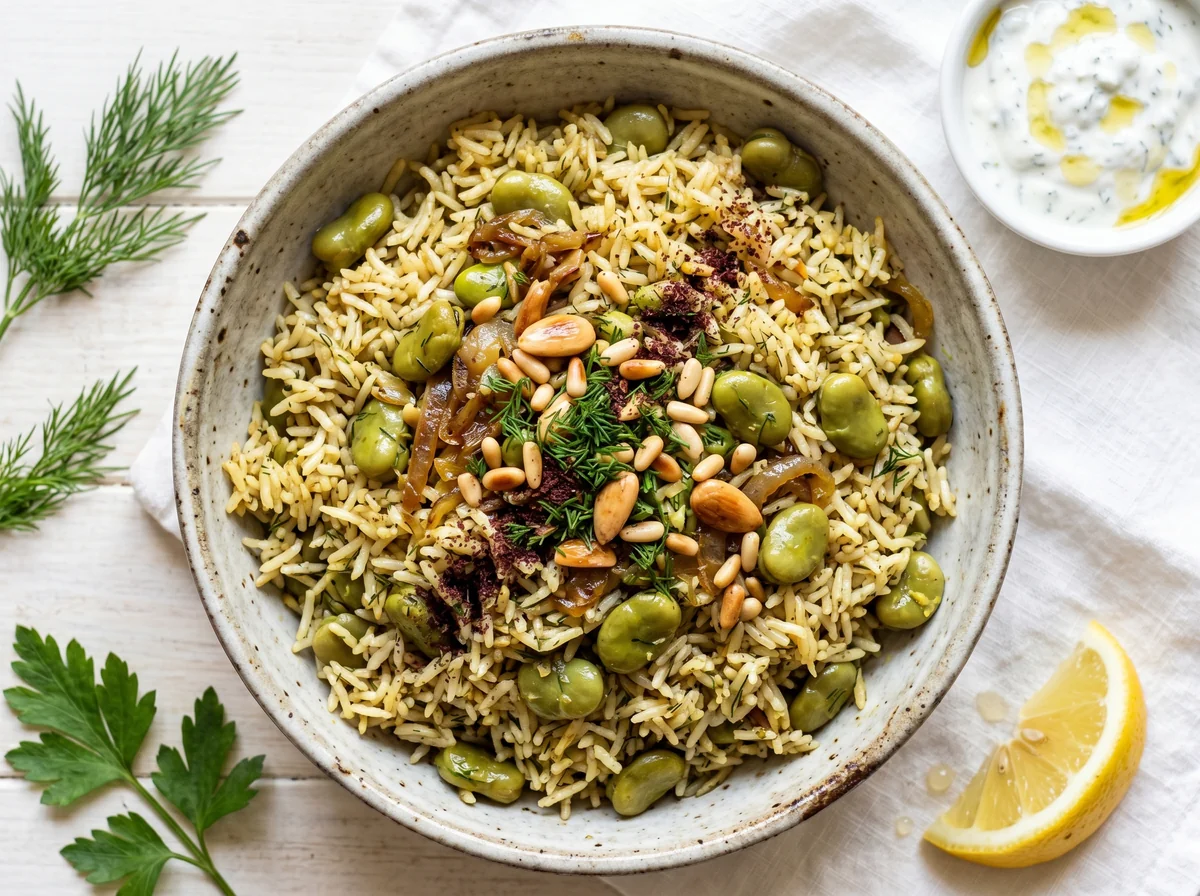
Iraqi Timman Bagilla (Rice with Fava Beans and Dill)
Iraqi rice with fava beans — rice steamed with bagilla (fresh fava beans), dill, and spices, served with meat. A fragrant Baghdadi dish, rich in fiber, medium glycemic load, and free from common allergens.
Timman bagilla (rice with fava beans) is a beloved Iraqi (Baghdadi) rice dish (timman means rice in Iraqi Arabic) combining rice with bagilla (shelled fresh fava beans) and generous fresh dill. It is prepared especially during the fresh fava bean season (spring) and is a staple of the Iraqi home kitchen, served with meat or chicken.
The dill and fava beans give it a distinctive fragrance and a beautiful green color that sets it apart from ordinary rice. The dish reflects the Iraqi love of rice flavored with vegetables and herbs, and holds a cherished place in memory as the taste of spring and the Iraqi home.
Preparation Steps
Par-boil the rice
Par-boil the soaked basmati rice in salted water until half cooked, then drain it. Par-boiling allows the rice to finish cooking by steaming with the fava beans without becoming mushy — the Iraqi method for fluffy, grain-separated rice.
Prepare the fava beans and dill
Briefly blanch the bagilla (shelled fresh or frozen fava beans) until just tender, then mix generously with the chopped fresh dill. Fava beans and dill are a classic Iraqi pairing (timman bagilla with dill) — a beloved Baghdadi flavor combination.
Layer
In a pot, sauté the onion in ghee, then add a layer of rice, a layer of fava beans and dill, then more rice, and so on — sprinkling ghee, baharat (Gulf spice blend), and cardamom between the layers. The layering distributes the fava beans and dill evenly through the rice.
Steam
Cover the pot tightly (place a kitchen towel under the lid to absorb steam) and leave on very low heat to steam until the rice is fully cooked and has absorbed the flavor of the fava beans and dill, about twenty minutes. Gentle steaming produces fragrant, perfectly fluffy rice.
Check and gently fold
Verify that the rice is fluffy, grain-separated, and that the fava beans and fresh dill are evenly distributed (the dill gives a beautiful green color and aromatic flavor). Fold gently to distribute the ingredients without breaking the rice grains.
Serve
Spread the timman bagilla on a serving platter and serve hot alongside the cooked meat or chicken and its broth, with salad, pickles (torshi), and labneh (strained yogurt). This is a beloved Iraqi (Baghdadi) rice dish, especially popular during the fresh fava bean season (spring). The fresh dill and fava beans give it a distinctive fragrance and color — a nourishing, fragrant home dish cherished on the Iraqi table.
Blood Sugar Impact
The glycemic index (GI) measures how quickly a food raises blood sugar, while the glycemic load (GL) measures how much a full serving raises it. Together they give the complete picture.
Glycemic Index
GI
66Medium
Low0–55Medium56–69High70+
A low value (≤55) means a gradual rise in blood sugar — the most suitable range for diabetes and insulin resistance.
Glycemic Load
GL
46High
Low0–10Medium11–19High20+
Glycemic load reflects the impact of the full serving. To lower it: take half a serving, or pair the recipe with a source of protein and fiber.
Nutritional Information
Per ServingMakes 5 servings · one serving is about 155 g of raw ingredients
Calories346 kcal17%of Daily Value*
Protein11 g22%of Daily Value*
Carbohydrates73 g27%of Daily Value*
Fat1 g1%of Daily Value*
Fiber4 g14%of Daily Value*
Sodium14 mg1%of Daily Value*
* Percent Daily Values are based on a 2,000-calorie diet per FDA food-label reference values — your daily needs may be higher or lower. Values are derived from the recipe's ingredients via the USDA database.
Troubleshooting
The most common problems when preparing Iraqi Timman Bagilla (Rice with Fava Beans and Dill), and how to fix them:
The rice is mushy
Over-boiled or not soaked. Par-boil only to half-cooked then steam; soak the basmati rice beforehand. Par-boiling to half-done then steaming produces fluffy, grain-separated rice.
The fava beans are tough
Not blanched long enough, or they are old. Blanch the fava beans until tender before mixing them with the rice — older or larger beans are tougher (you can remove the inner skin). Fresh or small frozen beans are most tender.
The dill is pale and lost its color
Added too early or cooked too long. Add the fresh dill generously with the fava beans and do not cook it for a long time (it loses color and flavor). Generous dill gives the distinctive flavor and color.
The rice is undercooked
Insufficient steaming. Steam the par-cooked rice tightly covered over very low heat until fully cooked (20 minutes), and add a splash of water if it dries out. A tight-fitting lid traps the steam needed for cooking.
The flavor is bland
Not enough dill or spices or salt. Use plenty of dill and fava beans, season with cardamom and baharat (Gulf spice blend) between the layers, and the ghee adds flavor. The accompanying meat broth enriches the dish.
Storage and Make-Ahead
Refrigerator (4°C)
Timman bagilla keeps in an airtight container in the refrigerator for 3 days. Reheat with a splash of water (the rice dries out). The color of the fava beans and dill holds well. Serve fresh meat alongside.
Freezer
Freeze the rice with fava beans for two months in an airtight container. Thaw and reheat with a splash of water. Practical for preserving the fresh fava bean season (spring) and enjoying the dish year-round (with frozen fava beans).
Advance preparation
Blanch the fava beans and prepare the dill in advance, then cook and steam the rice with them at serving time. Frozen fava beans make the dish available year-round (fresh beans are seasonal in spring).
Food safety
Cook the rice and fava beans through, cook the accompanying meat well, cool the rice quickly, do not leave it at room temperature for more than two hours, and reheat thoroughly.
Tested Ingredient Substitutions
Original Ingredient
Tested Substitute
Ratio
Flavor Difference
White rice
Brown rice
same amount
Raises fiber and lowers the medium glycemic load, with adjusted cooking time; the fava beans already improve the load
Bagilla (fava beans)
Green peas or frozen fava beans
same amount
Green peas are a readily available substitute (for those avoiding fava beans due to G6PD); frozen beans make the dish available year-round
Ghee
Olive oil or less ghee
as desired
Reduces saturated fat; ghee is the traditional Iraqi flavor; olive oil is healthier
How Much Does It Make? Scaling Guide
Number of servings
Rice
Fava beans
Dill
3 (half recipe)
1 cup
1 cup
0.5 bunch
5 (base)
2 cups
2 cups
1 bunch
10 (gathering)
4 cups
4 cups
2 bunches
EEINA Nutrition Tip
Timman bagilla is a well-balanced dish: bagilla (fava beans) are a legume rich in plant protein, high fiber, iron, and folate (they lower the glycemic load of the rice), and the dill provides antioxidants, while the rice provides energy. The glycemic load is medium (better than plain rice thanks to the fava beans and fiber). The challenges are the ghee and the white rice. To lighten it: use brown rice, reduce the ghee, increase the fava beans, and balance the accompanying meat. Note: those with G6PD (fava bean anemia) should avoid fava beans.
Add This Recipe to Your Plan
The EEINA app saves your favorite recipes, calculates them from their real ingredients, and shows your daily numbers toward your goal. Try it free now.
An Iraqi rice dish (timman means rice) cooked with bagilla (shelled fresh fava beans) and generous fresh dill and spices, served with meat or chicken. A beloved Baghdadi dish especially popular during the spring fresh fava bean season — fragrant with dill and bright with the green of the fava beans.
What are bagilla?
Bagilla is fresh shelled fava beans (broad beans) — a spring legume rich in plant protein, fiber, iron, and folate. They are cooked with rice and dill in this Iraqi dish. Note: those with G6PD (fava bean anemia) should avoid them.
Is timman bagilla healthy?
Yes, well-balanced: fava beans are plant protein and high fiber with iron and folate (they improve the glycemic load of the rice), and the dill provides antioxidants while the rice provides energy. The glycemic load is medium (better than plain rice thanks to the fava beans). Use brown rice, reduce the ghee, and increase the fava beans. A nourishing, balanced dish.
When is the fava bean season?
Fresh fava beans are seasonal in spring — the best time to make this dish with fresh beans (unbeatable flavor). Out of season, frozen fava beans are available and good, making the dish accessible year-round with a similar flavor.
Sources: University of Sydney · Gulf GSO · Our methodology · Updated on